✅ONLINE LECTURE: Living Environments and Migration Patterns
 Housing and Relocation Patterns
Gerontologists started looking at the living environments of the elderly in the 1960s. Still, it was only in the 1980s that researchers used census data to track older adults' movement, both from a national and regional view. Everett Lee, a migration expert, examined where our older adults move when they move, and in some cases, why they move. There are some pretty predictable patterns in the migration of contemporary older adults. Movement patterns may change as the Boomers age, but we see similar patterns across the United States and other countries right now. (Lee, 1980)
Gerontologists are concerned with the effects of living environments on older people. It's not just the house in which we live, but the surroundings, the community, the systems and infrastructure that can influence our sense of safety and wellbeing. What factors influence our levels of satisfaction with our homes? Safety, ease of maintenance, climate, cost of living, community amenities and proximity to services are all key factors that make a difference. As we age, issues of household amenities like one level living and accessibility factor into our housing choices. (NAHB Research Center, 2005)
Independent Elders
Did you know that 75-80% of all older adults own their own homes and live alone?
It's true. Most older adults own their own homes. (Folts, 2002) In fact, less that 5% of Americans over age 65 live in institutionalized settings like nursing homes (the percentage gets larger after age 85.). Many would like someone to come and live with them, but most are unwilling to give up their dwelling. The ownership rate is higher for older adults than it is for other age groups. However, the cost of maintaining that home is higher. In surveys of older adults, this group overwhelmingly notes that they want to "age in place," which means to live where they have always lived. When caring for older adults who want to age in place, the goal should be to assist them with staying in their own homes for as long as possible. It isn't until people are in the oldest old age grouping (85+) that issues can arise with safety, access to services or other factors that impede the ability to live independently. It is a minority of elders who suffer from chronic or acute health conditions that will most frequently relocate to a location where they can access greater care and support. (Frolic, 1996)
What might keep elders from being able to live in their own homes until they die? Well, lack of adequate assistance with ADL's, inability to navigate safely in the home, and costly repairs are a few examples. Because older adults' houses are usually older, roofs, plumbing, fences, etc., need more frequent maintenance. However, the most common reason elders must leave their own homes is the inability to get up unassisted at night to use the bathroom. One can often find daytime caretakers, but reliable and adequate nighttime help is both costly and challenging to find.
What Does Home Look Like?
For 81% of older men, home means living with family - usually a spouse. (Palloni, 2000)That's primarily because wives outlive older men, so they don't live as long to experience widowhood or living alone. We also know that once an older man has been widowed or divorced (regardless of ethnicity or race), he is far more likely to remarry quickly and experience a shorter time of living alone.
57% of older women live with a spouse. That means that 43% of older women are NOT living with a spouse. They are either living alone or with friends or family. (Palloni, 2000)
Whether an older adult is living alone or with a spouse, the overwhelming evidence shows that they want to live in their homes and age in place. We don't move frequently. Most often, if we do move, it is because of medical necessities - which tend to occur after age 85 and involve both acute and chronic health conditions, a decline in strength, and a fear of falling mobility issues. For many, the need to move disability is not the determining factor. It may be that the home is just only too big and too much to manage. (Grundy, 2000)
Planning and Design
The United States has been very slow to deal with our population's changing needs, just in terms of architecture and community design. The older adults spend more time in their homes than any other segment of the population. For those of you who experienced "shelter in place" during the COVID-19 pandemic, we have all become aware of how important a home's design can be - in terms of space, layout, amenities, and technology.
The average new home size has grown from 1200sf to 3000sf for average new construction. There are frequently two stories, with upper level bedrooms. The majority of new building development is being done away from city centers because real estate is less expensive and available. (Dietz, 20018) Often, off of public transportation routes (because who wants to live near a bus line), we make our neighborhoods perfect for those who will be home from 6 pm until am and head off to a workplace. But, where does that leave the older resident who may not drive and may experience difficulties going upstairs?
Where's Waldo? - Relocation Patterns of Older Adults
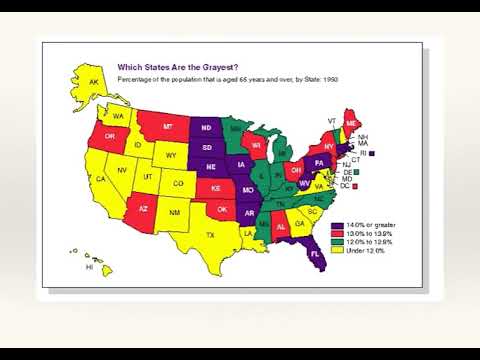
Demographers are chasing older adults. We want to know where they are and where they are going. If we look at the percentage of population by states, Florida, Maine, and West Virginia has the highest rate of older adults in their population. (Hines, 2018). Wait. I bet you thought that old people all moved to Arizona! Well, lots of them do, but because states like California and Arizona have such a large population, the percentage of older adults per capita is smaller - California is quite a young state overall.
Take a quick peek at the map in the article "One-Quarter of Older Americans Live in California, Florida or Texas," you'll see which states are the "greyest." The states that are much more interesting to me would not appear to be destination states for retirement - Montana, Rhode Island, Iowa and Ohio all have severe weather. So why are there so many older people? It's not that older people are flocking to them. It's because older people are moving away - a phenomenon called "out-migration." While they are young, they live in more metropolitan states. Then, they move back to the country when they are older.
If we look at California, and less so Arizona, the populations there are so big that while their older population doesn't constitute more than 13%, it still represents nearly 4 million people. (Census.gov, 2020)
The states with the highest population always have the highest number of older adults. Nine states have over nine million persons over age 65 - California tops the list in terms of sheer numbers, but not percent. California is joined by Arizona, New York, Pennsylvania, Texas, Ohio, Florida, Illinois, Michigan, and New Jersey.
Where are the rest of them? Let's take a look.
Please watch the video:
Choices....Choices
When we decide to move, there are lots of options. The most popular is "aging in place," by staying in our own homes and adapting them to our own needs. We can move into granny units or shared housing. We can use day-services to provide respite if our partner needs care that we aren't able to provide but don't require us to move. There are adult-only communities and retirement cities. If we start needing more care, assisted living and residential care facilities can move into. When our care needs cross into a higher level, we can relocate to nursing facilities and care centers. The critical element to older adults' housing choices is the desire to remain independent for as long as possible.

(Source: Stonybrook University)
Can We Afford "Home?"
Does "home" equal security? Yes, absolutely. We can be very critical of our homeless population and say, "oh well, if you just get a job, you'll be fine." It's just not that simple. We have a huge population in the United States who experience "home insecurity." It's that knowledge that we are one paycheck or one illness away from not being able to stay in our homes. For older adults, that insecurity may come from an inability to maintain the property or pay for upkeep. We know that the number of homeless in the United States is expected to double just in the next 30 years. Having a home gives us a sense of shelter but also a sense of permanence. The loss of that home at any age, but particularly for an older adult, can be devastating.

(Source: 1Q103 Fox Seattle)
Image Citation
Image courtesy of Jay Stackpool under Unsplash License