✅ONLINE LECTURE: Aging in Place
Aging in Place

Most older adults would prefer to stay in their own homes for as long as possible, a reality for those who need only basic support and have only minimal challenges with their activities of daily living. In my humble opinion, the goal is to give as much choice as possible to our older population and support them in remaining as independent as possible for as long as possible.
"Aging in place is when a person lives and ages in their residence of choice, for as long as they are able to. Aging in place includes having services, care and needed support in the residence as well. These needs may change over time and as the individual ages." Please take a moment to review "What Does Aging in Place Really Mean" by SeniorLiving.org to introduce yourself to the concept.
What Does It Take to Age In Place?
Services
Elders may need help with everyday livings skills (ADL's) to remain at home. There are a variety of programs to assist. These include Older American Act programs . Services might include home-delivered meals, lifeline (the "help I've fallen" buttons), chore workers, homemakers (for meal prep and housecleaning), utility bill, and weatherization programs.
-
-
- Custodial care (ADL assistance) also called “supportive care
- Home delivered meals
- A chore worker
- Transportation
- Home care; this includes skilled nursing care, requiring nursing or medical intervention, provided in the elder’s home
-
Custodial and Supportive Care means hands-on assistance, such as bathing, shampooing, dressing, light housekeeping, meal preparation, non-medical supervision (help up to the bathroom or to bed), monitoring health status (calling the doctor or seeking care when needed), self-administered medications, and companionship. It might also include Instrumental Activities of Daily Living or IADL's which can include non-hands-on help, such as reading to the elder or helping in paying bills and providing transportation to the doctor, market, bank, or post office.
Normally, Medicare will not pay for these services on a long-term basis. Instead, these expenses are paid by the elderly themselves (called out-of-pocket expenses) or by Long-Term-Care Insurance. However, fewer than 1 in 30 Americans own a long term care insurance policy. Less than 7% of the population over age 50 have LTC insurance, but the need is beginning to come to the public's attention. (Sammon, 2020)
Skilled Nursing and Medicaid - skilled services usually are medically necessary care and prescribed by a doctor and implemented by a hospital's or private agency's home care divisions. Sometimes, home care can fill in between moves and keep an elder in his/her home longer. After an illness that requires hospitalization, Medicare will pay for home care with a physician's orders.
Medicare will not pay for custodial care (long-term-care with ADLs), but short-term rehabilitation needs only. Many elders assign their Medicare benefits to an HMO. They often gain prescription coverage but lose the extended home care options provided by Medicare. Home care can include a nurse, physical therapist, occupational therapist, social worker, and homemaker (they cook and serve meals and do light housekeeping and help with ADL's). (Grabowski, 2007)
A wide range of non-medical services exists to assist those who find it difficult to function independently due to illness or injury or diminishing capabilities.
These options can include:
Adult Day Health Care or ADHC - a center where elders who live in the community spend the day for socialization and meals. ADHC includes rehabilitation services in physical therapy, occupational therapy, speech, and nutritional services. These services are typically covered by Medicaid (not Medicare) for low-income elders.
Telephone Lifelines may be used to keep in contact in emergencies.
Paratransit can help with door-to-door transportation (for disabled elders). IHSS (in-home support services) assists low-income elders with homemaking duties.
When Medicare (not Medicaid) benefits for skilled care run out, seniors often turn to hire in-home help. If they are low income, most communities provide IHSS services. This is a means-tested service that offers assistance during the day with ADL's and IADL's. One usually applies to these through the local Social Services Department.
If an elder does not qualify for IHSS, then paying someone to assist them is another option. If a family member or close friend is not available, it is preferable to hire from an agency rather than a newspaper. Workers from agencies are bonded and insured.
Safety
Older homes may need adaptations to prevent accidents and to prolong their independence. Aging bodies often can adapt to an environment and remain independent with assistive devices and someone to assist the coordination of their use. These include:
- Eyeglasses
- Hearing aids
- Dentures
- Canes, walkers, grab bars, high rise toilet seats, and shower chairs
- Telephone and doorbell amplification
- Brighter lighting
- Clothes that open in front (especially bras and tops for women)
Technology
Seniors today are faced with a dilemma. They did not grow up during the era of computers and the internet, yet this age group now depends on this technology. As a result, seniors are learning more and using technologies for the first time. In general, technology is helping to give senior citizens an improved quality of life through increased connectivity and a sense of community." Please click the link to read "Technology for Seniors and the Elderly"from Seniorliving.org. to learn about the innovation that we are seeing in senior living environments. Imagine what we might be able to do through technology in the future!
Activities of Daily Living
Consider what it takes for you to live independently. What's the first thing you do in the morning? You probably get out of bed. That means that you can rise without assistance from wherever you are sleeping. Then, most of us probably visit the bathroom and take care of toileting needs. Most of you probably never give that task a second thought unless the roommate is in the bathroom with the door locked! We use the toilet, brush our teeth, and address all of our hygiene and beauty issues with relative ease. We then dress, walk down to our cars or our bus, and mosey our way to work or school. We are managing our activities of daily living if we can conduct these activities without requiring outside assistance.
Two measures help us assess personal function. Basic Activities of Daily Living (ADLs or BADLS) are the most basic functions we need to perform every day. Typical lists of ADLS include personal hygiene, toileting, dressing, feeding, and ambulating. "Independence" is measured by our ability to do these five basic functions without assistance. If an older adult is unable to perform 2 or 3 activities is often a criterion for participation in public assistance programs. .The level of ADLs partially determines nursing home qualification. Unfortunately, Medicare does not pay for custodial care, which would assist with this kind of disability. (medicare.gov, 2020)
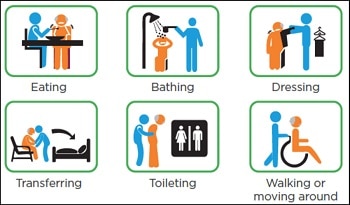
There's more to life than washing, dressing, feeding, transferring, and mobility. Think about the activities that you do every day that allow you to take care of your home. Instrumental activities of daily living (IADLs) are things you do every day, like meal preparation and driving your car. IADLs take more complex planning and thinking and are a good measure of whether we can safely live independently without help.
We include eight activities in the list of instrumental activities of daily living to evaluate older adults' level of self-sufficiency and determine if they can live independently. Most of these ADLS center around day to daycare, rather than personal care. They are more complex tasks but are a part of contemporary measures of independence. In the early stages of illness, IADLS are the first to weaken and maybe the first sign of challenges with living alone. (Jefferson et al, 2006)
- Cooking: Can the individual plan, prepare, and serve adequate meals?
- Managing Medications: Is the individual capable of taking correct doses of medications at the right times? Is the individual capable of the above if their medications are organized in separate dosages in advance?
- Shopping: Is the individual able to independently shop for all their needs, including clothing, personal care items, and groceries?
- Communicating Via Telephone: Can the individual operate a telephone and look up and dial phone numbers?
- Managing Money and Finances: Is the individual able to independently make and follow a budget, write checks, pay bills, make trips to the bank, and monitor their income and expenses?
- Performing Housework: Can the individual maintain an acceptable level of cleanliness throughout their home?
- Driving or Using Public Transportation: Is the individual able to drive, use public transportation, or arrange a taxi service?
- Laundering Clothing: Is the individual able to wash and dry their personal laundry?
The Smart Home
One of the most innovative ways for us to age in place is to use the available technology. Recently, I put motion-sensor LED lights under my kitchen cabinets, so when I go into the kitchen late at night, I don't blind myself, but I'm also not going to fall over my dog, who has fallen asleep right in front of the water dispenser.
Earlier in the semester, we talked about how innovation can be a multigenerational boon. Well, here we are again with my friends Alexa, Siri and Cortana to help out!

(Source: Dwell)
Image Citations
Image courtesy of MarCuesBo under Pixabay License
Image courtesy of ElderNeedsLaw.Com