Unfinished Wisdom · Wild Darkness Curriculum Library

3.3 Intelligence, Wisdom and Cognitive Adaptation

Read in original module order · Review copy

3.3 Intelligence, Wisdom and Cognitive Adaptation

We Are More Fluid Than Fixed

One of the biggest misconceptions about intelligence is the idea that it can be fully captured by a number on a test.

Modern culture tends to define intelligence very narrowly. We reward speed, memorization, rapid problem solving, standardized testing, productivity, and the ability to arrive at answers quickly. People who process information rapidly are often viewed as “smart,” while those who think more slowly, cautiously, emotionally, or contextually may be underestimated.

Human intelligence is far more complicated than that.

Traditional IQ testing measures certain cognitive abilities very well, particularly verbal reasoning, mathematical reasoning, pattern recognition, and processing speed. But intelligence also involves creativity, emotional awareness, social understanding, adaptability, judgment, insight, communication, intuition, and the ability to function effectively in real-world environments.

A person may struggle with algebra yet possess extraordinary interpersonal skills. Another may be musically gifted, artistically innovative, mechanically brilliant, emotionally perceptive, or highly intuitive in ways that traditional testing does not measure well at all.

Culture also shapes what societies define as intelligence. Some cultures value rapid verbal response and individual achievement. Others value reflection, cooperation, emotional restraint, storytelling, practical survival skills, or interdependence. Intelligence is not experienced identically across all environments.

And aging complicates these conversations even further because cognition changes across adulthood in ways that are not always obvious from standardized testing alone.

Some abilities become faster.
Some become slower.
Some deepen dramatically with experience.

We are more fluid than fixed.


Fluid and Crystallized Intelligence

Psychologists often describe intelligence across adulthood using the concepts of fluid intelligence and crystallized intelligence.

Fluid intelligence involves rapid processing, quick reasoning, multitasking, abstract thinking, and solving unfamiliar problems. This is the type of cognition most associated with mental speed and flexibility. Fluid abilities generally peak earlier in adulthood and may gradually slow over time.

Crystallized intelligence is different.

Crystallized intelligence involves accumulated knowledge, expertise, vocabulary, pattern recognition, contextual understanding, emotional insight, and practical wisdom developed through education and lived experience. These abilities often remain stable or continue growing across adulthood.

Screenshot 2026-05-28 at 8.30.54 PM.png

In the last lecture, I mentioned my favorite metaphor about memory and intelligence - The Jar.

Early in life, the jar is mostly fluid. Information moves around easily. New experiences, ideas, and learning happen rapidly because there is relatively little existing structure inside the jar. Young adults are often highly flexible cognitively. They absorb information quickly and adapt rapidly to unfamiliar situations.

Over time, experiences, skills, beliefs, memories, education, habits, and expertise begin forming crystals inside the jar.

Those crystals represent accumulated knowledge.

As adulthood progresses, the jar becomes increasingly structured by experience. We develop expertise, shortcuts, pattern recognition, emotional frameworks, professional skills, language, values, and deeply practiced ways of understanding the world.

This creates enormous advantages.

Experienced adults often recognize patterns younger adults completely miss. A seasoned nurse may notice subtle changes in behavior before obvious symptoms emerge. A long-time teacher may recognize emotional distress in a student long before the student says a word. An experienced mechanic may diagnose a problem by sound alone before opening the hood.

Pattern recognition is cognitive expertise.

At the same time, highly crystallized systems can sometimes make entirely new learning more effortful because new information has to fit into existing structures. Learning unfamiliar technology, new systems, or radically different frameworks may require more intentional cognitive effort.

Honestly, building new crystals can be exhausting.

That does not mean adults lose the ability to learn.
It means learning often becomes more contextual, intentional, and experience-based.

Importantly, people do not simply “lose” fluid intelligence and become entirely crystallized. Human cognition remains dynamic throughout life. The balance shifts, but the fluid never disappears entirely.
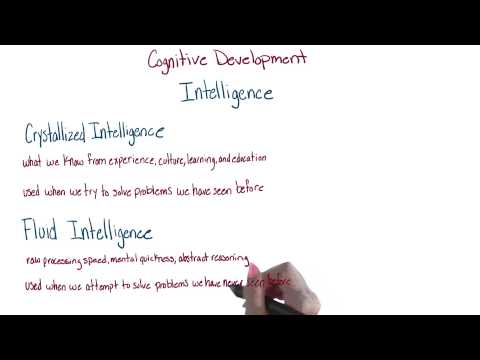
YouTube video Iy96H0BeM2g

(Source: Udacity.com)

Adult Learning and Cognitive Adaptation

Adults do not learn the same way children do.

Children often absorb information because adults tell them they should. Adult learners usually need a reason.

Relevance matters enormously.

Adults learn best when information feels useful, emotionally meaningful, immediately applicable, or connected to lived experience. This is one reason people may struggle to remember abstract instructions in one setting while mastering incredibly complicated systems in another that feels personally important.

The brain constantly searches for meaning and connection.

When adults encounter new information, they rarely store it in isolation. Instead, they compare it against previous experiences, emotional memories, beliefs, values, habits, and existing knowledge structures. Learning becomes less about collecting disconnected facts and more about integrating information into an already complicated mental framework.

This is also why adults can become resistant to changing beliefs or habits.

Existing cognitive structures are powerful. Once patterns become deeply practiced, efficient, emotionally reinforced, or socially rewarded, changing them requires tremendous cognitive and emotional effort. People are not simply “stubborn.” The brain prefers familiarity because familiar systems require less energy.

And honestly, adulthood often comes with cognitive overload already built in.

Work responsibilities, caregiving, relationships, financial stress, health concerns, emotional labor, parenting, chronic stress, grief, and daily logistics all compete for attentional resources. By the time many adults sit down to learn something new, the brain is already juggling fifty open browser tabs internally.

This is one reason emotionally engaging learning environments matter so much.

People learn more effectively when they:

  • feel psychologically safe
  • understand why material matters
  • can connect concepts to experience
  • actively engage with ideas
  • apply knowledge meaningfully
  • revisit information repeatedly

Meaning strengthens memory.

And despite stereotypes about aging and learning, research consistently shows that healthy adults remain capable of learning throughout the lifespan. The process may require more repetition, stronger motivation, additional context, or fewer distractions, but the capacity for growth does not suddenly disappear because someone reaches a certain birthday.


Compensation, Plasticity, and Expertise

One of the most remarkable things about human cognition is how adaptive it is.

As adults age, they often become more strategic about how they use mental energy. People compensate constantly, often without even realizing it.

Calendars.
Phone reminders.
Medication organizers.
Sticky notes.
GPS systems.
Routines.
Timers.
Written schedules.
Environmental cues.

These are all forms of cognitive compensation.

Younger adults compensate constantly too. They simply do not think about it in those terms because technology has normalized external memory systems. Most people no longer memorize phone numbers, maps, schedules, or appointments because devices now carry much of that cognitive load externally.

Older adults often become especially skilled at prioritizing what matters.

Many rely more heavily on routines, familiarity, pattern recognition, and selective attention to reduce unnecessary mental strain. They may avoid chaotic environments, excessive multitasking, or unnecessary distractions because attentional resources become more valuable over time.

This is not necessarily rigidity.
Often, it is efficiency.

There is also strong evidence that the brain retains significant plasticity throughout much of the lifespan. Neuroplasticity refers to the brain’s ability to adapt, reorganize, strengthen neural connections, and continue learning over time.

Healthy adults continue developing new skills, learning languages, adapting behaviors, forming memories, and building neural pathways well into later adulthood.

Human beings remain capable of growth.

Expertise also changes cognition itself.

Experienced adults frequently solve problems differently than younger adults because they recognize familiar patterns quickly. They often rely less on trial-and-error problem solving and more on contextual reasoning developed over years of lived experience.

Sometimes wisdom looks less like rapid brilliance and more like quietly recognizing what actually matters.


Wisdom, Creativity, and Postformal Thought

For much of childhood and early adulthood, people are taught to think in relatively simple categories:
right or wrong
success or failure
good or bad
certainty or uncertainty

Life eventually complicates those categories.

One of the most fascinating areas of adult development research explores the idea that cognition changes qualitatively across adulthood. Thinking itself may become more contextual, layered, emotionally informed, and tolerant of contradiction over time.

Psychologists sometimes describe this as postformal thought. (And yes, I know I introduced this concept in the last lecture, but I think it bears repeating in context.)

Postformal thinking moves beyond rigid either/or reasoning and begins tolerating ambiguity, paradox, uncertainty, and competing truths existing simultaneously. Instead of assuming every problem has one simple correct answer, adults increasingly recognize that human situations are often emotionally layered, historically shaped, culturally influenced, and deeply complicated.

Honestly, aging has a way of humbling certainty.

People who once believed relationships were simple eventually encounter caregiving, grief, illness, betrayal, parenting, loss, financial hardship, reinvention, regret, mortality, and competing responsibilities that resist simplistic solutions.

Experience changes cognition.

Wisdom is difficult to measure because it does not always appear as speed or confidence. Researchers studying wisdom often identify qualities such as:

  • contextual reasoning
  • emotional regulation
  • perspective-taking
  • self-reflection
  • tolerance for uncertainty
  • balancing competing priorities
  • recognizing limits
  • understanding contradiction

Unlike standardized testing, wisdom often emerges through lived experience.

Modern culture tends to reward quick answers and unwavering confidence, yet mature cognition frequently involves slowing down enough to evaluate nuance, context, ethics, relationships, and emotional complexity more carefully.

Creativity also changes across adulthood.

Many people assume creativity belongs primarily to youth, yet some of the most innovative work humans produce emerges later in life after decades of accumulated knowledge and experience. Creativity is not simply inventing something entirely new from nothing. Often it involves combining existing knowledge in new ways, recognizing patterns others miss, or approaching problems from broader perspectives.

Highly creative adults frequently draw from enormous reservoirs of accumulated experience.

And perhaps one of the most psychologically interesting aspects of adulthood is this:

For many people, maturity is not about becoming more certain.
It is about becoming more capable of living inside complexity without needing easy answers for everything.

Across adulthood, cognition often becomes less rigid, more contextual, and more reflective. People draw upon experience, emotional insight, pattern recognition, memory, intuition, and accumulated knowledge in ways that are difficult to measure on standardized tests.

In many ways, adulthood changes not only what people know, but how they understand knowledge itself.

In the next lecture, we will move from normal cognitive adaptation into situations where cognition becomes impaired through mental illness, neurodegenerative disease, delirium, substance misuse, and disorders that disrupt normal functioning across the lifespan.