1.12 Foundations of Aging Theory - Part 4 - Meaning, Wisdom and Existential Development
Eventually, gerontology began confronting questions that earlier theories often avoided entirely. Earlier models focused heavily on behavior, adjustment, retirement, activity levels, or adaptation to changing social roles. Those issues matter, certainly, but over time researchers realized that aging also changes the way many people think about identity, meaning, mortality, spirituality, and the overall shape of their lives.
At some point, adulthood stops being entirely future-oriented.
Early adulthood is often dominated by construction. People build careers, relationships, families, routines, financial stability, and public identity. Much of young adulthood is structured around achievement and forward motion because there is an assumption, usually unspoken, that time is abundant. Even when younger adults experience grief or crisis, there is often still a sense that life remains expandable and unfinished.
That relationship to time gradually changes across adulthood.
By midlife and later life, many individuals begin asking different kinds of questions. Instead of focusing exclusively on what comes next, people often begin evaluating what has already occurred. Certain ambitions lose emotional intensity. Other concerns become more psychologically important. Relationships may matter more than status. Meaning may matter more than performance. Individuals often become increasingly aware that some opportunities are closed, some identities no longer fit, and some emotional truths can no longer be postponed indefinitely.
These are not signs of decline. They are developmental shifts.
Modern gerontology increasingly recognizes that aging involves not only physical and social change, but existential development as well.
Jung and the Second Half of Life
Development Turns Inward
Although Carl Jung is not typically categorized as a gerontologist, many of his ideas became highly influential in theories of adult development and later life meaning-making. Unlike Freud, who focused heavily on childhood and instinctual drives, Jung believed development continued across the lifespan and that the psychological tasks of later adulthood differed substantially from those of youth.
According to Jung, the first half of life is often dominated by external development. Individuals focus on education, work, social identity, family formation, competence, adaptation, and achievement. Much of early adulthood involves becoming the person one is expected to become within society.
The second half of life often involves a different process entirely.
Jung believed that many adults eventually begin turning inward psychologically. People start reevaluating values, priorities, relationships, ambitions, spirituality, creativity, and identity itself. Parts of the self that were neglected earlier in life sometimes begin demanding attention. A person who spent decades focused entirely on productivity may suddenly feel emotionally disconnected from their own life. Someone who organized identity around caregiving may begin realizing they no longer know who they are outside of responsibility to others. Individuals may begin confronting grief, regret, loneliness, mortality, or unresolved emotional patterns that were easier to avoid while life remained fast-moving and externally structured.
Jung referred to this process as individuation, the gradual integration of different parts of the self into a more coherent whole.
Importantly, individuation does not mean becoming perfect, peaceful, or spiritually enlightened. Jung viewed human beings as psychologically contradictory by nature. Most people contain tensions between independence and dependence, ambition and contentment, logic and emotion, responsibility and freedom. Earlier adulthood often rewards simplification because social functioning requires efficiency and performance. Later adulthood may create more psychological space for complexity.
In many ways, Jung believed that aging challenges individuals to become more honest with themselves.
This helps explain why major life reevaluations often occur during midlife and later adulthood. The goals that once structured identity sometimes stop feeling emotionally sufficient. Achievement, productivity, and social approval may no longer provide the same psychological reward they once did. Some people become more interested in creativity, spirituality, reflection, family, or emotional authenticity. Others begin asking whether the life they built actually reflects the person they are.
Jung also argued that many modern societies handle aging poorly because they place overwhelming value on youth, speed, productivity, external achievement, and physical attractiveness while undervaluing reflection, wisdom, emotional integration, and inward development. Modern gerontology has reached similar conclusions through entirely different research traditions.
Although aspects of Jung’s work remain difficult to measure empirically and continue to be debated within psychology, his influence on theories of adult development, spirituality, creativity, and later life reflection remains substantial. Many contemporary theories examining meaning-making and existential development echo his core observations about inward psychological change during the second half of life.
Gerotranscendence
Aging as Psychological Expansion
One modern theory that strongly reflects some of Jung’s observations is Lars Tornstam’s theory of gerotranscendence. Tornstam proposed that aging may involve not simply adjustment to loss, but an actual shift in perspective and consciousness.
According to this theory, some older adults gradually move away from highly materialistic, competitive, productivity-centered ways of understanding life and toward a broader, more reflective perspective. People may become less concerned with superficial status, less interested in constant social performance, and more focused on meaning, continuity, memory, spirituality, or existential reflection.
Importantly, Tornstam argued that these shifts are often misunderstood by younger generations and by institutions organized around productivity and activity. Earlier theories sometimes interpreted increased reflection, solitude, or selective social engagement as evidence of decline, withdrawal, or depression. Gerotranscendence challenges that assumption directly.
An older adult who becomes less interested in endless social obligations may not be “giving up.” Someone spending more time reflecting, revisiting memories, writing, creating, or thinking about mortality may not be psychologically deteriorating. In some cases, these changes may represent developmental maturation rather than disengagement.
This theory becomes especially interesting because it pushes back against deeply Western assumptions about successful aging. In the United States especially, people are often expected to remain permanently productive, socially active, physically optimized, and externally engaged in order to be viewed positively. Gerotranscendence suggests that later life development may involve a different psychological orientation entirely, one that places less emphasis on external validation and more emphasis on reflection, interconnectedness, emotional depth, and existential awareness.
We will return to this theory in much greater detail later in the course because it opens the door to larger conversations involving spirituality, wisdom, creativity, mortality awareness, and meaning-making across adulthood.
Mortality Awareness and Meaning
Living With the Knowledge of Finite Time
One reason existential questions become more psychologically significant later in life is that aging changes a person’s relationship to time itself.
Younger adults usually understand mortality intellectually while experiencing it psychologically as distant. Later adulthood changes that perception. Mortality becomes more concrete and less abstract. Friends die. Parents die. Bodies become less predictable. Medical systems become more familiar than most people would prefer. Time begins feeling less infinite.
That shift can create anxiety, grief, or fear, but researchers have also found that increased awareness of mortality often changes emotional priorities in important ways. Many individuals become more selective about relationships, less tolerant of emotionally meaningless conflict, and more focused on purpose, connection, or unfinished emotional issues.
Existential psychologists such as Viktor Frankl argued that human beings are fundamentally meaning-seeking creatures. Frankl believed psychological suffering becomes especially difficult when individuals feel disconnected from purpose, belonging, hope, or meaning. Modern gerontology increasingly supports this broader perspective. Physical health matters enormously, but later life wellbeing is also strongly influenced by dignity, autonomy, emotional connection, spirituality, creativity, belonging, and identity.
Importantly, existential development does not require becoming perfectly wise or emotionally peaceful in old age. Human beings remain psychologically uneven throughout the lifespan. Some individuals become more reflective, compassionate, and emotionally flexible with age. Others become more rigid, fearful, or bitter. Most move back and forth between growth and struggle depending on health, support systems, personality, trauma history, relationships, and circumstance.
Still, one of the central insights of modern gerontology is that aging is not simply about surviving longer. It is also about how people make sense of living longer.
Maslow and Human Needs Across Adulthood
 Aging Has a Way of Reprioritizing Everything
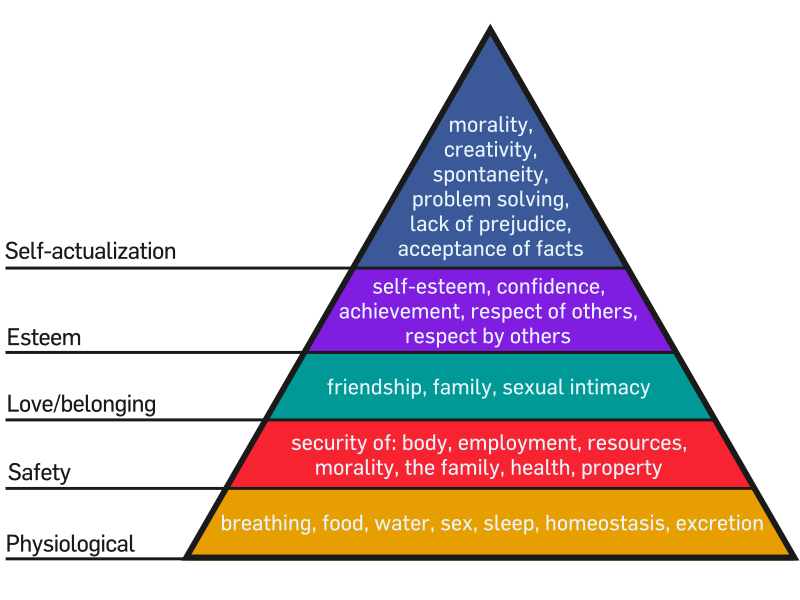
Abraham Maslow’s Hierarchy of Needs remains one of the most recognizable theories in psychology, although it is often oversimplified into a rigid pyramid that implies human beings neatly progress from one level to another. Real life rarely works that cleanly.
Maslow proposed that human beings are motivated by different categories of need, including physiological survival, safety, belonging, esteem, and self-actualization. Although the model has been critiqued heavily over time, it remains useful in gerontology because aging often destabilizes needs people once assumed were secure.
A younger adult in relatively good health may rarely think consciously about mobility, pain control, housing security, continence, transportation, or physical vulnerability. Aging, illness, disability, caregiving strain, or financial instability can abruptly force those needs back into awareness. When physiological comfort or safety becomes uncertain, psychological energy often shifts accordingly.
This helps explain why transitions into hospitalization, assisted living, rehabilitation, or long-term care can feel psychologically overwhelming even when individuals understand logically that support is necessary. A person may lose privacy, routine, independence, familiarity, social belonging, or control all at once. These losses are not merely practical disruptions. They affect identity, security, dignity, and emotional regulation simultaneously.
Maslow’s theory also becomes useful when examining the emotional importance of belonging and esteem across later life. Human beings continue needing connection, recognition, purpose, and emotional validation throughout adulthood. Older adults do not suddenly stop needing affection, meaningful relationships, autonomy, competence, or respect simply because they age.
This is one reason ageism can be so psychologically damaging. When societies treat older adults as invisible, burdensome, incompetent, or irrelevant, they threaten not only social participation, but also core psychological needs involving dignity, belonging, and self-worth.
At the same time, later adulthood may intensify questions involving self-actualization and meaning. Individuals often begin asking whether they have lived authentically, contributed meaningfully, developed neglected parts of themselves, or created a life aligned with their deeper values. Some people experience this as spiritual development. Others experience it through creativity, mentoring, caregiving, activism, reflection, or legacy-building.
Importantly, Maslow never intended self-actualization to mean perfection or endless self-improvement. In many ways, self-actualization involves becoming more fully oneself, including acceptance of limitation, contradiction, and incompleteness.
And honestly, aging has a way of stripping away enough illusion that people sometimes become more psychologically honest with themselves than they were earlier in adulthood.