1.11 Foundations of Aging - Part 3 - How Identity Changes Across Time
One of the biggest misconceptions about human development is the idea that personality and identity become fixed sometime during early adulthood. Many people unconsciously assume that development is something children and adolescents do while adulthood is simply maintenance mode with taxes.
Developmental psychology does not support that assumption.
Identity continues evolving across the lifespan, although not always in dramatic or obvious ways. Across adulthood, people repeatedly revise their understanding of themselves in response to relationships, work, illness, success, failure, caregiving, grief, aging bodies, changing priorities, and shifting social expectations. Some of those changes happen gradually enough that people barely notice them while they are occurring. Others arrive all at once through disruption, loss, or major life transitions.
In many ways, adulthood involves repeatedly renegotiating the question:
Who am I now?
That question becomes especially important in later life because aging often strips away roles, assumptions, routines, physical abilities, or expectations that once felt stable. At the same time, aging may also create opportunities for reflection, reinvention, emotional clarity, and meaning-making that are less accessible earlier in life when survival, work, family building, and constant forward motion consume most of a person’s attention.
Some of the most influential theories in developmental psychology attempt to explain how identity evolves across adulthood and how people create continuity and meaning across time.
Erik Erikson and Psychosocial Development
Development Does Not End at Adulthood
 One of the most influential developmental theorists of the twentieth century was Erik Erikson, a psychologist who challenged the assumption that psychological development ended after childhood. Building on and revising earlier psychoanalytic theories, Erikson proposed that human beings continue developing across the entire lifespan through a series of psychosocial conflicts or developmental tasks.
Importantly, Erikson did not use the word “conflict” to mean argument or dysfunction. He used it to describe the tension between competing psychological needs that individuals must learn to balance over time. Each stage of development involves negotiating a central question about identity, relationships, competence, meaning, or belonging.
Unlike many earlier theorists, Erikson placed enormous emphasis on social relationships and cultural context. Human beings do not develop in isolation. Families, communities, institutions, historical conditions, and social expectations all influence development across the lifespan.
Although Erikson described eight stages of psychosocial development, several become especially important when studying adulthood and aging.
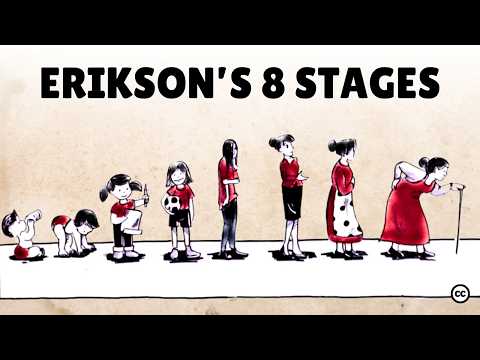
During adolescence and young adulthood, individuals often struggle with questions involving identity and intimacy. Who am I? Where do I belong? What kind of relationships do I want? What values, goals, or beliefs actually belong to me rather than simply reflecting family or cultural expectations? These early struggles matter because unresolved identity issues frequently continue resurfacing later in adulthood.
By middle adulthood, Erikson believed most individuals confront the tension between generativity and stagnation. Generativity refers to the desire to contribute meaningfully to others or to the world beyond oneself. People begin asking whether they are building, teaching, mentoring, creating, caregiving, contributing, or leaving something of value behind.
This stage is often misunderstood as applying only to parenting, but Erikson meant something much broader. A teacher mentoring students, a nurse caring for patients, an artist creating meaningful work, a grandparent helping raise children, or an individual volunteering in the community may all experience generativity. The central issue is whether people feel they are participating in something larger than their own immediate needs.
Stagnation, by contrast, may occur when individuals feel emotionally disconnected, directionless, unproductive, or psychologically stuck. This does not necessarily mean someone is failing externally. A person may appear highly successful professionally while privately feeling detached from meaning or purpose.
Many adults experience this conflict quite intensely during midlife, particularly when earlier goals no longer feel emotionally satisfying. A career once pursued enthusiastically may begin feeling empty. Children grow up and leave home. Caregiving responsibilities intensify. Parents age. Bodies change. People often begin reevaluating priorities, relationships, identity, and purpose during this period, which is one reason midlife transitions can feel psychologically disruptive even when life appears outwardly stable.
Erikson’s final stage, integrity versus despair, becomes especially relevant in later adulthood. At this stage, individuals begin reflecting more deeply on the overall shape and meaning of their lives. Rather than focusing primarily on future achievement, attention often shifts toward integration and evaluation.
Did my life matter?
Did I live according to my values?
Can I accept both the successes and failures that shaped me?
Can I tolerate the fact that some parts of life remained unresolved?
Integrity does not require believing one lived a perfect life. Rather, it involves developing enough acceptance and coherence to view life as meaningful despite mistakes, grief, limitations, disappointments, or unfinished ambitions. Individuals experiencing integrity are often better able to tolerate ambiguity and recognize that human lives are inherently imperfect and incomplete.
Despair tends to emerge when people become overwhelmed by regret, bitterness, fear, hopelessness, or the belief that life has been wasted or emotionally disconnected from meaning. Erikson believed unresolved despair could contribute to depression, hopelessness, and fear of death in later life.
Importantly, Erikson did not view development as neat, sequential, or permanently resolved. People revisit earlier struggles repeatedly throughout adulthood. Illness, divorce, caregiving, trauma, job loss, widowhood, disability, or major transitions may reactivate earlier questions involving trust, identity, competence, intimacy, or autonomy even decades later.
Development, in other words, continues.
And that realization opened the door for researchers to examine not only how identity changes across adulthood, but also how people actively construct meaning from the stories they tell about their lives.
Narrative Identity and Life Review
Human Beings Understand Themselves Through Story
One of the most important psychological tasks of adulthood involves creating a coherent sense of identity across time. Human beings do this largely through narrative. We organize experience by turning it into story.
People constantly interpret, revise, emphasize, minimize, or reinterpret their experiences in ways that help create continuity and meaning. Two individuals may live through similar events while constructing entirely different psychological narratives about what those experiences meant.
One person may describe divorce as evidence of failure.
Another may describe it as survival.
One person may view caregiving as burden.
Another may experience it as love, obligation, exhaustion, resentment, meaning, and grief simultaneously.
Narrative identity theory argues that these stories are not superficial. They become central to psychological functioning and self-understanding.
This becomes especially important in later life because aging often involves increased reflection and life review. As people age, they naturally begin looking backward as well as forward. Earlier experiences are reevaluated through new perspectives. Old wounds may acquire new meaning. Earlier judgments about oneself sometimes soften with time and experience.
For example, a person who once viewed themselves as weak because they struggled emotionally during a difficult life period may later reinterpret that same experience as evidence of resilience or survival. Someone who spent decades regretting a career decision may later recognize that the same decision allowed for relationships, opportunities, or experiences that otherwise would not have existed.
Life review is not simply nostalgia. It is a developmental process involving integration.
This process becomes especially significant because later life often requires people to integrate contradictory emotional realities simultaneously:
love and resentment,
grief and gratitude,
regret and acceptance,
loss and meaning.
Human beings generally prefer tidy stories, but aging often forces people to tolerate complexity instead.
Researchers have also found that reminiscence itself may serve important psychological functions. Sharing memories can reinforce identity, strengthen relationships, transmit cultural history, preserve continuity, and help individuals maintain dignity during periods of physical or social change.
This helps explain why older adults often return repeatedly to particular stories or memories. Sometimes they are not merely remembering events. They are reinforcing identity and attempting to preserve coherence across time.
Socioemotional Selectivity Theory
Emotional Priorities Change Across Adulthood
Psychologist Laura Carstensen proposed one of the most influential modern theories of emotional development in adulthood. Socioemotional Selectivity Theory argues that people’s goals and priorities shift depending partly on how they perceive time.
When individuals experience time as expansive, as younger adults often do, they tend to prioritize exploration, novelty, achievement, information gathering, and future-oriented goals. Relationships may be broad, experimental, or socially expansive because there appears to be ample time ahead.
As people age, however, their perception of time often changes. Time begins feeling more finite, and emotional priorities shift accordingly. Individuals may become less interested in superficial social interaction, status competition, or emotionally draining relationships and more invested in emotionally meaningful experiences and close relationships.
This helps explain why social circles often become smaller in later life without necessarily becoming less emotionally satisfying.
An older adult may willingly reduce participation in large social networks while becoming far more invested in a handful of deeply meaningful relationships. What appears from the outside to be withdrawal may actually represent increased emotional selectivity.
This theory also helps explain why many older adults become less tolerant of unnecessary conflict, emotional performance, or obligatory social interaction. Emotional regulation often improves across adulthood partly because people become more selective about where they invest time and energy.
That does not mean older adults stop caring about relationships. In many cases, the opposite occurs. Relationships simply become more intentional.
Modern research strongly supports many aspects of this theory. Older adults frequently report greater emotional stability and satisfaction despite smaller social networks. Contrary to stereotypes that portray aging primarily as emotional decline, many individuals become more emotionally skilled and psychologically selective over time.
Internalized Ageism and Anticipated Aging
The Future Self Problem
One of the more troubling findings in gerontology is that many people absorb negative beliefs about aging long before they become older themselves. Societies communicate constant messages about what aging supposedly represents:
decline,
irrelevance,
frailty,
dependence,
forgetfulness,
loss of attractiveness,
reduced value.
These stereotypes become internalized gradually through media, institutions, family attitudes, workplace culture, humor, advertising, and social interaction.
Research by psychologist Becca Levy and others suggests that these beliefs matter far more than many people realize. Individuals who hold more negative expectations about aging often experience poorer health outcomes, greater stress responses, reduced engagement, and even shorter life expectancy over time.
In some cases, stereotypes about aging become self-fulfilling.
For example, individuals who strongly believe memory decline is inevitable may become more anxious during memory tasks, perform more poorly under stress, and interpret ordinary forgetfulness as evidence of serious decline. Meanwhile, cultures that hold more positive expectations about aging often demonstrate better outcomes in areas such as cognitive functioning, social participation, and longevity.
This also helps explain why so much anxiety about aging emerges long before old age itself. Many younger adults are not actually afraid of wrinkles, gray hair, or birthdays. They are afraid of what society tells them those things represent.
In many ways, fear of aging is often fear of becoming socially invisible, dependent, irrelevant, isolated, or devalued.
Gerontology challenges those assumptions directly by showing that later life is far more psychologically complex and developmentally rich than most stereotypes allow.