2.5.1 Death Related Customs and Rituals in History
Throughout human history, people have developed an extraordinary variety of customs and rituals surrounding death. Some are familiar to us: funerals, burial ceremonies, wearing black, lighting candles, or gathering with family and friends. Others may seem unusual, even unsettling, when viewed through our own cultural expectations. But here's something to consider: Why do we do any of these things? After all, the person has died. Why does it matter what they're wearing, where we place their body, whether we light a candle, or what we say as we gather around them?
From a sociological perspective, death rituals serve several purposes. They help communities acknowledge a death, express grief, honor the person who died, and recognize the changes that death creates in the lives of those who remain. Anthropologist Arnold van Gennep (1909/1960) described funerary practices as rites of passage, rituals that help individuals and communities navigate important transitions. But death rituals aren't always about honoring the dead. Sometimes they're about protecting the living.
Consider the custom of closing the eyes of someone who has died. Today, we might associate this with dignity, peacefulness, or simply making the person appear to be resting. Historically, however, some traditions connected the eyes with the spirit or believed that an open-eyed corpse might bring misfortune. Or consider the practice of carrying a body out of a home feet first. One traditional explanation suggests that this prevented the deceased from looking back toward the house and calling another family member to follow.
Now, these explanations belong to the realm of folklore. We shouldn't assume that every culture practiced them or that everyone who followed a custom believed the same thing. But they reveal something fascinating about the relationship between death and human imagination. People have not only feared dying. They've also feared what the dead might do afterward.
Even Victorian mourning customs reflected a complex mixture of grief, religious beliefs, social expectations, and superstition. Widows, particularly in middle- and upper-class Victorian society, were expected to observe elaborate periods of mourning, often wearing black clothing and limiting their participation in social activities. Mourning dress communicated something to the larger community: Someone important to me has died, and my place in the world has changed.
And perhaps that's one of the most important things about death rituals. They don't simply tell us what a society believes about death. They tell us what that society believes about relationships, family, identity, and our responsibilities to one another.
Read: Victorian Mourning Culture
Why I Wore Black After He Died: Lessons from Victorian Mourning Culture
As you read, consider how mourning customs have changed. Victorian society had fairly explicit expectations about how grief should be expressed publicly. Today, we tend to emphasize personal choice. But does that freedom come with a cost? When there are fewer shared expectations about mourning, do grieving people have more room to express themselves, or are they sometimes left wondering what they're supposed to do and how others will respond?
How Have Humans Cared for Their Dead?
When we look at death-related customs throughout history, one of the most fascinating questions is what people have chosen to do with the bodies of those who have died. Archaeologists have uncovered an extraordinary variety of practices. Human remains have been buried underground, placed in caves, cremated on funeral pyres, preserved in tombs, and even suspended from cliffs. Some societies have buried their dead with elaborate possessions, while others have practiced what anthropologists call secondary burial, in which human remains are handled, moved, or reburied sometime after the initial death.
And while some of these practices may seem strange to us, remember that our own customs might seem equally strange to someone from another time or culture. After all, we routinely place bodies in expensive boxes, sometimes preserve them with chemicals, and gather in specially designated buildings to say goodbye. What might an archaeologist 2,000 years from now conclude about us?
Let's consider a couple of examples that illustrate just how differently societies have approached the care of their dead.
Cave Burials in Ancient Italy
Approximately 7,000 years ago, Neolithic communities in what is now southern Italy practiced elaborate rituals involving human remains. At Scaloria Cave, archaeologists discovered evidence that bones had been carefully cleaned of remaining tissue, separated, and deposited within the cave. Researchers believe these practices may have represented an important stage in the mourning process, perhaps marking a final transition in the relationship between the living and the dead (Robb et al., 2015).
Although the practice might seem disturbing through a modern American lens, the archaeological evidence suggests that these remains were handled deliberately and according to established rituals. In other words, what might initially strike us as disrespectful may actually have represented a deeply meaningful way of caring for the dead. Our discomfort tells us something about our own cultural expectations, not necessarily about the intentions of the people who performed these rituals.
Anglo-Saxon Burial Mounds
In early medieval England, Anglo-Saxon communities used a variety of burial practices, including graves and burial mounds. One of the most remarkable examples is Sutton Hoo, an archaeological site in Suffolk, England. In 1939, excavators discovered an extraordinary seventh-century ship burial beneath a large mound of earth. The burial chamber contained weapons, jewelry, precious metals, and objects from distant regions. The individual commemorated there was almost certainly someone of considerable importance, possibly a member of the East Anglian royal family.
Think about what that burial tells us. The elaborate ceremony and valuable possessions weren't simply about disposing of a body. They communicated wealth, power, social position, and perhaps beliefs about the afterlife. Death rituals could reinforce social hierarchies even after someone had died. And that raises another interesting question: if burial practices tell us who a society considered important, what might the differences between an elaborate royal burial and an ordinary grave reveal about the people whose lives received far less recognition?
Illustration from the original Canvas course (image not included in this lightweight export).Hindu Cremation Traditions
In Hinduism, cremation has long been an important funeral practice, although customs differ among communities, regions, and families. Traditionally, the deceased may be placed on a wooden funeral pyre, accompanied by prayers and rituals performed by family members. These practices are connected to Hindu understandings of the body, the soul (atman), and the continuing cycle of birth, death, and rebirth (samsara).
Cremation remains widely practiced among Hindus today, although electric crematoria and other contemporary arrangements are also used. For many families, the funeral is not simply a farewell to the physical body. It is part of a larger spiritual understanding of death and what follows. The body may be temporary, but the rituals surrounding its death carry meaning for both the person who has died and the family members who remain.
The Catacombs of Rome
Beneath Rome lie extensive networks of underground burial chambers known as catacombs. Jewish and Christian communities developed these burial spaces during the early centuries of the Common Era. The chambers contained burial niches, inscriptions, and religious imagery reflecting the identities and beliefs of the communities that used them.
For early Christians, burial practices were closely connected to beliefs about resurrection and the continuing significance of the dead within the religious community. The catacombs remind us that burial places can serve several purposes simultaneously: caring for human remains, expressing religious identity, and maintaining connections between the living and those who have died. In a sense, these underground spaces weren't simply places to put bodies. They were also places where communities expressed who they were and what they believed.
The Hanging Coffins of Sagada, Philippines
Perhaps one of the most visually striking examples comes from the mountainous region of Sagada in the Philippines. Among certain Indigenous communities, particularly the Kankanaey, families historically placed wooden coffins along cliff faces or within elevated burial sites. These traditions are associated with ancestral relationships, spiritual beliefs, and the significance of the surrounding landscape. The practices have continued in some circumstances, although they are much less common today.
What Do These Practices Have in Common?
Caves, ships, funeral pyres, underground chambers, and cliffs might seem to have very little in common. But each represents a society's attempt to answer some remarkably similar questions. What do we owe the people who have died? What happens to them after death? How should we remember them? And what responsibilities do the living have in helping someone make that final transition?
The methods may differ dramatically, but the need to give death meaning appears across human societies.
As you explore these examples, I'd encourage you to resist the temptation to classify unfamiliar customs as strange or primitive. Instead, ask what those practices tell us about the people who developed them. And perhaps more importantly, what do our own funeral customs tell us about ourselves?
Read: Historical Perspectives on Death and Dying
These two readings offer additional examples of how societies have understood death, mourning, and the relationship between the living and the dead.
-
Death, Burial & the Afterlife in the Ancient Celtic Religion
-
What Ancient Cultures Teach Us About Grief, Mourning and Continuity of Life
Death in North America, Late-18th to late-19th Century
“It is important to recognize that the experience of dying and death, like all experiences in life, from pregnancy and birth onward, are affected by gender, race, class, ethnicity, geography, marginalized status, ability, sexual orientation and marital status, and, perhaps more than any, by… [Indigenous] status. Nonetheless, it is important to document the major changes that have taken place to enable us to place present-day conditions within evolving trends” (Arnup, 2013, p. 6).
When Death Was a Family Affair
Imagine that someone in your family dies in the year 1850. You don't call a funeral home. There may not even be a funeral director in your community. Instead, the responsibility for caring for the person who has died falls largely to the family, with help from neighbors, friends, and religious communities.
In many European-descended North American households, particularly in rural communities, death was managed at home. Family members, often women, washed and dressed the body. A local carpenter or neighbor might construct a simple wooden coffin. The deceased might be laid out in the family parlor, or wherever there was sufficient space, so relatives and neighbors could visit and pay their respects.

Death was not something that happened exclusively behind hospital doors or within the professional funeral industry. Caring for the dead was often part of family and community life.
And consider what that meant for the people involved.
Children might witness the preparation of a grandparent's body. Neighbors might help dig a grave or prepare food for the family. Religious leaders might offer prayers, while friends gathered to support those who were grieving.
These rituals provided practical assistance, but they also reinforced relationships and community obligations. Death created responsibilities that extended beyond the immediate family.
Of course, that doesn't mean people were necessarily more comfortable with death than we are today. They experienced grief, anxiety, religious uncertainty, and fear of losing the people they loved. But the physical realities of death were often more visible, and families were more directly involved in caring for their dead.
But Whose History Are We Talking About?
There's an important limitation to the familiar image of a nineteenth-century family gathered around a coffin in the parlor: it doesn't represent everyone's experience. Indigenous peoples throughout North America maintained diverse burial and mourning traditions long before European colonization, and many of those traditions continue today. They cannot be reduced to a single set of practices, nor should we assume that European American customs represented the experiences of everyone living on this continent.
African American communities also developed distinctive funeral traditions, shaped by African cultural heritage, Christianity, enslavement, emancipation, and the struggle to maintain family and community connections. For enslaved African Americans, the opportunity to gather, mourn, and bury loved ones could be constrained by the authority of enslavers. Yet funerals and communal mourning remained important expressions of faith, identity, and human dignity. Even after emancipation, race and economic circumstances influenced where people could be buried and what resources were available to their families.
 Throughout North American history, access to particular funeral practices has been shaped by social class, religion, geography, and political power. So when we say that death was once a family affair, we need to remember that families did not all have the same freedom, resources, or opportunities to care for their dead. Who had the authority to decide what happened to a body, who was allowed to mourn publicly, and who could be buried where? Those questions tell us as much about the society as the funeral customs themselves.
Cemeteries: More Than Places to Bury People
Think about the cemeteries you've visited. Some are small churchyards with weathered gravestones. Others are enormous landscaped grounds with winding roads, trees, elaborate monuments, and carefully maintained lawns. Have you ever wondered why we designed them that way?
In the nineteenth century, growing cities began confronting practical problems associated with crowded burial grounds. At the same time, changing attitudes toward nature, public health, and memorialization helped inspire the development of large, landscaped cemeteries outside densely populated urban centers. One important example was Mount Auburn Cemetery, established near Boston in 1831. Its gardens, walking paths, and natural scenery helped establish a model for the American rural cemetery movement.
These cemeteries weren't necessarily the quiet, isolated places we imagine today. They also became destinations for walking, reflection, and recreation, helping influence the development of public parks (Linden-Ward, 1989). In other words, cemeteries were part of the social life of communities, not simply places where bodies were buried.
And like other social spaces, cemeteries reflected inequalities. The size of a monument, the location of a burial plot, and even whether someone was permitted to be buried in a particular cemetery could communicate wealth, status, race, and belonging. Our treatment of the dead often reveals quite a bit about how we organize the world of the living.
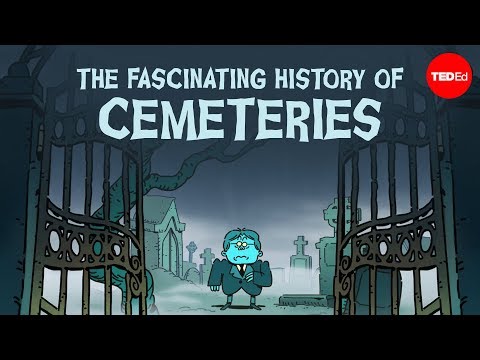
VIDEO: The Fascinating History of Cemeteries
In this animated TED-Ed video, architectural historian Keith Eggener explores how burial grounds evolved and why cemeteries came to look the way they do today. As you watch, consider how cemeteries reflect changing relationships between the living and the dead. Were burial grounds always intended to be solemn, quiet places? And what does the design of a cemetery tell us about the society that created it?
Death in North America, Late-19th to Early-20th Century
In this video, Chris Woolf of PRI's The World explains how death was a much more visible part of everyday life before the twentieth century. Food insecurity, poor sanitation, infectious diseases, and high childhood mortality all contributed to shorter average life expectancies.
As you watch, consider how improvements in public health and medicine have changed not only how long we live, but also how often we encounter death in our everyday lives. We may be living longer, but have we also become less familiar with dying?