2.5.2 Death Independence
When Death Moved Out of the Home
Think back to our discussion of family-directed funerals in nineteenth-century America. Families washed and dressed their dead, neighbors helped prepare coffins, and communities gathered to mourn. Over the next century, much of that changed, and the transformation was more complicated than simply moving death from the family parlor into the hospital.
Four developments were especially important: improvements in public health and life expectancy, advances in medical treatment and hospital care, the growth of the professional funeral industry, and changes in where and how Americans buried their dead (Lundgren & Houseman, 2010). These changes didn't happen overnight, and they didn't affect every community equally. But together, they fundamentally altered how Americans experienced dying, death, and the responsibilities that followed.
Living Longer, Dying Differently
In 1900, life expectancy at birth in the United States was approximately 47 years. Today, Americans can generally expect to live well into their seventies, although life expectancy varies considerably by race, income, geography, and other social conditions. That's an extraordinary change in a relatively short period of human history. So what happened?
Some of the greatest improvements came from public health rather than sophisticated medical technology. Cleaner drinking water, improved sanitation, safer food, better nutrition, and vaccination dramatically reduced deaths from infectious diseases, particularly among infants and children. Later, antibiotics, advances in surgery, and increasingly effective treatments for chronic diseases further transformed survival. As more people survived childhood and infectious diseases, larger numbers lived long enough to develop the chronic conditions associated with later life.
Now, remember something important about that 1900 life expectancy figure. It doesn't mean that most people dropped dead on their forty-seventh birthday. High rates of infant and childhood mortality pulled the average down considerably. People certainly lived into their seventies and eighties, but far fewer survived the hazards of early life to reach those ages. As those hazards diminished, the entire pattern of mortality began to change.
And that changed the social experience of death. When death occurs primarily in later life, we may come to think of it as something that happens to older people rather than as a possibility throughout the life course. But there's an interesting consequence to that progress: as medicine became increasingly successful at preventing death, dying itself became something that medicine was expected to manage.
Hospitals evolved from institutions that often provided care for the poor and seriously ill into increasingly sophisticated centers of medical treatment. Over time, more Americans experienced their final illnesses under professional medical supervision rather than exclusively at home. We gained extraordinary opportunities to prevent suffering and extend life, but we also began transferring some of the responsibilities surrounding dying from families and communities to healthcare institutions.
Think about that trade-off for a moment. Medical professionals can do things that nineteenth-century families couldn't possibly have imagined. They can treat infections, manage complicated symptoms, perform extraordinary surgeries, and sometimes give people years of life they otherwise would not have had. But as those capabilities expanded, we also began looking to medicine for answers to questions that aren't entirely medical. When is enough treatment enough? What makes life worth prolonging? And who should decide what happens when the treatments are no longer working?
Those questions are still very much with us.
The Civil War Changed How Americans Cared for Their Dead
Now, here's a piece of American history you might not expect to encounter in a course about death and dying: the Civil War helped transform the American funeral industry.
Between 1861 and 1865, hundreds of thousands of soldiers died, often far from home. Their families faced an agonizing problem. How could they bring their loved ones home for burial when transporting a body over long distances could take days? For families accustomed to preparing and burying their dead within their own communities, the distance between battlefield and home created an entirely new set of difficulties.
One answer was embalming. It wasn't a new idea. Ancient civilizations had developed various methods of preserving bodies, and nineteenth-century physicians were experimenting with chemical preservation. But the Civil War created enormous demand for techniques that could delay decomposition long enough to transport soldiers' remains. Embalmers began offering their services near battlefields, and some families paid substantial amounts to have a son, husband, or brother returned home for burial.
Consider what that meant to a family waiting hundreds of miles away. They might not have been able to prevent their loved one's death, but they could at least hope to bring that person home, hold a funeral, and bury them among family and neighbors. The ability to preserve and transport a body made something emotionally important possible, even as it created a market for a service that most families had never previously needed.
The war helped turn body preservation into a commercial service and contributed to the development of professional funeral care (National Museum of Civil War Medicine, 2016). And then, just as the war was ending, Abraham Lincoln was assassinated.
Abraham Lincoln and the Funeral That Changed America
When President Lincoln died in April 1865, his body was embalmed and placed aboard a funeral train that traveled from Washington, D.C., to Springfield, Illinois. Along the way, enormous crowds gathered to mourn. His body was displayed publicly in several cities, allowing people to see their president one final time.
For many Americans, this was an introduction to the possibilities of modern embalming. A body could be preserved long enough for extended public viewing and transportation across considerable distances. Lincoln's funeral helped bring embalming into the American mainstream, and the growing funeral profession began offering families services that had previously been performed at home (Walsh, 2017).
Think about how extraordinary that transition was. For generations, families had taken responsibility for preparing their dead. Now, professionals could transport, preserve, dress, and present a body for viewing, often in a setting outside the family home. Over time, Americans increasingly came to expect those services, and funeral care developed into an organized profession with its own businesses, facilities, practices, and costs.
Of course, there were real benefits. Families no longer had to manage every physical aspect of caring for a body themselves, and professional services made transportation, preservation, and increasingly elaborate funeral arrangements possible. But the change also meant that families became more dependent on businesses to perform tasks that had once been part of community life.
And here's the question I want you to carry into our later discussions of the funeral industry: When we handed the care of our dead over to professionals, what did we gain, and what might we have lost?
It's tempting to imagine that one approach was better than the other, but history rarely offers us such tidy choices. Professionalization brought new possibilities and conveniences, while also changing the relationship between families, communities, and the people who had died. Understanding that history helps us make sense of the funeral practices, expectations, and decisions we encounter today.
READ: How Lincoln Helped Popularize Embalming
When You Die, You'll Probably Be Embalmed. Thank Abraham Lincoln for ThatLinks to an external site.
As you read, consider how a national tragedy helped change what Americans regarded as a normal funeral. Why might families have welcomed embalming and professional funeral services? And what might they have given up in the process?
From Undertakers to Funeral Directors
Think about the difference between arranging a funeral in 1850 and arranging one in 1950. A century earlier, families might have relied on a local carpenter to build a coffin, neighbors to help with burial, and relatives to prepare the body. By the middle of the twentieth century, many of those responsibilities had shifted to an entirely new kind of professional.
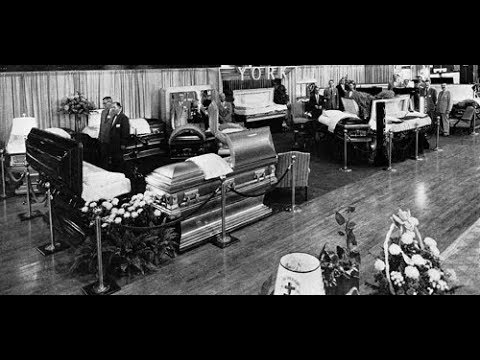
The nineteenth-century undertaker might have built coffins, arranged transportation, or assisted with burial. By the early twentieth century, funeral professionals increasingly offered a much wider range of services. Families could hire someone to prepare the body, arrange a viewing, coordinate a religious or memorial service, provide transportation, and manage burial arrangements. Funeral homes also provided a dedicated place for visitation and ceremonies, so families no longer had to open their own homes to everyone who wished to pay their respects.
There were real advantages to these changes. Imagine trying to coordinate a funeral while you're exhausted, grieving, and perhaps responsible for children, work, or other family members. Having someone who understands the practical arrangements and can take care of them for you might be an enormous relief. Professional funeral services also made it easier to manage transportation, sanitation, and increasingly complex arrangements, particularly as families became more geographically dispersed.
But there were trade-offs. As professionals assumed responsibility for preparing the body and organizing the funeral, the physical care of the dead became less familiar to ordinary Americans. Tasks that had once been performed by relatives and neighbors were increasingly handled behind closed doors. Families might participate in planning a funeral without ever seeing what happens between the moment someone dies and the moment their body is presented for viewing.
And there was another important change: the funeral itself became a service that families purchased. Instead of relying primarily on family labor and community assistance, families increasingly encountered a business offering different services, products, and prices. That doesn't mean professional funeral directors were necessarily exploiting grieving families. Many provided valuable assistance and genuine compassion. But it does mean that caring for the dead became part of a commercial system, with all the questions about affordability, expectations, and consumer choice that come with it.
Here's something I find particularly interesting. What many Americans now think of as a traditional funeral, with an embalmed body, a viewing, a professionally arranged ceremony, and burial in a cemetery, is actually a relatively recent development in American history. And it isn't a universal American tradition. Religious beliefs, cultural practices, financial resources, and individual preferences have always influenced what families choose to do.
So when someone tells you that a funeral has to be done a certain way because that's how we've always done it, you might want to ask: Always? According to whom?
VIDEO: North American Funerals (History of Funerals in the U.S.)
This video traces the evolution of American funeral practices from family-directed arrangements to the emergence of professional funeral services. As you watch, think about the relationship between convenience, cost, cultural expectations, and personal choice. How much of what we consider a traditional funeral reflects longstanding cultural or religious beliefs, and how much reflects the development of the modern funeral industry?
What Have We Gained, and What Have We Lost?
We've now seen how changes in public health, medicine, transportation, and funeral services transformed the American experience of dying and death. People began living longer, hospitals became increasingly involved in end-of-life care, and funeral professionals assumed responsibilities once managed by families and communities. Cemeteries and funeral homes became specialized spaces associated with death, and the entire process of dying, preparing the body, and arranging a funeral became increasingly professionalized.
Some scholars argue that these developments contributed to a growing separation between everyday life and the physical realities of death (Lundgren & Houseman, 2010). Think about it. Many of us have never seen someone die, helped prepare a body for burial, or participated in the practical arrangements that follow a death. We may attend a funeral or memorial service without knowing much about what happened before we arrived.
But let's be careful about romanticizing the past. Earlier generations weren't necessarily more accepting of mortality simply because they encountered death more frequently, and modern funeral practices aren't somehow less meaningful because professionals are involved. Families may welcome the assistance of funeral directors, medical institutions can provide essential comfort and treatment, and contemporary Americans have more options for memorialization and body disposition than previous generations could have imagined. There isn't one correct way to care for someone who is dying or to honor someone who has died.
What concerns me isn't that we've changed how we manage death. Change is inevitable, and many of these developments have improved people's lives. The more interesting question is whether we've become so accustomed to turning death over to professionals that we've forgotten we still have choices. We can ask questions, participate in decisions, and consider what matters to us and to the people we love, rather than simply assuming there's a prescribed way things must be done.
So let me leave you with something to think about. If someone you loved died tomorrow, would you know what happens next? Who takes responsibility for the body? Who makes the decisions? And how much of that process would you want to participate in yourself?