🎓 ONLINE LECTURE: Relationships and Why They Matter
 According to Barbara Streisand, "People. People who need people are the luckiest people in the world." I'm perfectly fine to avoid the disagreeable and angry of people in the world, but for the most part, I truly love the human race. I value the relationships that I have. Humans are essentially tribal, and we pick our people based on our region, our interests, our commonalities, and our belief structures. No, we don't all agree on everything, but we do seek out people who are like-minded for the most part.
Relationships Matter at All Ages
Relationships matter. We know that interpersonal connectedness is a direct influence on our life satisfaction. But to have strong relationships, you need to have a strong sense of self too. How do you perceive yourself? How do you define yourself when you're going into a new relationship? Is your definition of yourself based on who you know or what you know? Is it based on what you do professionally, who you love, or who loves you?
Just as they are to you and me, friendships are extremely important in an older person's life. Most maintain socially active lives that mimic their younger activities (remember activity theory and continuity theory?). Studies show that most who name a close friend name a woman. That is because women still outlive men, meaning there are more of them available for late-life friendships, and because more women exist in society.
Older adults look for equitable friendships just as we do. Those friendships are more comfortable if there is an equal exchange. Do you remember the exchange theory from a few weeks ago? Think of your friendships. If you give too much or receive too little, is your morale affected? If we feel like we are getting more than we are offering, we may feel uncomfortable or inferior. Likewise, if you give too much, you might at first enjoy the giving without receiving, but after a while, it can leave you feeling empty, unappreciated, or even resentful. It's essential to be able to balance give and take in meaningful relationships.
Late-life is not a static time for older family members. Because we live longer, things are more likely to change. Multiple marriages, divorces, death of a spouse, step-children, great-grandchildren, all change our family structure. Along with these changes our social values are such in America, that the value and opportunities for people in old age are reduced. There are fewer opportunities to interact with cohorts, fewer social events (weddings, baby showers, party get-togethers), retirement reduces peer contacts and opportunities for social contact, and there remains little opportunity to replace these losses. This results in fewer social interactions.
We all need confidants and companions in life. It's an essential element for older adults, too. We want someone who understands, can be trusted, accepts you and, whose friendship endures over time. Sometimes our confidant is a friend, but research has shown that our most common confidant is a member of our family. It is only when our family is not available that our friends take on that essential role. (Connidis, 2003)
Family and Friends
The family continues to be an operating social network to compensate for and replace social losses in late old age. Empirical evidence indicates that despite the cultural lore, the family ties between older people and their children are still strong and functioning. We will see this when we look at caregiving and the oldest old. For now, it is important to know that the myth that the majority of families abandon their elderly in America is not true.
Whether or not the aging parents live with their adult children, certain conflicts are bound to arise between the generations due to cohort differences and changing roles as the family's life-cycle progresses.
Women in the workforce, increasing life expectancies, and the improved financial condition of the elderly population has changed the timeline \of expected life events. It has changed the quality of our family roles.
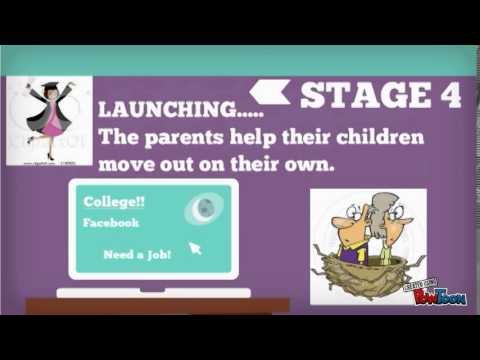
All families go through a family life cycle. As members age, their roles and, thus, the cycle of the family changes. Perceptions change, and ways of behaving change with changing roles. The changing of the roles of child, student, worker, retiree, remarried, widowhood, grandparenting, and others all contribute to any family's life cycle.
As you watch the following video, think about where you, and your immediate family members, might fall along this spectrum.
Kinfolk

“One touch of nature makes the whole world kin.” (Shakespeare)
Our kin is our friends and family. Our kin group can take lots of different forms. Sometimes it's our extended family, our nuclear family, our friends, our colleagues, a group of like-minded individuals - I call mine my "tribe." They qualify as kin, too. The act of maintaining those relationships, the "feeding and nurturing of our connections," is called kin-keeping.
Females tend to do more overt kin-keeping, like meeting obligations like birthday cards and family dinners and phone calls. Men certainly have a strong feeling of attachment, but they tend to be more capable of maintaining relationships more covertly. I asked my son about this once, and he said he didn't need to talk to his buddies daily. He kind of laughed and told me that it would be 'weird' to need to talk to his friends every day. He had some that he didn't talk to more than once a year. But when they got together, it was like they never separated.
Social class and geographic location can also influence your contact. Interestingly, it's almost inversely proportionate. Research shows that the more affluent we are, the fewer face-to-face contacts we have face-to-face with our kin in a given year—the lower the income, the higher the correlation with more face-to-face contacts.
How do we define family? Consider these terms: nuclear and extended family. Traditionally a nuclear family is a two-parent, child arrangement. Maybe it's a husband and wife, maybe it's to moms or dads, however, you define it, it's a single-family, in a single dwelling. The extended family includes the aunts and uncles, cousins and nieces and nephews, grandchildren, and great-grandchildren. We now have more children, and parents, and grandparents, and great grandparents, then we have ever had existing at one time.
We refer to this phenomenon as the verticalization or the bean poling of family structures, where we don't necessarily have big families. What we DO have lots of generations to live at one time. I was fortunate to know all of my grandparents and several of my great grandparents. I now know of a great, great grandparent who has just sent me a picture with the recent addition to the family - cutest baby ever.
More generations are alive at the same time than ever before. So even though we may not have the volume of humans in a family, we certainly have the potential to have some cool inter-generational interactions.
Changing Family Roles
Over our lifetime, our relationship patterns change, moving from marriage to widowhood, working to retirement, and sometimes even to divorce or remarriage.
There is even a change in perception of our rules about roles. We now see transitions, like when we move from being a mother to a grandmother, or when our independence level shit from being a child to an adult and back again, maybe to a dependent parent, as quite fluid.
Our relationship patterns are influenced by what we've done in the past. Even our gender and culture influence our relationships. Think about your family. Is it okay to have friends of the opposite sex when you are single? What about after you marry? I would hate to have lost my friends when I married just because most of my friends are men. I would've been deeply affected if that was a cultural construct that I would have had to say goodbye to all of these people.
Parents and Children
All along the path of our lives is our family relationship. They are the friends that we have the longest career with. The longest of all of them being the relationship we have with our parents. How well do you know them? How well do they know you? What role do you hold in that relationship? As I grow older, my mother becomes one of my closest friends and confidants. No one is more surprised than me!
I found this great video of parents and children just before getting ready for the kids to move away to college. Check out how little or how much they actually know about each other.

(Source: Discover and NBC News)
Parents and Children
Those of us that have children will, statistically speaking, have a very long relationship with them. Contrary to popular belief, most children do not abandon their parents, leaving them to fend for themselves financially and socially. We do stay in close contact. In fact, over 80% of adult children communicate with their parents weekly. More and more adults are sharing homes. Sometimes it's about caregiving, and sometimes it's a financial arrangement. Sometimes, it's just because they like each other!
We are finding multi-generational families becoming more and more common. It has always been more common among people of color than Caucasians, but we are now seeing that population of multi-generational families growing as well. It is interesting to me that it is equally common for a parent to move in with a child and for the child to move back into the home of the parent.
Certainly, the relationship we have with our parents can be very complex. There's a reason that most of us have moved away. So, if we're going to have long-term relationships into our adulthood, we may have to negotiate. What are the ground rules of our new relationship? If I'm going to be responsible for caregiving, or if we are going to cohabit, I need to know what issues we need to resolve from childhood. Is the economic benefit worth the stress that unresolved issues may cause?
One change that happens in our child/parent relationships is that of filial maturity. It's a stage in middle age when the family cycle has progressed to the point where we don't consider our parents the rock of support in times of economic trouble or stress. Instead, they need comfort and support from their adult children. The adult children then realize that their parents are becoming dependent upon them.
The mature adult must have the capacity to be depended upon by the parent. The adult children must accept and resolve what their parents cannot do for themselves and develop a maturity that accepts what the parent can, and should, do for themselves. The goal is to maintain functionality and dignity. The adult child also needs to assess, accept what he/she can do for the parents, and find other resources for what he/she cannot do. It's a huge learning curve, and you won't know that the changes are coming until they happen!
The more children in a family, the greater the potential for distributing the responsibilities for parent care. Women the duo have stronger attachment to extended family, and the more daughters in the family, the greater the likelihood that parents will have assistance from their children (Connidis, 2001). It’s not that having boys decreases the chance that parents will receive care. What is different is the kind of care most likely to be given. Men will provide care, but are less likely to be the ones doing the hands-on, day to day caregiving.
Functional Dependency
Many experts warn against creating a functional dependency as filial maturity and role change set in. Not allowing people to do what they can for themselves creates a needless dependency and a lower level of functioning and self-esteem on the part of the older adult.
Many younger family members inadvertently create functional dependency when an elder suddenly needs assistance. At the beginning, anxious to make the elder feel comfortable, adult children take care of activities of daily living (ADLs) that the elders themselves could attend to. Examples might be combing their own hair or managing their own affairs. The elder then sees this format and begins to think that this level of care is required for his age. Perhaps thinking, "since I am old, I better not try.”
Functional dependency can create a nightmare for an adult child who then has to get back to his/her own daily routine. It also lowers the esteem of the elder and accelerates the decline.
Siblings
The second-longest relationship we will have is with her siblings. I am an only child, so I only see it from outside of the bubble. But my observation and science tell us that these sibling relationships can be some of the most intense and complicated, positive or negative relationships that you will have in your lifetime. (Connidis, 2003)
Today, older adults have more siblings alive than they may have children because they didn't have as many children as their parents did. (Butrica, et al., 2003/2004). So, we're finding that they are moving in with each other and cohabiting. It is funny because, in many cases, they couldn't wait to get away from each other when they were teenagers. If you think about it, though, it makes a lot of sense. They've got a shared history, similar biology, experiences they can share. They can reminisce together, which is super important when you are in that reflection period of your life. (Waldinger, et al., 2007, Baur & McAdams 2006 & Baur et. Al., 2012)

If you want a giggle, unrelated to anything academic, take a look at this little interview of two sisters - both over age 90 - who became an internet sensation. Here's Gramma and Ginga:

(Source: Steve Harvey Show)
Grandparents
Most of us will become grandparents in midlife. (Pilkauskas, 2012) So, we will have 20, 30, 40 years depending on our life expectancy with these little people. 60% of us, on average, are going to have at least one grandchild. Again, it is not uncommon to have for generations that are interacting. Grandparents are very important. I am all about grandparents, because I was raised in my grandparent's home. In fact, I didn't realize that everybody didn't live with their grandparents until I started school, and I was genuinely surprised. The degree to which grandparents are involved in our lives is significantly influenced by the relationships that we had with our own grandparents. (Dunifon & Ashish, 2012)
Being a grandparent role provides family members with the opportunity to give a family history, have continuity in value in ethics, and mentor those younger folk and have someone to attach to securely. Because we live in an era of divorce, sometimes the grandparents are more constant than the parental role. Intergenerational relationships are pivotal for passing on family history, providing continuity, exchanging emotional and physical support. (Wiscott & Kopera-Frye, 2000)
The role of grandparents varies. They can be the storytellers, the advocates, the unconditional supporters. Grandparents can serve as family watchdogs. They keep an eye on things. They keep their fingers on the pulse of the family. There are, however, different kinds of grandparents.
The Fun Seeking Grandparent - The fun seeker is an informal type of grandparent. They are playful and look for and find opportunities to play with their grandchildren.
The Formal Grandparent - The formal grandparent is a traditional style. Usually, these grandparents are indulgent to their grandchildren. They buy gifts, give money, and allow the children ample leeway in behavior. This type of grandparenting style leaves the rearing of the children to their parents. Formal grandparents are not comfortable in an authoritative or punitive role..
The Distant Grandparent - Grandparents who live far away often make ritual appearances. Because of the distance between them and their grandchildren, the visits frequently center around holidays and summer vacations. This type of grandparent shows up at the door on birthdays or Christmas.
The Surrogate Grandparent - Because of the increase in drug addiction and older adults' longevity, more and more grandparents are taking over parental duties because Mom and Dad are impaired or unable to fulfill the parenting role. Sometimes, grandparents are just surrogate parents during the daytime when parents are at work. Sometimes they are the key to helping children maintain identity in single parents families or in stepfamilies. Higher levels of grandparental involvement, especially during adolescence, is associated with fewer emotional problems in adolescence. (Dunifon & Ashish, 2012; Lussier, 2002); Pilkauskas, 2012)
The Reservoir of Family Wisdom -Some families include an old-fashioned, patriarchal type of grandparent. They hold the family wisdom and are consulted in matters of importance. This type of grandparent would tell the family stories and pass on recipes or family traditions.
Age is one chief determinant of grandparenting style. Those over age 65 tend to be more formal while those younger more fun-seeking. However, the institution of grandparenting is undergoing rapid change.
Grandparents Matter!
Because of the increase in longevity, grandparents are more available to take on their grandchildren's parenting roles. Because of parental joblessness, poverty, drug use, and single parenthood, many grandparents are being called upon to assume the role of surrogate parents to their grandchildren. Often this role extends beyond grandchildren to great-grandchildren as well.
Adult children who cannot function as parents may need parenting as well. This surrogate parent role may begin as a temporary measure. Still, it can easily evolve into a long-term commitment to provide care and support for the second, third, and even fourth generation.
Grandparents can be faced with providing care for multiple generations-
some grandparents still have teens at home or maybe caring for an elderly parent or relative and now must add another generation to their duties. Each of these generations has its own particular needs.
A 63-year-old lady who cares for her teen daughter, seven grandchildren, and three great-grandchildren commented:
"Can you believe that I do all this? I can't even believe it
myself. All these people depend on me. I am stretched so thin
that sometimes I wonder if I can seriously make it. I guess that I
have no choice."
People who care for more than one generation at a time are referred to as the sandwich generation. They are said to be "sandwiched" between two generations; their own children and their grandchildren or their aging parents. For these women (caregivers are overwhelming women), it may feel like they will be caretakers all their lives.
Although many elders are currently able to keep up with their grandchildren's school, social, and physical activities, some are concerned about the future as they age and the child gets older. Who will take care of the grandparents when they need help? The ability to care for others will have skipped a generation. They express being both extraordinarily committed to raising their grandchild to feeling anger and despair that they “failed” their own child. (Burnette, 1999; Lussier et al, 2002; Ruiz & Silverstein, 2007)
For many grandparents, there is a loss of control of their personal lives. They may need to quit a job to care for the children or give up plans to retire or travel. Surrogate parenting can strain the relationship between the parent and children, husband and wife, and grandmother and grandfather. It can be especially challenging if the children needing surrogate care are not from that marriage. Many may not be able to meet their own needs, let alone the needs of a growing child.
Rewards of Grandparenting
Most parents with grown children look back and contemplate things they might have done differently or better. No one does a perfect job of raising his/her children. Often, the opportunity to parent grandchildren can be an opportunity to parent again-- perhaps doing a better job this time.
Parents are often blamed for their children's problems, and parents blame themselves and carry that guilt. Parenting the grandchildren can be seen as an opportunity to redeem one's self.
Parenting grandchildren can also be seen as an investment in the future (do you recall Erikson's developmental stage in middle adulthood?). For some, they are nurturing a legacy. Grandchildren provide companionship and love. Some say that they "keep you young" by forcing you to deal with youth and their cohort needs.
Raising grandchildren can also provide a sense of being needed and a sense of accomplishment.
Grandparental Rights
Grandmothers are typically involved in the day-to-day than grandfathers. That does not make the grandfathers aren't involved. However, the bathing, dressing, feeding, and caring of the grandchild most frequently falls to the grandmother. Why the difference? Historically, women visualize themselves as grandparents from the moment they have their first child, and they see the role as being positive - even those early life grandmothers who like the idea of being a grandmother, but not the idea of being old enough to ‘be’ a grandmother. Men, on the other hand, are in the prime of their careers at midlife when they become grandfathers, and consequently may not become involved in the grandchild’s life until after retirement. (Pratt et al, 2008)
We've had some real challenges in the last 15 to 20 years sorting out where grandparents fall in the time of divorce. What happens if angry former spouses block the relationship between the grandparents and the grandchildren. It reached a point where grandparents had to sue for visitation rights. The courts had to come in and intervene and create legal standards for grandparental rights. Why? Because we recognize that grandparents are often the principal older adult and children's lives, and children deserve continuity. It also recognized the value of intergenerational relationships.

(Source: Sioux City Journal)
Intergenerational Relationships
These intergenerational relationships matter. Regardless of whether there is a biological connection, we recognize the importance of generations interacting in substantive ways. These relationships allow the old and the young to have a sense of purpose, learn new skills, and teach young people how to interact with older people. It can invigorate and energize the older adult, and it's really good for kids who may not have biological grandparents around. Young people need the opportunity to learn, to hear stories, to share historical perspectives. It takes the life out of the textbook and brings it to the reality of a young person's life. In my opinion, that is really important.
In fact, so important are intergenerational relationships that we have a term to measure the quality of those relationships. We call it inter-generational connectedness. We look at the amount of interaction between the different generations. We explore how people feel about each other. If there is a positive sentiment between family members, we recognize that it helps cement those intergenerational bonds.
If you agree on basic values and beliefs and don't have any tension around that, you are strengthening those intergenerational bonds. The degree to which children, parents, and grandparents exchange services matters. A service can be anything from helping someone get to and from the store, giving money, making food, and doing things collaboratively. Hillary Clinton used the quote, "it takes a village to raise a child." Well, it also takes a village to care for an older person. In tribal times, the older person and the youngest person relied on each other while the hunters were hunting and the gatherers were out gathering.
We look closely at how families live near each other and how they interact with people in other generations. Following is a video that I would like you to watch. It shows what happens when students go to live in a retirement community. It's a growing trend, particularly in Europe, because housing is at such a premium.
And there is a recognition that bringing young energy into a primarily older residential facility can bring a new life. So once you have had a chance to watch, I'd like you to think if you would be willing to live in a multi-generational setting like this. Could you do it?
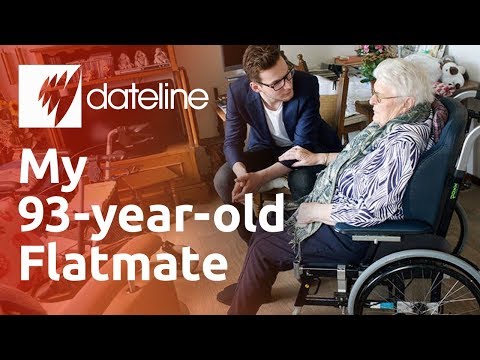
(Source: Ted-X)
After viewing the video, please take a moment to visit Humanitas site, that tells the stories of the residents and seniors who live together. There are six students currently living at Humanitas. See if you can relate to one of their stories! There are supplemental videos for each of them, plus some news stories about Humanitas and their innovative living arrangements. Be prepared to share your thoughts on the discussion board.
Image Citation
Image courtesy of Siggy Nowak under Pixabay License