🎓 ONLINE LECTURE: Personality and Aging
Illustration from the original Canvas course (image not included in this lightweight export). Personality & Aging

Think of an older person in your life. Can you imagine who they might have been when they were younger? If, as the adage is accurate, we become more of who we are as we age - only more so, what might they have been like as a twenty-year-old? A lifetime of environmental exposures and experiences have honed those personality traits that we developed pretty early on. Students ask if significant life experiences or traumas change our personality. What changes may be behaviors, but the basic core of who we are stays with us and will influence how we act. Our actions may contradict our personality - an introvert may become a performer out of necessity and appear like an extrovert.
Personality consists of traits and characteristics, behaviors, and expressions. There are moods and feelings. We may feel on the inside (covertly) and express differently for the world to see (overtly). As we develop our personality, we are influenced by our environment. Research conflicts over the influence of genetics vs. environment, with varying estimates that genetics determine anywhere from 50% to 90% of our temperament.
Social Influences
Where we grow up, with whom we develop, and in what cultural context we mature all have a profound influence on our early personality development. Consider the differences between American cohorts and the availability of education, nutrition, economics, and social interaction. The contemporary older adult had a childhood directly tied to post-WWII, Korea, and Vietnam. Their personality development occurred during a time of national and international tension. It caused them to perceive the world differently from the cohort that followed.
Consider personal experience. Women or men who experienced trauma early in life respond very differently to adults who experience trauma. We are the culmination of all of these experiences. It is a very complicated psychological process.
Researchers have developed a theoretical framework to describe the variations to study and define personality and temperament. There are, of course, different models from which we examine personality. Let’s explore a few and see if something resonates with you.
Personality Types - The Alphabet (A,B, C, D)

Personality Types - Strategic Types
The Codependent Personality
Arden approval seekers and perfectionists in nature, often seen as a “Type A” personality, the codependent personality wants to get things done. They want to manage the crisis. They will sacrifice themselves at their own expense to make others succeed. It comes from a sense of inadequacy, and a self-perception of being in a position of victim. That perfectionist overachiever, excellent in a crisis, loyal to a fault person, frequently partners to someone abusive or struggling with addiction. The codependent personality can quickly lose themselves in the attempt to make others happy, and not recognize the risk factors to their wellbeing.
The Hardy Personality
If we examine a hardy personality traits, we will see challenge, control, and commitment (Kobasa, 1979). These individuals thrive in stressful environments, gain reputations for investing in solutions, and see problems as challenges to conquer. This personality type rarely reports stress-related illness, because they have developed cognitive processes to manage stress risk factors. They thrive in chaos and do their best work to bring together innovation in a controlled environment.
The Survivor Personality
The survivor personality thrives on danger and stress. They enjoy being chased by the tiger. Theirs is a biphasic personality, which means that they use both their left brain and right brain to problem solve. Outwardly, they are a bit of an enigma. They are very proud of their accomplishments but personally humble. They embrace both altruistic and selfish goals and purposes. They are seen by society as both revered and rebellious. Inwardly, there is an underlying spirit of cooperation and a strong sense of spirituality. They are often considered our cultural optimists. They help us solve problems creatively. Forgive the cultural reference, but they are the ones we want to have with us in the zombie apocalypse! They exist at a high-intensity level and experience a high stress that might debilitate others. (Siebert, 1996)
The Sensation Seeker Personality
These people love the thrill. They are the parkour, base jumper, sky-diver, and high-risk venture capitalist investor who lives their entire life seeking adventure and thrill, taking calculated risks at every step. Those risks can be physical, emotional, or financial. It’s not about danger, but a desire to pursue new and different sensations, feelings, or experiences. Researcher Marvin Zuckerman summarized sensation seeking as “ a personality trait defined by the search for experiences and feelings that are varied, novel, complex, and intense, and by the readiness to take physical, social, legal and financial risks for the sake of such experiences.” (Zuckerman, 1972)
Temperament (The Big 5)
Learning more about ourselves gives us more agency over our choices and behaviors. Some personality types are at greater risk for heart disease or stroke. Our personality influences how we manage stress. How you manage your educational stress may indicate your ability to cope with careers or childrearing. Our personality and temperament can directly impact our long-term life satisfaction.
Many contemporary personality theorists believe that five dimensions of personality combine to create predictable temperaments that influence our choices in life. A synthesis of the work of D.W. Fiske (1949), Smith (1967), Goldberg (1981) and McCrae & Costa (1987), “The Big 5” traits include extroversion, agreeableness, openness, conscientiousness, and neuroticism. Each of these aspects influences how we process and cope with stress.
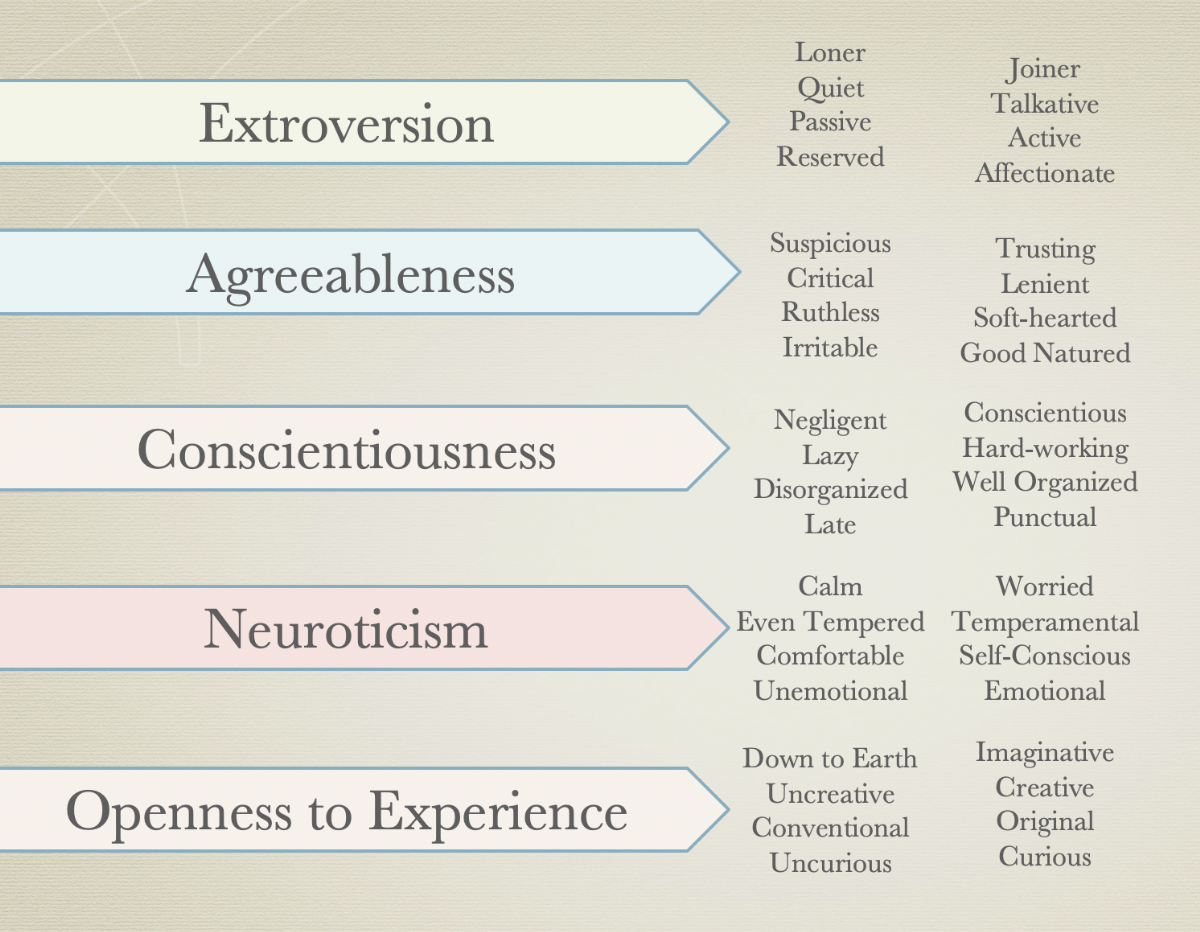
Each of these traits describes innate behavior.
People who are high in openness are very creative and “open” to trying new things, versus those who resist change and dislike abstract concepts.
Those on the high end of conscientiousness also have high thoughtfulness levels and pay attention to details, while those on the lower end dislike structure and tend to procrastinate.
Extraversion is characterized by talkativeness and emotional expressiveness. They enjoy meeting new people and find it easy to make friends. Those on the lower end of the scale prefer solitude, dislike being the center of attention, and are exhausted by socializing.
Agreeableness relates to trust, affection, and cooperation. Those who are on the high end of the agreeableness measures are very interested in others and enjoy contributing to others' happiness. Those on the lower end show little concern or regard for others, is not particularly concerned with other people’s feelings, and are willing to manipulate others to get what they want.
Neuroticism is characterized by sadness, moodiness, and emotional instability. Those highly neurotic individuals are worriers who get upset quickly. They express dramatic shifts in mood and struggle to recover from stressful events. Those who score low on the neuroticism measure rarely feel sad or depressed, are more relaxed than their counterparts, and deal well with stress. (Power & Pluess, 2015; Jang, et al., 1996)
The Meyers-Briggs Personality Inventory
If you have ever taken a career counseling course, you may have participated in a self-assessment tool called the Meyers-Briggs Temperament Indicator. It is a 90-question long survey that provides useful information on our temperament related to our career choices, but it also serves as a tool to understand our reactions to life circumstances, our relationships and our tendencies toward interests, study habits and workplace performance. The test evaluates our measures of introversion or extraversion, sensing or intuition, thinking or feeling, judging or perceiving. Some researchers assign the Meyers-Briggs to the category of pseudoscience (Bailey, et al., 2018), but I find it to be a useful springboard for conversation. The discussion post that follows lecture will require you to complete the typology test and share your thoughts.

Personality in Later Life
Personality becomes more intricate and complex as we age. Our personality traits, experiences, and cognitive abilities influence how we react and behave later in life. We also become more selective about how we engage, with whom we engage, and what engages us. Older adults select their goals differently, choosing which is most gratifying. Whether we focus on emotion-centered activities and relationships or gravitate to knowledge-based activities depends on how we perceive time. If we perceive time as limitless, we focus more on gathering information - learning a new skill, and making new acquaintances. If we perceive time as limited, our energies and attention tend toward nurturing our existing relationships, focusing on the positive and reconciling differences. (Cartensen, 1991)
Image Citation
Image 1: Image courtesy of ivangood under Pixabay license
Image 2: Image created by author using Microsoft Powerpoint