🎓 ONLINE LECTURE: Financial Challenges of Aging
Money Matters

Most of us are in college to get a better job and have a better life. Most of us also grew up with the idea that there will come a time to leave the workforce. We know the millennials, in particular, are entering the workforce ten years later than their parents and grandparents, who enter the workforce at age 18. Likely, those of you that are currently taking this class will not find your "forever job" until you are 28 or 30 and will stay IN the workforce for far longer than your predecessors.
In 1990, less than 3.9% of us stayed in the workforce past 75. In 2014, that number had jumped to 12%. Why? Well, economics certainly plays a part, but so does longevity. As we live longer, healthier lives, the age at which we become less able to contribute to the workforce gets older and older. We get the rare and new opportunity to live longer and to contribute to the workforce longer than any generation before us. (BLS.gov, 2020)
Consider what is driving you to succeed in college? What might influence or challenge your successes, both in school and in the workforce after graduation? We know that gender and ethnicity directly correlate to earnings in contemporary society and can profoundly impact financial welfare at the end of life. My hope is that your experience won't be the same. For now, we can only study what we know….so let's take a look at where we are.
Most of us, though, have it in our heads that we want to retire. To do that, we need to have built a metaphoric "three-legged stool." One leg is our retirement savings. One leg is our healthcare coverage. The third leg is our housing.
Let's start a conversation about what it takes to be solvent, safe, and happy later in life.
Factors influencing Wealthspan
The American workforce is diverse, in terms of ethnicity and gender, and in growing numbers, age. The Bureau of Labor Statistics projects that by 2026, the number of workers over age 65 will have jumped to 30%, compared with 17% in 1996. For workers over age 76, the rate is in 2026 is projected to be 10.8%, compared with 4.7% in 1996.
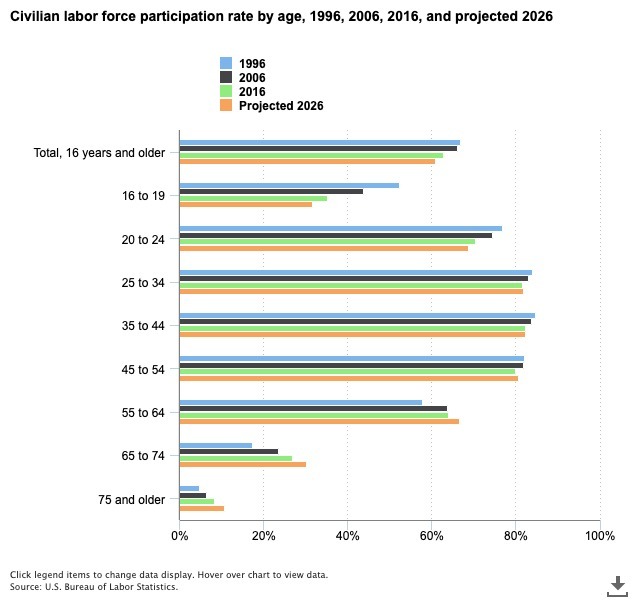
Among our contemporary older adult population, racial and ethnic differences in employment history impact later life. Black men have a lower labor force participation rate and higher unemployment levels than their white Asian or Hispanic counterparts. (bls.gov. 2017) Also, black men are more likely than white men to experience health difficulties and have lower-paying jobs. What is this ultimately mean? It means that they have lower retirement incomes.
Hispanic women over the age of 65 have the lowest rate of labor force participation of any ethnic group. We know that white women stay in the workforce more than any other culture, up to about age 60, but after age 65, those participation rates level out. (bls.gov., 2017) We also know that women have historically experienced lower compensation in the workforce. In terms of labor participation, we went through a period in the 90s when we realized that we had so many young people coming into the workforce that we actively encouraged people to retire at age 65. (bsl.gov, 2020) We now realize that it may not have been such a great idea.
We've got young people in the workforce, but we also have to pay for the benefits packages (health, retirement, etc.) for these new workers - but we committed to paying for the healthcare and pensions for the retirees too! There is a move to encourage people to stay in the workforce longer, postponing their need to access government-funded pension and healthcare programs. The longer we are in the workforce, the less burden we are to the Federal budget!
Age Discrimination in the Workforce
We can't have a conversation about work and aging without addressing one of the major barriers to staying in the workforce. Age discrimination. In 1967, legislation was passed to protect applicants and employees 40 years of age or older from discrimination on the basis of age in hiring, promotion, discharge, compensation, or terms, conditions or privileges of employment. The " Age Discrimination in Employment Act of 1967 changed the laws, but 50 years after its passage, age discrimination happens. ProPublica, an Urban Studies institute estimates that more than half of older workers are pushed out longtime jobs before the would choose to retire. (Wilkie, 2019)
The Act, designed to protect older workers was weakened by a 2009 Supreme Court ruling that imposed a higher burden of proof on the worker who alleges discrimination. (Farrell, 2017) The burden of proof is much higher for age discrimination than that of race, religion or gender. An AARP survey done in 2007 reported that a majority of workers over age 45 have seen or experienced work place discrimination.(Terrell, 2017) According to testimony from attorneys at AARP, employers who would never overtly reject applicants on age have found ways to subtly discriminate in the hiring process:
- Specifying "digital native" as a requirement in a job posting.
- Limiting recruiting for new jobs to college campuses
- Requiring a college e-mail to apply for job openings
- Using algorithms to filter out resumes by "years of experience"
As a college student, you may be throwing your hands up and doing a happy dance right now, but the fact is that this behavior is illegal, unfair and limits the range of experience and institutional memory for organizations. Remember the Modernization Theory? Not all new knowledge is better than old knowledge.
So, what about those workers who have contributed for 20 or 30 years, and helped to grow the organization. We know that older workers can produce as much as younger workers Yet, the myths persist that older workers lack strength, stamina and speed. Especially in tech firms, it is not uncommon to hear about the older worker being difficult to train, or lacking drive or imagination. With only minor adjustments in attitude, those who are managing older workers might find that they are an excellent source of institutional knowledge, and are eager to develop new skill sets. Businesses need employees who are honest, dependable, have good work ethic and bring maturity to the workforce. (Bastien, 2006)
If you are up to the viewing of a 'rom-com,' take two hours and watch "The Intern" starring Anne Hathaway and Robert DeNiro. It is a great example (albeit it a bit fluffy) of how valuable the experience and wisdom of older workers can be to the workforce.
Yet, we see age discrimination in cases of the long-employed worker over age 40 in age discrimination complaints across the country. Typical causes include:
Position Terminated - Older workers are told that their position is being eliminated; but when they leave, a younger person is hired and often paid less.
Career Caps - Older workers may find that they reach the maximum retirement contribution, or reach the top scale salary with no room for advancement.
Downsizing - If during any downsizing it is predominantly the older workers who are laid off, it is probably a discrimination act.

(Source: The Big Think)
Financial Predictors
Financial readiness is often the biggest determining when we can retire. Can we live comfortably without generating new income from work? It would be nice to live in a utopia where it wasn't a concern, but the reality is that we all need money. What makes us different from each other is how much money we want or need. Our ability to live as we have chosen to live is one of the biggest predictors of life satisfaction after retirement.
We know that the biggest predictor of our contemporary older population's financial stability was whether they met some very specific criteria. (apa.org, 2020)
- Male
- White
- College-educated
- Married
- Live in the suburbs or an urban setting
Why? Well, for those currently over age 65 or 70 who met the above criteria, we know that history played a part in their affluence. They came into their young adulthood post WW2 when jobs were plentiful, and the economy was thriving. Divorce rates were low. They had an opportunity for the first time in history for an average person to gain a higher education. With that came a higher pre-retirement incomes, great and greater job stability. They were able to stay in the workforce longer than their parents and retire when ready. And, they had the opportunity to contribute to their retirement savings plans and build equity in homes. Goodness, we could buy a 3-bedroom home for $15,000!
On the flip-side, we know that when we look at the population over the age of 65, the process strongest predictors of poverty also met some very specific criteria:
- Female
- Non-Caucasian
- No high school diploma
- Divorced or widowed
- Living in a rural area.
It should seem rather obvious, but this population is one of the most at-risk groups in our contemporary older population. These are women at risk. When we talk about poverty, we often refer to it as being a woman's issue – particularly an older woman's issue. (O'Grady & LeShane, 1990). In most of these cases, these women spent their adult years caring for children and managing a home, while their spouse was the primary breadwinner in a very traditional household. There was no contribution to family wealth-building nor retirement planning. Upon their spouse's death, their income will have been substantially reduced and greatly dependent on whatever planning was done by the spouse on their behalf. It is not uncommon in many cases to find an older widow who has never balanced the checkbook or paid a bill.

(Source: Corinne Baumbarten)
I think one of the reasons a course like this, and particularly a lecture content area like this is vital. Money is one of those uncomfortable conversations because many generations prior to ours were taught that it was improper to talk about money. In many cases, my family and friends have never known their parents' financial situation until they die, and the lawyer reads them the will. It puts all of us at a disadvantage if we do not have the language to talk about money, and especially the ability to share resources and understandings about ways to make money work for us
Money is one of those uncomfortable conversations because our parents, grandparents, and great-grandparents thought it improper to talk about money. In many cases, my family and friends have never known their parents' financial situation until they die, and the lawyer reads them the will. It puts all of us at a disadvantage if we do not have the language to talk about money, and especially the ability to share resources and understandings about ways to make money work for us.
Image Citation:
Image courtesy of Joshua_Willson under Pixabay License
Image courtesy of Bureau of Labor Statistics under the public domain