🎓 ONLINE LECTURE: Biological Theories of Aging
Biology of Aging - The Theories
What happens when we age?
It's not enough to know that there are more older people in the United States or the aging population's demographics. It is essential to understand what happens when we age. Our bodies, our brains, our social networks….they all go through shifts.
Though, the reality is that despite our spiritual age, our bodies do experience a certain amount of decline. We need to remember that age is a natural progression that brings alterations in our cell structures. Age is not a disease, nor does age bring inevitable illness. Disease is just that. Dis – ease. It is when our bodies experience something going wrong, out of the ordinary. Some physiological changes are, indeed, associated with diseases. For example, the brain of a 90-year old may contain nerve cells that have plaques and tangles commonly associated with Alzheimer's disease, even though the person did not have the condition.
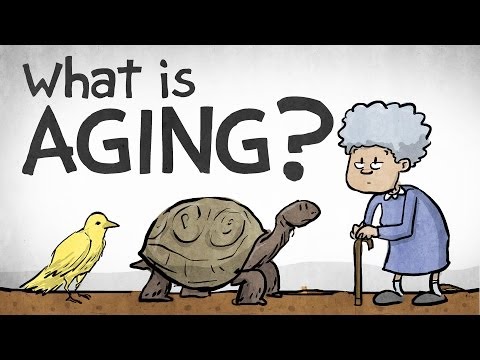
(Source: PHD Comics.com)
Acute vs. Chronic Conditions
There are two different kinds of "disease" that we experience. Acute disease is sudden onset, usually short duration. Chronic disease is just the opposite. The onset may be sudden but is more often quite slow and sneaks up on us. Chronic disease is long-term, and sufferers may experience symptoms for the duration of their lives. We look at morbidity rates (the frequency of an illness within a population) and mortality rates (the death rate associated with an illness) to determine the seriousness of various acute and chronic illnesses. These rates help us determine where to allocate resources to fight or treat various conditions. We know that we will not survive indefinitely. The absolute human lifespan has been estimated to be about 120-125 years. (Weon & Je, 2009).
The Baltimore Study
The Baltimore Longitudinal Study on Aging (BLSA, 2011) began in 1958 and has traced the aging process in 1,400 people from age 20 to 90. Researchers from the BLSA have found that the aging process varies significantly from individual to individual and from one organ system to another. Kidney function may deteriorate earlier in some individuals. Bone strength declines more rapidly in others. Much of this is determined by genetics, lifestyle, and disease. However, some generalizations about the aging process have been found:
- Heart muscles thicken with age
- Arteries become less flexible
- Lung capacity diminishes
- Brain cells lose some functioning but new neurons can also be produced
- Kidneys become less efficient in removing waste from the blood
- The bladder loses its ability to store urine
- Body fat stabilizes and then declines
- Muscle mass is lost without exercise
- Bone mineral is lost. Weight bearing exercise slows this down.
Watch this video clip from the National Institute of Health as it explains the research involved in the Baltimore Longitudinal Study on Aging. You’ll see some of the tests done on individuals, including measurements on energy expenditure, strength, proprioception, and brain imaging and scans.

The Biology of Senescence
We need to understand that when we are young, we feel that life is super short, but as we get older, we realize that we have a lot more life to live, and we should probably be paying attention to what's going on with our bodies. That's what we're going to be doing this week. I used to call this lecture segment "the biology of aging," but it wouldn't be entirely accurate. It's the biology of senescence because we all know what it's like to be healthy. We all know what it takes to be a vigorous mature person. The goal is for us to stay that way, right? Well, eventually, all creatures move into senescence, and we talked briefly about that. The goal is to delay the onset of senescence.
What do you think of when you picture an "old person?" Often, we generate images of gray hair, false teeth, wrinkled skin, and stooped posture. While that may be true, there are many exceptions to this rule. How we age is directly related to how we live, our diet, environment, and factors beyond our control like genetics.
There are lots of theories about why we age. Some scientists think that we age because our cells have a limited number of replications, and once we have exceeded that number, we run out of energy to reproduce cells, and we degenerate. Other scientists think that our organs only work for a specific amount of time, and we "wear out." Other scientists believe that toxins cause aging at the most basic levels of our cell structures – these are the ones that want you to take anti-oxidants and eat a specific diet to slow the aging process. Others believe that some fibers and proteins link together to create less flexible tissues, decreasing various organs' function. I don't know the answer, but I do know that some universal changes occur in our bodies as we age.
How Do We Measure Aging?

Aging begins at birth. The changes start becoming obvious for us if we're not taking care of our bodies, as early as 30. That period, when we move from that rapid rate of maturity into decline, ultimately ends in death. Those effects vary significantly from person to person. And it's not necessarily related to your chronological age at all!
In fact, let's talk about that. How old is old?
One of the ways we talked about last week was that old is measured relative to how old you are. A 20-year-old thinks a 50-year-old is old, but a 50-year-old thinks that an 80-year-old is old. There are other ways that we measure age.
- Chronological age - That's not disputable. It's just the number of years we've lived.
- Physiological age. That's how well your body is functioning. Many of us know someone who is in their 50s, who has had a lot of chronic injuries and may appear physically older than what they feel on the inside. They are experiencing a rapid rate of senescence because of injuries, and would not be as frail if it weren't for the injuries. It has nothing to do with her actual age. Someone who is 90, who has not had injuries, and has no decline Beyond what would be considered normal, might be said to be young in their body function. What this means is that their senescence hasn't kicked in yet, or at least not to the point that it's debilitating.
- Functional age is about what you can contribute to society. If you were vital and active, still engaged, and have a strong cognition, decision-making ability, and good reflexes, we consider you to be young in functional age.
Theories of Aging
There are many different measures to show how we age and as many theories to explain WHY we age. We think we know what we are supposed to be doing to extend age through lifestyle and education. We have expanded life expectancy by improving our living standards, nutrition, and healthcare. But is that enough? Why does it seem that no matter how well we live our lives, we all fall into some rate of senescence?
We do have some explanations of why it happens, and I want to address some of the significant theories of aging as part of these first few weeks of class. You may find that the terms are quite familiar because we use them as part of our everyday language.
Aging is a complex biological process in which changes at molecular, cellular, and organ levels result in a progressive, inevitable, and inescapable decrease in the body's ability to respond appropriately to internal and external stressors. (Chodzko-Zajko & Ringel, 1987)
Why do we age? Although the question has been raised since hundreds of years ago, the mysteries that control human life span are yet to be discovered. During the last decades, many theories have been proposed to explain the process of aging, but neither of them seems to be fully satisfactory. Instead, these theories interact with each other and all of these together contribute to aging. The image below shows different mechanisms that have been proposed to explain aging. In this module, however, we will only discuss three major theories of aging: cellular senescence, DNA damage, and telomere shortening.
The oldest person on record is Jean Calment of France. At the time of her death in 1997, she was 122 years old. As of 2020, no one has come close to beating her record, but as of this printing,
Kane Tanaka Japan, b. 2 January 1903) is close. She is the ripe age of 117 years and 41 days (verified on 12 February 2020). Currently living in a nursing home in Fukuoka, she celebrated her birthday among the residents and clapped happily when the birthday candles and cake arrived. She aims to live to 120, and does so by "eating delicious foods, and studying." According to an interview with her grandson (who is 61 years old), the pandemic has been difficult, but his grandmother is "having fun every day."

How old can the human body survive? Most researchers agree that the maximum life span is 120 years. Biological aging, or senescence, becomes noticeable between the ages of 40-50. However, disease is not a normal part of the aging process. If lifespan is getting longer, it is not because we have cured aging, but we have learned to prolong life. It was Thomas Perls, a Boston University geriatrician who stated, "We are not trying to find the fountain of youth. If anything, we are trying to find the fountain of aging well." (Sebastiani & Perls, 2012).
To be considered a valid theory of biological aging, four criteria must be met:
- The process must be universal (all members of the species experience it)
- The process must be deleterious (result in physical decline)
- The process is progressive (losses occur over time)
- The process must be intrinsic (cannot be corrected by the organism) (Hillier 2016)
There are two categories of theories. Damage/Genetic theories propose that aging is a result of accumulated errors from sources like free radicals. Environmental theories argue that genetics are more to do with aging than outside, random factors.
Programmed Theories of Aging
Somatic Mutation Theory (click the link to dig deeper) is a state of irreversible growth arrest, which was first introduced by Hayflick and Moorhead in 1961. They discovered that human cells reproduce up to 50 times before they become senescent and stop reproducing. What followed was a decades-long exploration into how to extend the number of potential cellular reproductions or uncover what causes the cells to stop reproducing.
One model proposes that we are on a pre-programmed biological clock that starts ticking on conception. One major study on deaths of centenarians found that 100 percent of those over 100 years of age died from systems failures, not "just old age." (Sinclair & Guarente, 2016). These findings are the basis for the quest to eliminate disease in the body, which would theoretically extend life indefinitely.
Wear and Tear (click the link to dig deeper) is the idea that irreplaceable body parts simply wear out. If we compare an organ or a cell to a car, it's easy to see how we can control how long our parts last by the way we treat those parts. If we run a vehicle without the right fuel or oil or run her only on rough terrain, it will have more mechanical failures than a car treated with care and attention. Through wild living or exposure to disease, toxins, or poor nutrition, it is possible to shorten our longevity. (Jin, 2010; Cristofalo, 1988))
DNA Damage Theories
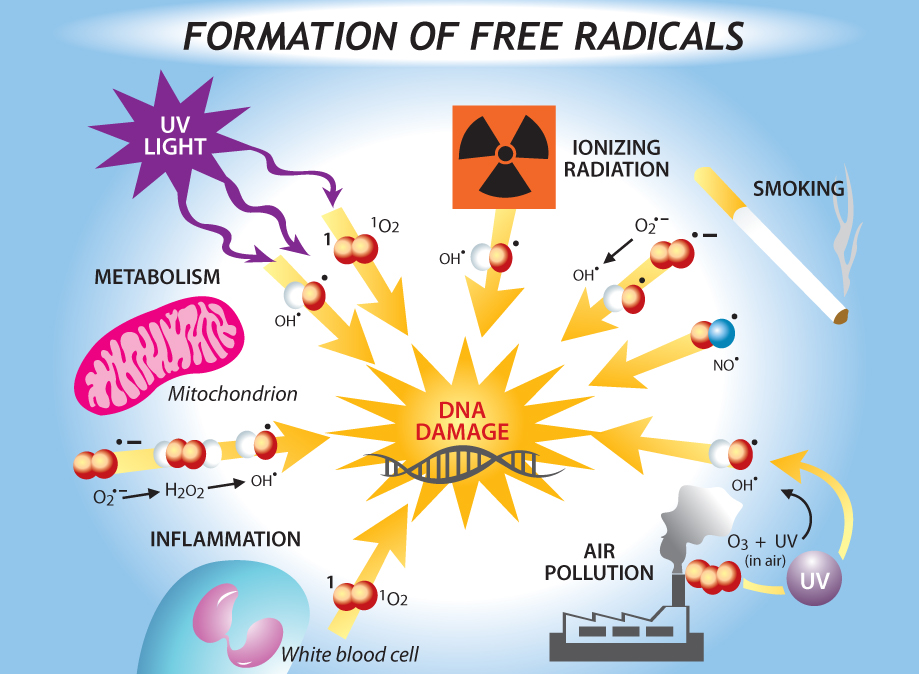
Studies showed that various forms of DNA damage commonly trigger cellular senescence. Consider the damage that we do to our cells through poor diet, alcohol, or smoking. Then, consider environmental factors like air pollution, exposure to radiation, or other toxins. Even the rays of the sun can damage our cells.
The image on the right shows a variety of sources of DNA damage. [Image source: http://churchandstate.org.uk/2013/02/the-first-person-to-live-to-150-has-already-been-born/]
The Free Radical Theory (click the link to dig deeper) explores molecules in the body that are highly reactive. They are the byproducts of our normal metabolism as we turn food into fuel. (Hekimi S, Lapointe J, Wen Y. 2011) These byproducts, called "reactive oxygen species (ROS)," include superoxide anion, hydrogen peroxide, and nitric oxide, and we believe they result in DNA damage. What damage? Researchers believe that ROS increases disease mechanisms for Alzheimer's disease, diabetes, cancer, and heart disease. (Gladyshev V. N., 2014)
The Cross Linkage Theory (click the link to dig deeper)- Cells are mostly made of proteins, and collagen is one of the most common. Collagen is what holds us together creating links that bind cells together. As we age, we create more links between cells, making us less flexible. According to the Cross Linkage Theory, the accumulation of these links can cause loss elasticity in our skin, our arteries, and even in our eyes, causing everything from wrinkles and hardening of arteries to cataracts. (Bjorksten J, Tenhu, 1990)
Telomere Theory (click the link to dig deeper) explores the nucleotide sequences at the end of our chromosomes that we believe protect our DNA. They lose a little of their length with every cell division. According to the Telomere Theory, the telomeres' loss may cause a cell to stop growing, or worse, to accumulate DNA damage instead of protecting against it. (López-Otín C, Blasco MA et al., 2013)
Telomeres are repeated nucleotides sequences on the end of chromosomes that are believed to protect the DNA strands and prevent them from fusing with other strands. Telomeres lose a little bit of their length during each cell division. Since replicative DNA polymerases are not able to replicate telomeres, and telomerase (specialized DNA polymerase that could replicate telomeres) are not expressed in normal mammalian somatic cells, telomeres become too short to replicate after a fixed number of cell divisions. Eventually, the cell will stop growing and enter cellular senescence. The image below illustrates the telomere shortening as cells divide.

[ Image source: http://www.wholehealthinsider.com/newsletter/2012/a-genetic-solution-to-slowing-aging-and-preventing-disease/]
Telomeres are particularly susceptible to the accumulation of DNA damage with age, and this damage at telomeres is restricted to be repaired because of shelterin, a multiprotein complex binding to the telomeres. Shelterin prevents the access of DNA repair proteins to the telomeres. Therefore, DNA damage at telomeres is persistent, inducing cellular senescence efficiently.


Admittedly, the Nutritional/Caloric Model Theory (click the link to dig deeper) is my least favorite theory, not because I disagree with it, but because I happen to love my food. We know that lean muscle mass is healthier for us and gives us the ability to live longer, and it is more beneficial than adipose (fatty) tissue. Research has shown that restricting daily caloric intake by 20-40% can extend life in rodents and yeast. One possible explanation is that caloric restriction reduced the production of reactive oxygen species (ROS) by mitochondria. Isn't that fascinating? (Sohal, R. S., & Forster, M. J., 2014)
(Source: UCSF.edu)
Immune Theory/Neuroendocrine Theory is based on the fact that aspects of our immune function deteriorate with age, leaving us vulnerable to many kinds of diseases, such as cancer. As age increases, we lose our capacity for immune reactions, and worse yet, our body's immune system starts attacking foreign proteins, bacteria, and viruses and producing antibodies against itself. (Bengston, et al., 2005)
((Source: Dr. Adonis Maiquez)
Our progressive inability to fight off diseases has led researchers to explore ways to improve our immune system through hormone therapy, specifically the hormone DHEA. Research on mice has demonstrated improvement with DHEA treatment, restoring youthful immune systems and ability to ward off diseases like Hepatitis B. (Trifunovic et al., 2005). Tests done with testosterone have shown increased muscle mass and decreased susceptibility to anemia. (Park et al., 2011)
Werner Syndrome
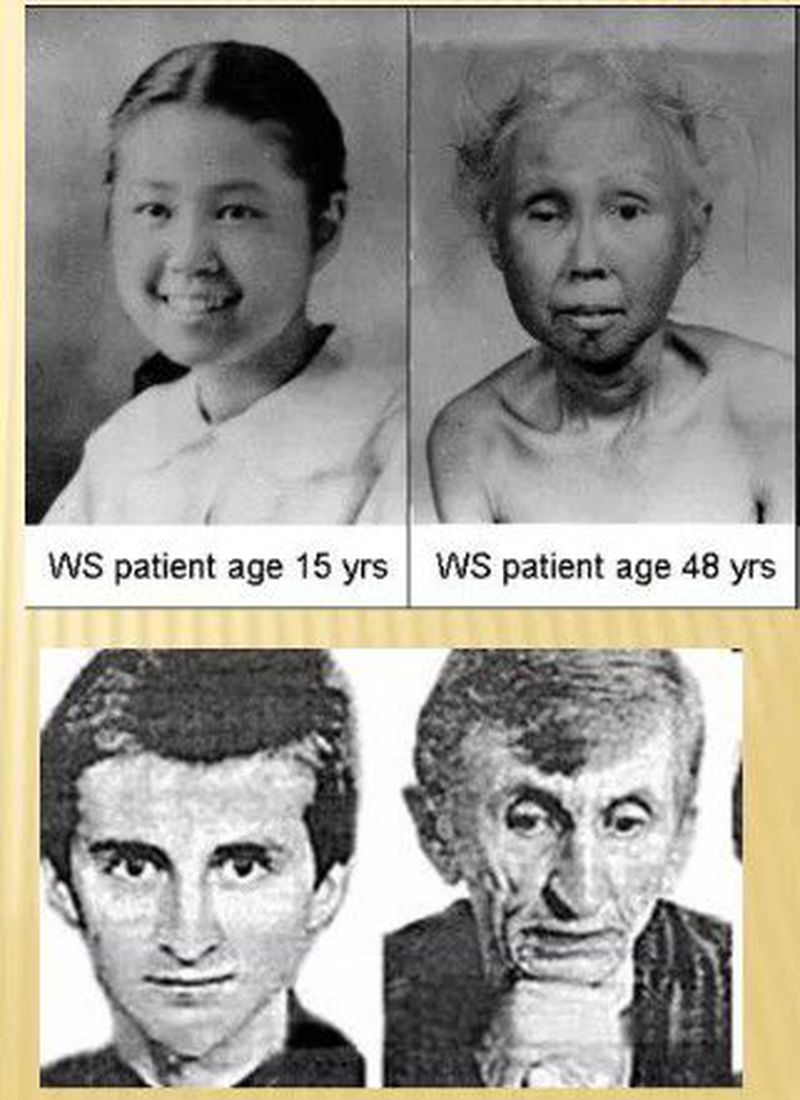
A rare, inherited disorder marked by rapid aging that begins in early adolescence or young adulthood and an increased risk of cancer. Signs and symptoms include shorter-than-average height, thinning and graying hair, skin changes, thin arms and legs, voice changes, and unusual facial features. What if the genetic factors that cause Werner's Syndrome could be studied in a way that helped us understand aging, and possibly prevent the degenerative changes that can accompany longevity? Given everything that you have just read in the lecture, consider whether this "new" theory of aging resonates with you. I'm still skeptical, but I'm always open to new learning!