✅ONLINE LECTURE: The Third Move
The Third Move - Long Term Care
As previously noted, over time, family members may become very fatigued and
As previously noted, over time, family members may become very fatigued and exhausted. The needs of the elders become more and more difficult for the caregiver. The caregiver must perform types of tasks that become harder and harder to accomplish, especially if the caregiver is also an older person.
The stress that the caregiver experiences is tremendous may lead to illness, anxiety, poor nutrition, or emotional problems. Following is a list of "red flags" that often signify that the caregiving burden is becoming more than the family members can handle and may result in the family realizing that the elder may need to be moved to a higher level of care.
When is it time to consider Long Term Care?
- Burdensome incontinence: Keeping the skin from breaking down when an older adult is incontinent is difficult. Caregivers can become exhausted from endless bed changes and laundry.
- Too much heavy lifting: The caregiver, who is often the wife or a daughter, is unable to lift and transfer the person safely due to her size and strength. Hiring help is not usually an option because of cost. R.N.'s can be up to $45 per hour and aids $14 - $15.
- The caregiver is sleep-deprived: Most caregivers are disturbed on a nightly basis, and the toll on the body can be extreme. This leads to more progressive exhaustion.
- The caregiver becomes ill or injured: If our caregiver becomes sick or injured, they may compound the issue by continuing to provide care.
- Other stresses impinging on the care: The pressures of normal life continue whether we are caregiving for an older adult or not. If the caregiver has personal stress - divorce, illness, or problems with employment or dependent children, this can add stress to an otherwise stressful situation.
- (Taking Care of Aging Family Members, (1994), Lustbader, W and Hooyman, N. The Free Press, New York / New York.)
When it becomes necessary to move into a living arrangement that provides increased levels of assistance and care, it is important that we understand the range of options. It is always best to place our older adults in environments that allow them to function at their highest possible level.
Let's take a look at the spectrum of long-term care alternatives that are available in the United States. Each has its own specific structure, pricing, requirements, and expectations.
Assisted Living/Residential Care Facility for the Elderly (RCFE)
If an older person cannot live on their own, and family care is not an option, YET they are not ready for a skilled-nursing level of care, there is a mid-point option. Unfortunately, it is not covered by Medicare or other healthcare providers - except for some long term care insurance coverage, which is rare. It's not an inexpensive option, but it is an option.
Often a residential care facility is a private home or a home purchased for the intended use of providing care for the elderly. A license to run a residential care facility is rather easy to obtain ( a few weeks of training and an examination). RCFE's have become a popular alternative to institutional care for people who can afford to pay for the care. Another term for RCFE is Assisted Living.

As of this date, there are no Medicaid or Medicare funds to pay for these facilities. However, there is a demonstration project in California for a Medical waiver, and there may be more in the future because they are a less costly alternative for the elderly in nursing homes who do not need nursing care. Many long-term-care insurance policies cover the costs of assisted living. Costs range from just under $1000.00 to several thousand dollars per month, depending on the standard of care provided. Some are elaborate homes with pools and hot tubs, while others are simple living quarters. (aging.ca.gov/2020)
RCFE's usually have a live-in staff person. These facilities are designed for adults who:
- don't need constant medical care, but who can not live alone
- are semi-independent physically and mentally
- are frail and need frequent assistance with ADL and IADL's
- need some health care monitoring or assistance with medications
- can not maintain their own homes and need transportation
Many think that RCFE's are a good middle ground between living in one's own home and skilled nursing. This may be an important concept to control the high cost of institutionalization in the future.
RCFEs are provided in both small and large format, the smallest of which are one or two beds in a home, the largest of which can have hundreds of residents. The goal is to create non-institutionalized, home-like settings and promote both dignity and independence for the resident, and a welcoming place for the family to visit and become a part of the community.
How are RCFEs Regulated?
In California, RCFEs are licensed by the Department of Social Services and regulated under the laws and rules set for by California Title 22. RCFEs must "promote resident independence and self-direction to the greatest extent possible in a residential, non-medical setting." (California Title 22, Division 6)
The need for these types of facilities has led to a booming market attracting big corporations like Hyatt Corporation, Marriott International Hotels, and Del Webb Corp building assisted care facilities. In fact, Hyatt operates approximately 3,300 units of senior housing in 16 communities around the country and is estimated to be worth $500 million. Assisted Care is becoming a very big business and continues to be in high demand. In fact, the Eldercare market, which includes all goods and services, was $86 billion in 1996, expected to be $490 billion by 2030. (aging.ca.gov/2020)
There are 32 states that permit limited Medicaid funding for assisted care, but so far, California has not allowed such a program.
One incredible upside of assisted-living is that facilities are able to adapt and accommodate the special needs of their clientele. One of the most common changes that I see is a move toward dementia-specific facilities. Because of the nature of the funding, there seems to be far more flexibility in innovation and design.
Please watch the video:
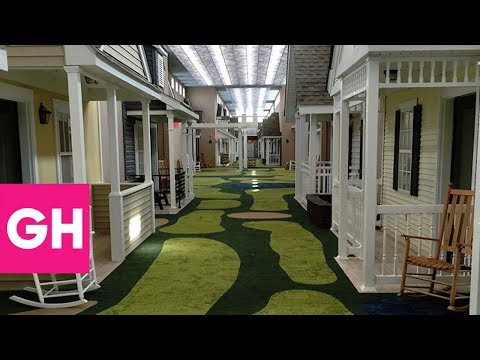
(Source: Good Housekeeping)
Continuum of Care Retirement Community (CCRC)
These centers take care of elderly people from the time they move into an independent living apartment through their death. A CCRC provides step-down units that increase the levels of care as needed.
There are typically three different levels of care:
Independent living; usually an apartment with a small kitchen. Meals are provided either in a community dining room, or the elder may cook simple menus in his/her room.
Assisted Living Centers where meals, medications, and ADL assistance is provided usually in a single private or semi-private room.
Skilled Nursing - 24hr institutionalized care that involves the skills of a registered nurse.
Upon admission to the CCRC, the elder must be able to live independently. For that reason, careful planning is required to know when to move into a CCRC before fragility becomes an issue. As a person becomes less independent, services are added, and the level of care increases.
There is usually an entrance fee plus monthly rent. Most require an elder to have long-term care insurance or other means of paying for custodial care.
Because of the three distinctly different types of housing included in one facility, the licensing is very complex. Costs can be quite prohibitive, leaving many people out of the potential resident pool. In California, there are only 102 CCRCs, serving 25,000 residents. 72% are non-profits, and only 15% offer "life care contracts." A lifecare contract covers all care for a standard monthly fee, and guarantees care for life, even if the resident's funds become inadequate to cover the full cost of future services and care. There has been a dramatic decrease in lifecare contracts due to high and unpredictable healthcare costs and rapidly extending longevity.
Please watch the video:

Skilled Nursing Care
As functional ability declines, elders typically make a second move to the suburbs or city to be closer to family or children and to be closer to hospitals and services. Ties to familiar neighborhoods and dependence on children are often motivating factors. If an elder has been even lightly confused, the confusion may increase when relocated. For this reason, consider all possibilities before relocating a confused older adult.
A third move is typically made into a higher level of care or Long-Term Care (LTC) as health deteriorates and frailty increases. Types of long-term care are discussed below.
Perhaps the most dreaded thought, for many seniors, is living in a nursing home. There is an image of uncaring family members dumping unhappy parents, so they don't have to care for them. This is not true. Most elderly stay only briefly until they recover and go home. Forty-three percent (43%) will use a SNF at some point in their lives, yet just five percent (5%) live there permanently. (cms.gov/2020)
Some are hospital-based, but these are not permanent residences and provide medical, rehabilitative care only. Remember, Medicare is limited to restorative care for a maximum of 100 days. The cost for a full-time resident can be more than $300 per day - or more if there are extensive medical needs.
"The term skilled-nursing refers to any facility that supplies some degree of nursing care. 80% are commercial, for-profit in the U.S. They can offer skilled nursing care (24-hour nursing care), intermediate care (as needed) nursing care), extended care (rehabilitation services), and custodial care (assistance with personal needs that can be provided by those without medical training)". (Moody, Harry: Aging Concepts and Controversies, 4th ed.) The cost of a year in a nursing home can exceed $100,000. Few individuals can afford this from their own resources for any length of time. Within a year of entering a nursing home as self-payers, 90% are impoverished.
Skilled nursing homes are the type of facilities that were called convalescent homes or the "old folk's homes." This level of care is licensed and regulated by the Department of Health Services. SNF's are required to have licensed personnel, including certified nursing assistants (CNA's), LVN's and R.N.'s. Physical, occupational, and speech therapists are also part of the staff. An activity director manages the daily activity schedule.
Patients who enter SNF's are usually medically frail and need skilled care. They may also be rehabilitation patients who are receiving therapy for an acute medical problem (like a fractured hip) and plan to return home. More often, patients in a skilled nursing setting have difficulty with ambulation, managing their own medications and may have higher-skilled needs, including a feeding tube, catheter, tracheotomy, daily injections, or have a decubitus (bed sores).
Approximately 50% of patients in SNF's have some form of dementia, and over 60% have other mental illnesses.(Moody, 2006
"About 5% of the elderly population resides in nursing homes. However, there is a 40% chance that a person over 65 will spend some time in a nursing home before they die.— 32% of those in nursing homes stay less than one month, many will return home. There is a five-percent fallacy, which is the mistaken idea that nursing homes are not important for older people. They are important to the 5 % of those over 65 are likely to need nursing home care" (Moody, 2006)

Elders refer to SNF's as "God's Little Waiting Room" and their fear is that they will be admitted to a nursing home and left to die there. In reality, some nursing home patients are quite content and are very involved in the activities, and have strong family support. A committed and capable staff can improve the quality of life and make a real difference in the experience of a patient who enters a skilled nursing facility.
Innovation in Action
There are some great programs that are challenging the traditional model. Just in San Francisco, On-Loc has been piloting projects of Medicare for many years. Clients assign their Medicare payment to the program in exchange for ongoing, managed care.

(Source: OnLok)
And once we’re there - who is watching out for us?
We will be examining the Omnibus Reconciliation Act of 1987 later in the semester. What's important for you to know right now is that OBRA has mechanisms in place to protect our older adults. OBRA -Omnibus Reconciliation Act of 1987
OBRA helped clean up the image of nursing homes. Some still question if the law was adequate. The nursing home industry is one of the most tightly regulated industries, yet society still is not satisfied with its services. OBRA provided for tighter licensing requirements.
- Nursing homes now must have a licensed long-term-care administrator who oversees the operation. This license requires either a Master's degree or several years of hands-on experience in the field.
- Patients have the right to visitors, knowledge about their care, resident council, and other controls.
- Specialized care plans are required for each patient must have a care plan that is followed by every staff member.
- Certified Nursing Aides are required to be certified and trained.
- Annual unscheduled on-site audits.
- Patients may be restrained ONLY with orders from a physician.
Ombudsman Programs are independent, federally and state-mandated non-profit agencies who train representatives to advocate for the needs and welfare of long-term care residents. Volunteers investigate complaints or claims of abuse or neglect. If they find the complaint to be valid, they file a formal complaint with the appropriate agency. Obmudsman programs are vital for the welfare of the resident who may not be able to self advocate.
Please watch the video:
(Source: Texas Department of Aging and Disability Services)