✅ONLINE LECTURE: Loss and Grief
On any given day, we can turn on the television and see death. It appears in our news, our television, and our video game entertainment. However, does this kind of exposure prepare us for first-person loss and death? This chapter will address the fact that despite being bombarded by images of Hollywood death, we are essentially a death-denying society. We do not want to talk about it. We do not want to be around it. Yet, if we are experiencing the loss of a loved one or even our terminal diagnosis, how will we know if our grief and sadness are normal? Have we removed death so far from our daily lives that we don't know what to do in times of loss? Let's explore.
Imagine being told you just got fired. First, your reaction is, "this can't be happening to me." Followed by, "you stupid people!" Often, we then go into "well, I didn't like the job anyway." Followed by, "if I do a bit more training, I can get a better job." Finally, we may accept that it was perhaps, a confluence of faults, and it is best to move on. Apply the same process to having a car broken into; a girlfriend/boyfriend breaks your heart or the news that you or a loved one has a terminal disease. It applies.
In life, we all experience losses. Some of our losses are more significant than others, but they all have an impact. We have to be careful not to compare losses because each of us experiences them in our own way. Loss of job, loss of home, divorce, death of a child, death of parent or spouse -it's all very personal. For most of us, loss through death is the most profound - because they are the most absolute. Depending on your perspective, death may represent the end. For others, it is perceived as the beginning of the next adventure. It really depends on your point of view.
Let's take some time to examine what we know about the loss & grief cycle.
Please watch the video:

(Source: Transform Grief)
Kubler Ross Stages of Death and Dying
In 1969, a Swiss-American psychiatrist named Elizabeth Kübler-Ross wrote in her book “On Death and Dying” that grief could be divided into five stages. Her observations came from years of working with terminally ill individuals. Her theory of grief became known as the Kübler-Ross model. While it was originally devised for people who were ill, these stages of grief have been adapted for other experiences with loss, too. The five stages of grief may be the most widely known, but it’s far from the only popular stages of grief theory.
- Denial -"No, not me" By denying a death sentence, the person creates a buffer around facing their death. This often provides temporary relief.
- Anger -" Why me?" This reaction can create a situation where the person does not take personally the fact they are dying. "It just isn't fair, I always get the short end of the stick".
- Bargaining- "Yes but..." The person may be bargaining for time. If I live right or eat right, perhaps I will live until some special event or time.
- Depression- "Nothing matters." At this stage, there is a great sense of loss and preparatory grief for losing it all. The person could be silent in their realized sorrow.
- Acceptance -"Yes", is a stage that is almost void of feelings.
We need not go through these stages in any particular order and may leave one level only to return to it at a later time. This is a framework to understand what is happening. A way to understand the experience, and not a developmental stage process. Reactions may ebb and flow.
In terms of death and dying Kubler-Ross found that hope is an important element in the dying process. Not only for recovery, but for relief of pain, resolution with loved ones, and in making the last bit of life more meaningful and valuable. She called this part "dying well." (Kubler-Ross, 2009)
The Living-Dying Interval Model
Living-Dying Interval Model is an alternative reaction to a crisis. It is not based on a progression because proponents say there is no right way to die. The task is to keep living while making the dying process as painless as possible. This model consists of three phases:
- Acute Crisis Phase: This is the realization of the possibility or inevitability of dying and is marked by high anxiety when the unknown is the greatest.
- Living-Dying Phase: During this phase, the focus is on specific fears and life management. How will I pay off the house before I die? Who will care for my loved ones when I am gone?
- Terminal Phase-This encompasses the task of letting go. Survival becomes not worth the struggle. (Copp, 1998)
The Four Tasks of Mourning
The Four Tasks of Mourning model centers around the idea that there are four tasks that we must complete during the processing of loss. These tasks are achieved in no particular order, and that grief is not linear.
- Task 1 - To accept the reality of the loss - for some this can come in the ritual of a funeral, for others the process is completed more covertly as we come to terms with the way our loved one died, and the significance of the loss.
- Task 2 - To work through the pain and grief - each of us will process our sadness, fear, loneliness, hopelessness, anger, guilt, shame and a myriad of other emotions. Most important is that we not deny having these emotions, and open ourselves to recognizing that we are experiencing them.
- Task 3 - To adjust to an environment in which the deceased is missing - much of this will depend on what our living environment was like prior to the death. For the adult child who has not lived at home for many years, the loss of a parent will be experienced differently to that of the spouse who has cohabited for decades.
- Task 4- To find an enduring connection with the deceased while embarking on a new life - how do we find meaning in a life without our loved one without guilt or fear of forgetting? According to Worden, the task is not to forget, but to figure out a way to keep living. ( (Worden, 2011)
Processing the End of Life
The study of geropsychology lends insight to how older adults process end of life. Both Erik Erikson and Robert Butler described a process of life review called reminiscence. As we review our lives, and take stock of the stories, tragedies and successes, we have a chance to examine and come to terms. This opportunity to bring significance to our existence can bring a level of peace and acceptance to the end of life. For those who are caring for a dying person, the act of listening and engaging in the process can be a beautiful gift both for the person sharing the stories, and for the person who is hearing them. (Butler, 1963; Erikson, 1981)
Fear of Death
In our conversation about loss and grief, we need to acknowledge that our experiences around death will help shape our attitude towards it. It is normal to fear the death or loss of a loved one. We love them, and we don't want to be without them. That's human. Sometimes, though, our fears can be exaggerated to the point of emotional paralysis. Let's assign some terminology to help us see the difference. Fear of death is a normal reluctance or apprehension about death, usually around a specifically identifiable source. Death anxiety, on the other hand, is a generalized fear that comes from an unidentified source and can lead us to limit our emotional attachments or physical pursuits. Someone with death competency is someone who understands death and demonstrates capability and skill in dealing with end-of-life issues.

Grief
Grief is a normal and necessary response to loss. When the loss is that of a loved one, it becomes the process by which we transfer a relationship into a memory in order to continue with life. Grief needs to be worked through, not avoided so that the bereaved continue with life. Grief is an emotion, not a simple one, but a natural one. A natural response to all loss. (Bugen, 1977)
Every culture develops ways to deal with death and grief. Rites or ritual ceremonies to mark death are ways to express strong emotions and draw strength from the community.
In our culture, death used to occur at home, forcing the entire family to become involved with preparing the body, sitting up all night with the body, digging the grave. Draping of black crepe and an extended period of mourning may seem brutal or senseless to us, but they forced people to face the reality of death and provided a social framework within which to work through grief.
Technology has removed illness and death from our view. Death now occurs in hospitals or convalescent homes, managed by medical personnel and funeral home employees.
Funeral practices reinforce the unreality of death by using makeup, artificial grass, immediate disposal of the body, sedating family members, or sometimes having no funeral or no viewing. Whatever the mourning practice, it should facilitate the fullest possible outpouring of grief together with the opportunity for the family and community to re-knit and continue.
Grief work begins with acceptance. Facing up to reality, not only intellectually, but emotionally. It takes time to work through the pain and hurt. Don't try to take the pain away from the bereaved. Delayed grief is worse.
Symptoms of normal grief that may be present include:
- Tightness of the throat, choking sensations, shortness of breath, need for frequent sighing, headaches
- Empty feelings in the abdomen, upset stomach, constipation or diarrhea
- Muscle weakness, fatigue
- Chills, tremors, excessive perspiration, dizziness
- Insomnia, loss of appetite, or overeating
- Depression, despondency, crying, shock, and disbelief
One common intellectual reaction to grief is idealization. (Hill, 2019) Ideation is an attempt to purify the deceased's memory by mentally diminishing that person's negative characteristics. If this idealization continues, it can prevent the formation of new intimate friendships or relationships.
No particular survivor will necessarily experience all of these symptoms and /or behaviors, nor must all be present if grief is to be considered "normal."
Please watch the video:
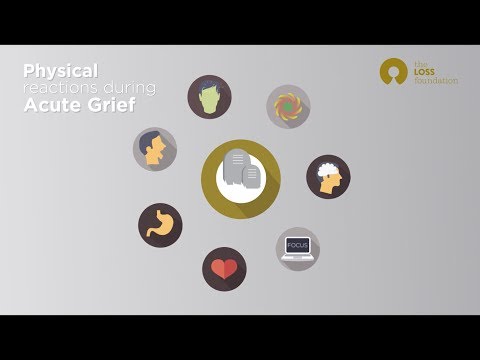
(Source: The Loss Foundation)
Grief and bereavement are a normal part of the reaction to loss. Please take a moment to visit "Grief and Bereavement," an excellent site offered by the State of Maryland Mental Health Division.
Bereavement and Mourning
As you have already learned, the grief process is hugely emotional, very personal, and depends on circumstance and culture. Bereavement and mourning are the socially dictated expressions of that grief.
In some cultures, the expression of mourning takes place over a specific number of days. In other cultures, it's a color that you wear, traditionally black. In the United States, there is a cultural time limit on mourning. Regardless of who has died in our family, most employers give a standard three days of paid time off for bereavement.
Expressions of mourning, bereavement, and grief can be highly personal. I talk with friends who have recently experienced a parent's death, and they express a sense of numbness or a sense of something being missing. (Sanders, 1989). A part of them is gone.
It's not uncommon to have disorganized thinking or feel the need to clean house to control our environment.
I see mourners who speak of grief very intellectually – that's me – I do my grieving with words, and sometimes it comes off very cold and uncaring, but it's my way of processing. I also see people who are feelers – where they experience that emotion of grief on a physical level. It could be completely overwhelming and devastating. Both are perfectly acceptable. However, one may make the other feel uncomfortable, and it can be the root of the conflict.
We use the terms loss, grief, and bereavement. They are three distinctly different things. Read through the following for a thorough exploration of the three concepts and how they influence the coping process. "Loss, Grief and Bereavement," (MedicineNet)
How Do We Grieve?
Do women experience grief and loss differently from men? Well, yes and no. As you have learned throughout the lecture, death and dying touch us all. Women, however, tend to outlive men and therefore experience a higher rate of loss.Although we all experience grief differently, it is important to understand that there are also essential differences in the way males and females grieve. Our gender impacts our experience of grief, our expression of grief, and others' perceptions of our grief. Males and females often react to loss differently and therefore have different needs in times of grief. Many biological and social influences contribute to the differences between men and women. These influences can lead to men and women having different needs, wants, and expectations that we find our relationships struggling when we need each other most. By gaining a greater understanding of these differences, we may find there is less conflict in our relationships, and we are better able to support and be supported in times of loss and grief.
Being male or female is not a clear dichotomy. Most men and women have a mix of masculine and feminine qualities. The important issue is not how masculine or feminine we are but how these qualities influence our experience of grief and affect those around us. Armed with this understanding, we can develop more fulfilling relationships in our daily lives and during times of grief.
Gender, culture, and initial temperament all influence how we grieve. There are three basic patterns of grief: (Martin & Doka, 1999)
Intuitive Grievers experience grief at a deep emotional level - they cry and shout and overtly express their grief.
Instrumental Grievers experience grief more covertly. They report grief as thoughts and express them in physical behaviors. They express their grief by "doing." For example, in one case, a man whose daughter died in a car crash found great solace in repairing the fence his daughter had wrecked. "It was," he shared later, "the only part of the accident I could fix" (Martin & Doka, 1999). Instrumental grievers use strategies such as 'bibliotherapy' (the use of self-help literature) and other interventions that use cognitive and active approaches.
Dissonant grievers are a mix of both the instrumental and intuitive griever. They may feel the loss intuitively but not be in a social role that allows expression of grief in the form of strong emotions. For example, a man might experience grief intuitively but feel constrained from expressing or adapting to grief in that way because he perceives it as contrary to his male role. Similarly, a woman might also experience grief more intuitively but believe she has to repress that feeling to protect her family. (Martin & Doka, 1999)
| Intuitive Griever | Instrumental Griever |
|---|---|
| FEELINGS are intensely experienced | THINKING is predominant to feeling as an experience; feelings are less intense. There is a general reluctance to talk specifically about feelings. |
| Expressions such as crying and suffering mirror the inner experience | Mastery of oneself & the environment are most important |
| Successful adaptive strategies facilitate the experience and expression of feelings | Problem-solving as a strategy enables mastery of feelings & control of the environment in creating the new normal |
| Prolonged periods of confusion, inability to concentrate, disorganization & disorientation | Brief period of cognitive dysfunction are common - confusion fogetfulness, obsessiveness |
| Physical Exhaustion & anxiety may result | Energy levels are enhanced, and symptoms of engeral grief reactions to the loss go unnoticed. |
There is no "correct way" to grieve, and we each have our ways to process loss. Some individuals have never dealt with a significant death, so the way they grieve and adapt to loss is unfamiliar to them. Patience is important; support and encouragement for where the individual is at any particular time after the loss is key to effective support.
Personality and style are also important- some people are simply less verbal than others; others think through things before reacting. Some go right into a task and take control of a situation, while others react emotionally first, then gather themselves for action. Both genders may represent this blended pattern.
Please take a moment to visit this "guest lecture" on Emotions and Death, developed by Professor Stacey Cooper, used by permission. It does an amazing job of introducing us to the range of emotions that come with death across the lifecourse. Be sure to read the entire article, and be prepared to share your thoughts in the knowledge check. Click here to enter, "Emotions Related to Death."
Gender and Coping Style

There can be gender conflict between the need to talk and the need to do. It is all a part of the grief process, and I want you to be able to extend it beyond the loss of a loved one. When I think about how people feel around major political movements, major tragedies, we all experience that same grief condition. The mourning process is a cultural mechanism that gives us time to recognize and accept losses, react and experience the loss, and process it. Sometimes it is through retelling stories, letting go of all the attachments, decorating, meeting new people, or even spending time on social media.
While it is a normal part of the life course, a parent's death can be profoundly upsetting. Most people will lose one or more of their parents when they're in their 50s. We know that sons and daughters respond differently to the death of a parent's gender. Losing a mother is reported to be far more upsetting than losing a father.
The most profound death in late life is that of a spouse. We know that the older we get, statistically, the more likely we are to be widowed. Think back to when we talked about the economy of old age. Think about the fact that women in widowhood face increased legal difficulties, reduced finance, and the simple reality that there are few were potential partners than when they were young. Men wouldn't experience the same economic disadvantages if they were the primary breadwinner. Because they were often away from home, they have not learned how to manage their household and how to do all of those things their spouse did while they were at work. These men report having far more difficulty adjusting to the more domestic tasks and report being lonelier than their female counterparts.
The Widow Effect
There is an interesting phenomenon called "the widow effect." There is actually a three-month marker following a spouse's death, where it is not uncommon to see the surviving spouse die. There won't of been anything wrong with them. We used to call it broken heart syndrome. It is, actually, possible, and plausible that part of what keeps us alive is the love of our spouses. And when that life partner passes, our spirit goes. It could also have to do with the incredible physiological strain that caregiving causes. When we talk about the widowhood effect, many doctors will see the caregiver has spent so much time caregiving that they won't have done any sort of self-care. So, whatever underlying condition they were dealing with will manifest itself in spades after they are no longer functioning at the high level of caregiving that they were before.

(Source: Ottowa Citizen)
It makes sense if you think about it. Consider you during the semester. I work hard during the semester, and I am guaranteed to come down with whatever cold or flu hits right about winter break and the first few summer weeks. It's like my body knows I've done everything that I'm supposed to do. Then, it decides to take over and crash.
When we talk about gender and grief behavior, we need to include culture into the conversation. While each of these factors influences how we experience death and grief, the combination of both gender and culture can pose specific challenges.
In some cultures, these norms can differ between genders. In a 1976 study, Paul Rosenblatt and his associates found that thirty-two had no differences in the expectation of crying between men and women in the sixty societies they surveyed. In the remaining twenty-eight, women were allowed more emotional expressiveness. Second, each culture defines relationships in different ways, which influences the level of attachment.
So we are different. Men and women do approach grief, death, and dying differently. So what. We sort of knew that already, didn't we? It's not that men feel griefless or experience a less intense range of emotions around the death and loss of a loved one. They just do it differently to women.
Women have the unfortunate advantage of being the majority of grievers. Therefore, more attention is paid to them, and family and community provide them with more services. When I entered a search for "women and grief" and "women and loss," I came up with millions of web resources for support services, information, and counseling. I did not find the same for men. Interesting that services are abundant for the gender that tends to self-support, and little available for the gender than internalizes and perhaps needs the intervention. Just thinking out loud...
I found one article that I really liked on grief recovery for women, read on: Grief Recovery for Women
Image Citations
Image courtesy of Pilot Brent under Pixabay License
Image courtesy of Deflyne under Pixabay License