✅ONLINE LECTURE: Funding Our Future
How do we fund our retirement?
Let's do a quick review of what we've learned so far, and add a few more money matters to the conversation. Click here to access a short review lecture, starring your instructor, revisiting some important information and introducing some new material to your financial literacy knowledge:

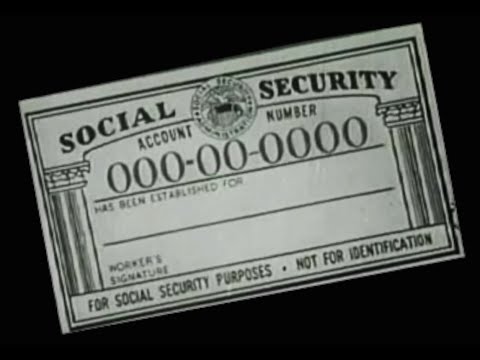
Meet Social Security - A National Safety Net
(Source: The Atlantic)
Social Security is social insurance. The program is designed so that people who are working to contribute to people who are not working. It is not a savings account for you. You work for your entitlement credits so that your income is helping to offset the Social Security payments for the 45 million people who are currently receiving it.
Before 1920, families took on the burden for nonworking children and older adults. Think about what life was like before 1920. Houses were not all electrified. We didn't have cars. After the stock market crashed, we had massive unemployment and massive national malnutrition. We had to do something.
In 1932, Roosevelt proposed his social welfare program. By 1935, the Federal Government had passed the Social Security Act. It was considered a slippery slope into socialism at the time. However, it was designed so that those of us who are working would help offset those people who needed our help.
The dependency ratio is the calculation that is used to measure the number of contributors to recipients in the social security system. When Social Security began, 18 workers to every retiree were receiving benefits. Those benefits were intended to provide a "security" income for food and shelter. The very first Social Security check was issued to Ida May Fuller of Ludlow, Vermont in the amount of $22.54. (ssa.gov)
In 2018, there were 4 workers to every one retiree receiving benefits, with an average payment in the amount of $1409.01 per month, or $16,919 per year - only $4000 above the national poverty line. It is anticipated that by 2038 there will be 35 retirees to every 100 workers. (ssa.gov)
The post World War II economy boomed, and Social Security contributions increased as wages increased. We saw poverty rates drop, and honestly, I think we all got a little lazy. I know that if someone else is taking money out of my paycheck, and I will ultimately get it back, and I don't have to think about it, I don't have to worry about saving. I can just spend what I earn. And spending is precisely what most of us do. We spend our paychecks. We are not great at saving on our own.
Did Social Security Help in 1935?
The financial status of the elderly improved with the advent of Social Security (1935) and later post World War II pension programs. Most historians agree that the war, not Social Security, got the U. S. out of the depression. Still, many credit Roosevelt's new programs.
America was experiencing a huge pent-up demand for products after WWII. The country had been at war, and families had not been growing. Production of new homes, cars, electric appliances, and other goods that drive the American economy had been at a standstill.
When the war ended and the men came home, a baby boom occurred along with demand for the products that growing families need. A strong economy created higher prices and, thus, the devaluation of Social Security benefits (remember, when inflation goes up, the value of money goes down because it costs more for the same goods). There was a stark contrast between the working class's affluent society (who had unions, pensions, and benefits and could buy the first suburban homes, T.V.'s, and washing machines) and the income problems of older people. Again, there was rising poverty among the elderly. Almost a quarter of the elderly were still in poverty, and that number was increasing rapidly as the economic growth and earnings of the 1950s continued. Inflation continued to devalue the amount that Social Security benefits paid to retirees.
Because the economy was strong, Congress began periodically revising Social Security benefits upward to compensate for inflation. NOTE: when the economy is strong, the Government collects more taxes and has more money to spend.
Beginning in the 1970s, indexing or increasing Social Security payments to match the cost of living increases (the cost of a market basket of goods) was instituted without any increase in payroll taxes. These increases were called "Cost of Living Adjustments "or COLA. As a result, between 1950 & 1991, the poverty rate among the elderly dropped from over 52% to just 11%. (Meyer, 2018)
Although never intended to be the sole source of retirement income, for more than 50% of the elderly, Social Security is their sole income source. (SSA.Gov, 2020)
How Does Social Security Work?

I want you to think back to your first job. You pulled out that first paycheck and probably screamed, "Who the heck is FICA, and why is it taking all of my money!" Well, allow me to introduce you to the Federal Insurance Contribution Act. The money that comes out of your paycheck under the FICA heading is taken directly out of your paycheck to pay older Americans their Social Security and Medicare benefits. It is mandatory.
There are four Social Security Trust Funds
- Old-Age and Survivors Insurance (OASI) - this is the program that provides check to retirees
- Disability Insurance
- Hospital Insurance Trust Fund ( Medicare Part A)
- Supplementary Medical Insurance (or Medicare Part B)
Old Age Security Income
You pay taxes (FICA) into Social Security (based on your earnings) when you work. When you retire or become disabled, you and your family members collect monthly benefits (based on your contributions). Thus the higher your wages, the higher your benefits. This is called Old Age Security Income (OASI)
Your portion of the payroll tax is 7.65% of your gross earnings (if you are not self-employed). Your employer matches that amount for a total of 15.3% of your gross earnings being paid into the Social Security Trust Fund. Of your 7.65%:
- 5.30% goes to retirement and survivor's benefits
- 1.45% goes to Medicare (the medical insurance program of Social Security)
- .09% goes to Disability Insurance
- Total: 7.65%
Each worker contributes 6.2% of their gross earnings (pre-tax income) up to the first $142,000 (up from $113,000 prior to 2020) you make yearly. Your employer matches it. If you are self-employed, you must pay both for a total of 12.4%. What do you get back? To be eligible for Social Security retirement benefits, a worker born after 1928 must have accumulated at least 40 quarters of work in "covered employment". A "quarter of coverage" generally means the three-month calendar quarter. You must also earn at least $1,410 in a quarter (in 2020) for it to count. (Cleaver, 2013)
How Much Does Social Security Help in 2020?
The United States average per capita income is just over $35,000. (And in California, that's $38,500) Take away 30% for taxes (federal income, federal state, local, sales), and we are left with just over $22,000 to spend annually - That's roughly $1900 a month. Out of that, you pay for housing, transportation, food, clothing, insurance, communication like phone/internet.
Let's revisit the fact that the average social security check is $1503 per month, or roughly $18,000 a year. California's poverty line, for example, is $12,760 for a household of one and $17,240 for a household of two.(hhs.gov, 2020). So, yes. It helps. It helps a LOT.
Where's My Money?
Social security earnings don't exist in tangible form until you get your first social security check and cash it! Up to that point, you are a number in a system that tracks your contributions and total earnings. Remember, the money is funneled directly to the current recipients, and we just cross our fingers that there will be enough workers to pay for our benefits when we get old enough to receive them.
When the time comes, most of us will get back our entire lifetime's worth of contributions within the first two years of retirement - maybe three if we assume a savings-bond rate of return on our investment. So, it's a really good deal, right?
Well, 91% of us who are eligible are currently receiving Social Security. For those born before 1960, benefits can start as early as 62, with full benefits starting at 65. Those of us "post-baby-boom" can get our full benefits at age 67. That's because, in 1983, Congress realized that if we were living longer, we could stay in the workforce longer and put less pressure on the Social Security system. Sorry!
Social Security as Income Replacement?
Social security was designed to bring people out of poverty. It was NOT designed to be our sole source of income in retirement. However, that is what it has become for many of us. How much are we talking about? Not a lot. In 2020, the average Social Security check is $1503, and the maximum possible benefit for anyone - regardless of pre-retirement income is $3,895 if retirement is postponed to age 70. (ssa.gov., 2020)
If you are married and do not qualify for your own social security, you are entitled to a social security payment equal to 50% of your spouse. So, if your spouse earns $1500, you would then be allotted an additional $750 to your household, bringing your total combined earnings to $1250. If you are widowed or divorced, you are also entitled to that 50% allotment (but not the full amount).
The Future of Social Security
Certainly, we have pulled more older adults out of abject poverty through Social Security programs. No one is living a lush life on Social Security, but 30% of our population of older adults rely on it as their sole source of income.
We need to be mindful that Social Security was put into place when we had far more workers than recipients. Remember that dependency ratio we talked about earlier in the semester? We expect by 2030, there will only be two workers for every one recipient. There is simply not going to be enough money in the system to make the system work. It is projected that Social Security can sustain for another 75 years, but we need to make adjustments.
Since 1983, the Social Security Trust Fund has operated on a "partially pre-funded" basis, meaning future benefits are anticipated and partially funded in advance.
The trust fund relies on a "pay as you go" basis. Taxes and benefits were adjusted so that there was no reserve accumulated. Under this system, the elderly were not supported by the payments they made into the fund but by younger workers' current taxes. Social Security was structured that way from the 1950 to-1970s.
When the baby boomers become eligible to receive benefits, there will be only two workers for every senior citizen collecting benefits, compared to a 15 to 1 ratio when the program first began - remember that pesky dependency ratio?
The U.S. Government has foreseen the impending crisis and has taken some measures to compensate. A Social Security "savings account" was created in 1983. The creation of "pre-funding" allows the fund to have a surplus. Taxes collected are more than the benefits paid out. Theoretically, the surplus is kept in reserve to fund the program when the workforce to benefit recipient ratio decreases.
This funding method, the Social Security system, shifts some of the retirement burden from future workers to the large currently-working group itself. Other steps (besides increasing the age of full retirement and pre-funding the program) to keep the fund solvent include a penalty for earnings over $9,000 when receiving benefits. The penalty structure looks like this:
- $1.00 for each $2. earned if under age 6
- $1.00 for each $3. earned if 65-6
- After age 70, there was no penalty.
President Clinton repealed this penalty tax to keep workers in the workforce longer and assist them in earning extra cash after retirement. It was anticipated that this would save the Government money because retirees would be more self-sufficient and not dependent on other Government programs. They would continue to pay employment taxes, adding to the social security fund.
So Why is the Program in Trouble?
The hope was that pre-funding the system would keep Social Security solvent for the next 75 years, but the predictions were not accurate.
Government borrowing resulting from large budget deficits outside of Social Security undermines this goal. The Federal Government has used Social Security funds to meet the Federal deficit. Also, the current economic situation (high unemployment rate) has forced many people to retire earlier than expected.
The outlook for Social Security depends on the growth of the economy. When the economy grows, workers earn more money and pay more taxes. More taxes mean more funds are available to retirees. It is unclear how the Pandemic of 2020 will affect the long term solvency of the Social Security Program. Even before the Pandemic, economists predicted the system would go bankrupt by 2029. (Borat, 2017)
However, Social Security will not go "bust" as we are being told by the prognosticators. What will happen is that by 2042 (if we follow the Social Security Trustee Office) or by 2052 (if we follow the Congressional Budget Office), the system will be unable to pay its current obligation in full. They will be able to meet 75-80%, which means that there will be some adjustments to how much retirees will receive, or possibly to the percentage of our paycheck we contribute to Social Security will need to go up.
According to Senator Bernie Sanders, the whole program is still the most successful the Government has ever established. The system will remain intact with only minor adjustments in the next 37 years. (Sanders)
If the current projections do hold and nothing is changed, the loss to someone 63 in 2042 would be about 27% cut from today's current numbers (that I see is not taking into account inflation). If that person lived to 100, he/she would have a 33% cut to his/her benefits, according to the 2004 Trustee report. Take a look: http://www.ssa.gov/.
Making Social Security Solvent
To fix this "at-risk" system, we either need more workers contributing to the system, have them pay more from their salaries into the system, or figure out how to have fewer retirees!
- Maybe we need to increase the age that we receive benefits.
- Maybe we need to increase the ceiling of tax liability from $142,000 to $500,000 - so everyone is paying more. I was only in 2021 that the ceiling was raised from $113,000 to $142,000. Beyond that, you aren't paying social security on any additional earnings, yet your benefits are calculated on your total earned wages. Shouldn't I be paying taxes into a system that I'm going to be more of a burden to because of my higher earnings?
- Should we make social security taxable? (Well, it is if you earn over a certain amount.).
- Should we eliminate or reduce the cost of living increases that are designed to keep up with inflation rates?
- Should we just give people that 6.2% of their earnings and let them be responsible for funding their retirements with it?
- More and more, I see arguments that social security should be needs-based, where we apply like Medicaid and show that we need the money to help keep us above the poverty line.

The difference between "making it," and "faking it" in retirement comes down to some pretty serious risk factors. Please take a moment to read this brief which reviews research by the U.S. Social Security Administration’s Retirement Research Consortium and others on the nature and extent of late-life financial risks. The brief is organized as follows. The first section explains how demographic and economic changes are leading to a larger population being susceptible to these risks. The second section explores the nature of the three risks outlined above. The final section concludes that out-of-pocket medical expenses, financial mistakes, and widowhood tend to severely impact the finances of only a minority of older Americans today, but that those threats may be more widespread in the future. "What Financial Risks Do Retirees Face in Late Life?" (Opens as PDF)
Conclusion
Social Security, one of the social programs that we refer to as an entitlement, has succeeded in preventing poverty for millions of older Americans. Women, minorities and those who live alone comprise 90 percent of the oldest poor, and Social Security and other social welfare programs make the difference to their survival. For the majority of Americans, with every paycheck, they contribute to both the current recipients of Social Security, but accumulate credit toward a future benefit for themselves. Social Security, however, replaces only 40 percent of most pre-retirement incomes. So in order to be prepared for later life, we must also make good financial planning decisions when we are younger. This philosophy of wealthspan development includes an awareness of cost of living, salary and savings, and an understanding retirement investment planning. We don't know the future of Social Security, but we can be pretty sure that there will be changes. The United States has made a commitment, since 1935, to provide for all of its citizens later in life, including those poor elders who are at risk. It may be necessary for those with greater financial resources to reduce or forgo their entitlement. It may be necessary to increase the contributions each of the working community makes to offset the increased need. Time will tell, but in the meantime it is vital that whenever we have the opportunity to actively engage in our future financial wellness, it is our obligation and in our best interest to do so.
As we wrap up this chapter, let's consider the planning that needs to go into financial wellness over the course of your life. Please take a moment to watch this quick video on Planning for Retirement Starting in Your 20's:

(Source: MissBeHelpful)