✅ONLINE LECTURE: Developmental Theories of Aging
Examining Aging Through The Prism of Psychology

(Source: Image courtesy of Gerd Altmann under Pixabay License)
The Life Course Perspective is used to explain the meaning (or lack of) in one's life. It is derived from the sum of all the decisions one has made from birth to death, the lifestyle choices chosen, and the emotional growth accomplished during the life course. It also involves the opportunities that we, as a society, have allowed people to participate in. If aging is changing, shouldn't the role of a healthy older person change too? We can only understand any stage of life by using this perspective because, as you have read, old age is no longer a clear-cut stage of life. When we transition through the rites of passage, as we reinforce our expected behavior.
For example, once you graduate from college (a rite of passage), your role in society will change. The behavior society expects from you will be different (like it or not). You have role models for what college graduates do next. Problems can occur when there are no previous role models or rites of passage in a development stage, as is happening in the world today as unprecedented numbers of folks move into the last third of life.
America is growing older, and today's elders are more educated and healthy than their parents, yet society has not yet decided how to integrate them. The way we grow old is not the same as it used to be, and not everyone grows old uniformly. What should the role be for older adults who can still work or contribute to society? If one-third of old age is spent in retirement, will future retired seniors follow the same pattern as their less educated and less healthy parents? Will society continue the mass-media stereotypes that see all older people as ill, demented, useless, and dependent on us for care?
Sigmund Freud - Psychosexual Stages of Development
The first developmental theory that we need to introduce came from Sigmund Freud. He believed that unconscious psychological forces, not human reason, affects our thoughts and behaviors throughout life. I'm sure you've heard the terms ID, EGO, and SUPEREGO - our base instincts, higher-order thinking, and the balance in the middle. I think of it as "the devil on one shoulder, an angel on the other, and me in the middle."
Freud's Psychosexual Stages of Development proposed that psychological development in childhood occurs during five psychosexual stages: oral, anal, phallic, latency, and genital. These are called psychosexual stages because each stage represents libido's fixation (roughly translated as sexual drives or instincts) on a different body area.
His research into the development of the human psyche over time established an entirely new perspective. We weren't born "as we are," but grew into our humanness. His psychoanalytic theory established how crucial early life experiences were on our development and influenced our behaviors around sex, creativity, aggression, empathy, and our inner motivations and instincts. (Freud,

(Source: Verywellmind.com)
Carl Jung - The Archetypes & Stages of Development

(Source: Medium.com)
Unlike Freud, Jung didn't break down human development into specific stages - rather, he used the sun's metaphor from rising to setting. According to Carl Jung, what prevents people from becoming autonomous, fulfilled, and ultimately happy is their refusal to open themselves to new and unfamiliar experiences, thus potentially threatening their sense of self.
Jung created some of the best-known psychological concepts, including the archetype, the collective unconscious and extraversion, and introversion. He argued that a balance between extraversion and introversion was necessary for a mature personality to develop and that over time, it was natural for an older person to move into an internal focus, or interiority where we focus on our inner mind, our dreams, and a world that exists only for ourselves.
Please read the following two articles on Jung.“The Four Stages of Life According to Jung" by Thomas Armstrong, and “The Four Major Jungian Archetypes, ” by Kendra Cherry.
If you want to have a bit of fun, take this quick "Archetypes" test to see your personality type according to Jungian standards: Jungian Archetype Test - Psychology Today. It's 35 questions, so not particularly rigorous or scientific, but I can tell you that my results from this mini-test match pretty darn closely with a much longer test that I took recently. My internal AND persona archetype? The Innocent Child.
Erik Erikson, 8-Stages of Adult Development

(Source: Verywellmind.com)
Erik Erikson was a student under Freud, but he saw things in a slightly different way. He maintained that personality develops in a predetermined order through eight stages of psychosocial development, from infancy to adulthood. (Erikson, 1966). During each stage, the person experiences a psychosocial crisis, which could positively or negatively affect personality development.
For Erikson, these "crises" are of a psychosocial nature because they involve the psychological needs of the individual (i.e., psycho) conflicting with the requirements of society (i.e., social). According to the theory, the successful completion of each stage results in a healthy personality and the acquisition of essential virtues. Necessary virtues are characteristic strengths which the ego can use to resolve subsequent crises. Failure to successfully complete a stage can result in a reduced ability to complete further stages and, therefore, a more unhealthy personality and sense of self. These stages, however, can be resolved successfully at a later time.
Please watch "The Stages of Adult Development" and come back to the discussion board to share your thoughts.
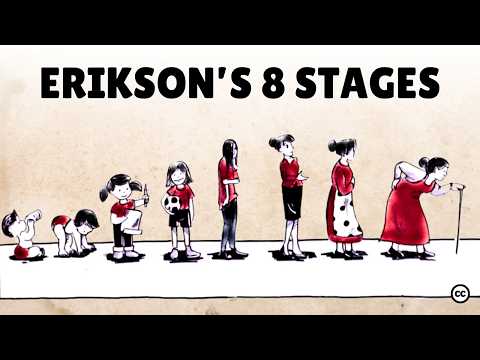
The first six stages of Erikson's developmental stages focus on what we need to do to have the highest level of life satisfaction in our later life before reaching middle adulthood. The final two center around life after age 40. We will talk more about "midlife" later in the semester, but for now, let's consider the period of middle adulthood as the time when we become more focused on our family, our community, and creating a legacy. This stage, 'generativity vs. stagnation,' is quite well described. During this period of our lives, our primary developmental task is to focus on what we can contribute rather than what we can gain.
The eighth stage examines later adulthood. This time, which, according to Erikson, comes any time after age 60, we hope to have passed into adulthood with a balance of ego resources. Our task becomes the integration of everything we have experienced in a way that brings meaning to our lives. This is the time for us to exist in a state of integrity or one of despair. Through life review or reminiscence, we come to terms with our lives, for better or worse, intending to die with a sense of peace and completion. (Hillier, 2015)
Erikson: Integrity vs. Despair
As a person grows older and enters into the retirement years, the pace of life and productivity tend to slow down, granting a person time for reflection upon their life. They may ask the existential question, “It is okay to have been me?” If someone sees themselves as having lived a successful life, they may see it as one filled with productivity, or according to Erik Erikson, integrity.
Here integrity is said to consist of the ability to look back on one’s life with a feeling of satisfaction, peace and gratitude for all that has been given and received. Erikson (1959/1980) notes in this regard:
“The possessor of integrity is ready to defend the dignity of his own lifestyle against all physical and economic treats. For he knows that an individual life is the accidental coincidence of but one life cycle within but one segment of history; and that for him all human integrity stands and falls with the one style of integrity of which he partakes.” (Erikson, 1959/1980, p. 104)
Thus, persons derive a sense of meaning (i.e., integrity) through careful review of how their lives have been lived (Krause, 2012). Ideally, however, integrity does not stop here, but rather continues to evolve into the virtue of wisdom. According to Erikson, this is the goal during this stage of life.
If a person see’s their life as unproductive, or feel that they did not accomplish their life goals, they may become dissatisfied with life and develop what Erikson calls despair, often leading to depression and hopelessness. This stage can occur out of the sequence when an individual feels they are near the end of their life (such as when receiving a terminal disease diagnosis).

Figure 1. Erikson emphasized the importance of integrity, and feeling a sense of accomplishment as an older person looks back on their life.
Erikson’s Ninth Stage
Erikson collaborate with his wife, Joan, through much of his work on psychosocial development. In the Erikson’s older years, they re-examined the eight stages and created additional thoughts about how development evolves during a person’s 80s and 90s. After Erik Erikson passed away in 1994, Joan published a chapter on the ninth stage of development, in which she proposed (from her own experiences and Erik’s notes) that older adults revisit the previous eight stages and deal with the previous conflicts in new ways, as they cope with the physical and social changes of growing old. In the first eight stages, all of the conflicts are presented in a syntonic-dystonic manner, meaning that the first term listed in the conflict is the positive, sought-after achievement and the second term is the less-desirable goal (ie. trust is more desirable than mistrust and integrity is more desirable than despair).[1] During the ninth stage, Erikson argues that the dystonic, or less desirable outcome, comes to take precedence again. For example, an older adult may become mistrustful (trust vs. mistrust), feel more guilt about not having the abilities to do what they once did (initiative vs. guilt), feel less competent compared with others (industry vs. inferiority) lose a sense of identity as they become dependent on others (identity vs. role confusion), become increasingly isolated (intimacy vs. isolation), feel that they have less to offer society (generativity vs. stagnation), or[2] The Erikson’s found that those who successfully come to terms with these changes and adjustments in later life make headway towards gerotrancendence, a term coined by gerontologist Lars Tornstam to represent a greater awareness of one’s own life and connection to the universe, increased ties to the past, and a positive, transcendent, perspective about life.
Jane Loevinger - Stages of Ego Development
Jane Loevinger believed that ego development emerged from our encounters with the world and how we make sense of our environment. Read the following article to learn more about her "Stages of Ego Development," and see if you can find where you fall in her process. Then, I challenge you to find a celebrity or politician and see if you can identify where THEY are in the nine stages of Ego Development!
Many theorists today see personality in terms of continuity or flexible adaptation over the life course. These theories are more optimistic than those that see old age as a time of loss resulting in either passive adjustment or dependency and depression. Today, most gerontologists believe that people bring positive resources to aging, including a personal sense of meaning. Empirical studies show that people generally cope well with the transitions of later life. When problems come, styles of coping tend to remain intact, and people adapt.
However, according to Loevinger, behavioral or psychological problems may emerge because of the difficulties in preparing for transitions without the help of widely observed rites of passage or institutional structures for older people.
A Hierarchy of Need - Abraham Maslow
(Source: Image courtesy or Factoryjoe under CC BY-SA 3.0)
What if you came to old age with role confusion and felt isolated and rejected? How might you respond to the challenges of old age with all this emotional baggage? What might your residents bring with them into a situation where they are suddenly out of their own home, not feeling their best, and relying on strangers for their wellbeing. You may find yourself with an older person who expresses strong emotions - sadness, loneliness, anger, or fear. What's going on? Maybe a glimpse at Maslow's Hierarchy of Need will help you make sense of the behaviors.
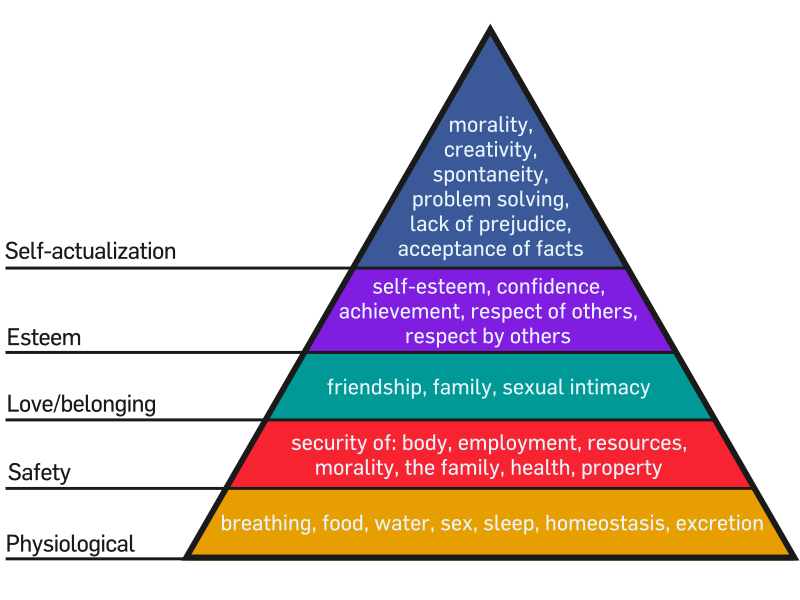
Maslow's Hierarchy of Needs is a theory by Abraham Maslow, which puts forward that people are motivated by five basic categories of needs: physiological, safety, love, esteem, and self-actualization.
- According to Maslow, we have five categories of needs: physiological, safety, love, esteem, and self-actualization.
- In this theory, higher needs in the hierarchy begin to emerge when people feel they have sufficiently satisfied the previous need.
Physiological
The first, and most important human need, according to Maslow, is basic physical needs, such as drinking when thirsty or eating when hungry. We are miserable when we do not adequately feed our bodies, we are cold or tired, or need to go to the bathroom. The worst is when we are in pain. If we can't get comfortable, how can we think about anything else?
Safety
Once we meet our physiological requirements, the next need that arises is a safe environment. Humans need safe and predictable environments and typically react with fear or anxiety without them. If I do not feel safe and secure in my environment, everything else is secondary. How can a caregiver make a senior feel safe and secure in a new and unfamiliar place? What extra steps might be useful? It could be something as simple as knowing where the call button (an alarm that rings at the nurse's station) or extra-large room numbers, so the resident knows where she is. I'm partial to the weighted blankets that not only keep me warm but give me a sense of being "nested" wherever I am. Think about what makes YOU feel safe!
Love and Belonging
According to Maslow, the next need in the hierarchy involves feeling loved and accepted. This need includes both romantic relationships as well as ties to friends and family members. It also includes our need to feel that we belong to a social group. Importantly, this need encompasses both feeling loved and feeling love towards others. A gentle word, or a touch of a hand, or the simple act of spending time with a senior can make the difference between a sense of being cared for and feeling alone and isolated.
Esteem
Our esteem needs involve the desire to feel good about ourselves. According to Maslow, esteem needs include two components. The first requires feeling self-confidence and feeling good about oneself. The second component involves feeling valued by others, feeling that other people have recognized our achievements and contributions. When people's esteem needs are met, they feel confident and see their contributions and achievements as valuable and essential.
Self-Actualization
Self-actualization refers to feeling fulfilled or feeling that we are living up to our potential. One unique feature of self-actualization is that it looks different for everyone. For one person, self-actualization might involve helping others; for another person, it might include achievements in an artistic or creative field. Essentially, self-actualization means feeling that we are doing what we think we are meant to do.
As you have seen, we currently have no consensus about how people are supposed to act when, in late life, they confront events that have traditionally been linked to younger ages. How are older widows supposed to go about dating? How much help should elderly parents expect from their children who are themselves at the point of retirement? When confronted with such questions, we realize that norms previously related to many of the later life transitions have shifted.