✅ONLINE LECTURE: A Little History of Aging and Politics
As the population over age 65 gets larger, so does the impact of this population have on our public policies, laws, rules and government funding allocations. It is vital to understand that there is no "age block" for voting, but while they are a widely diverse voting group, they are quite powerful by sheer volume. No group votes in greater numbers. No group takes greater care to study issues. We have an idea that it is the "old, white" population that makes the rules and sets policy, but in reality, the "old" has far less to do with voter trends. In fact, oftentimes it is the oldest voter who chooses issues based on the greatest benefit to the youngest! Let's explore a bit about the history of aging and politics.
Aging Policy...the Early Days
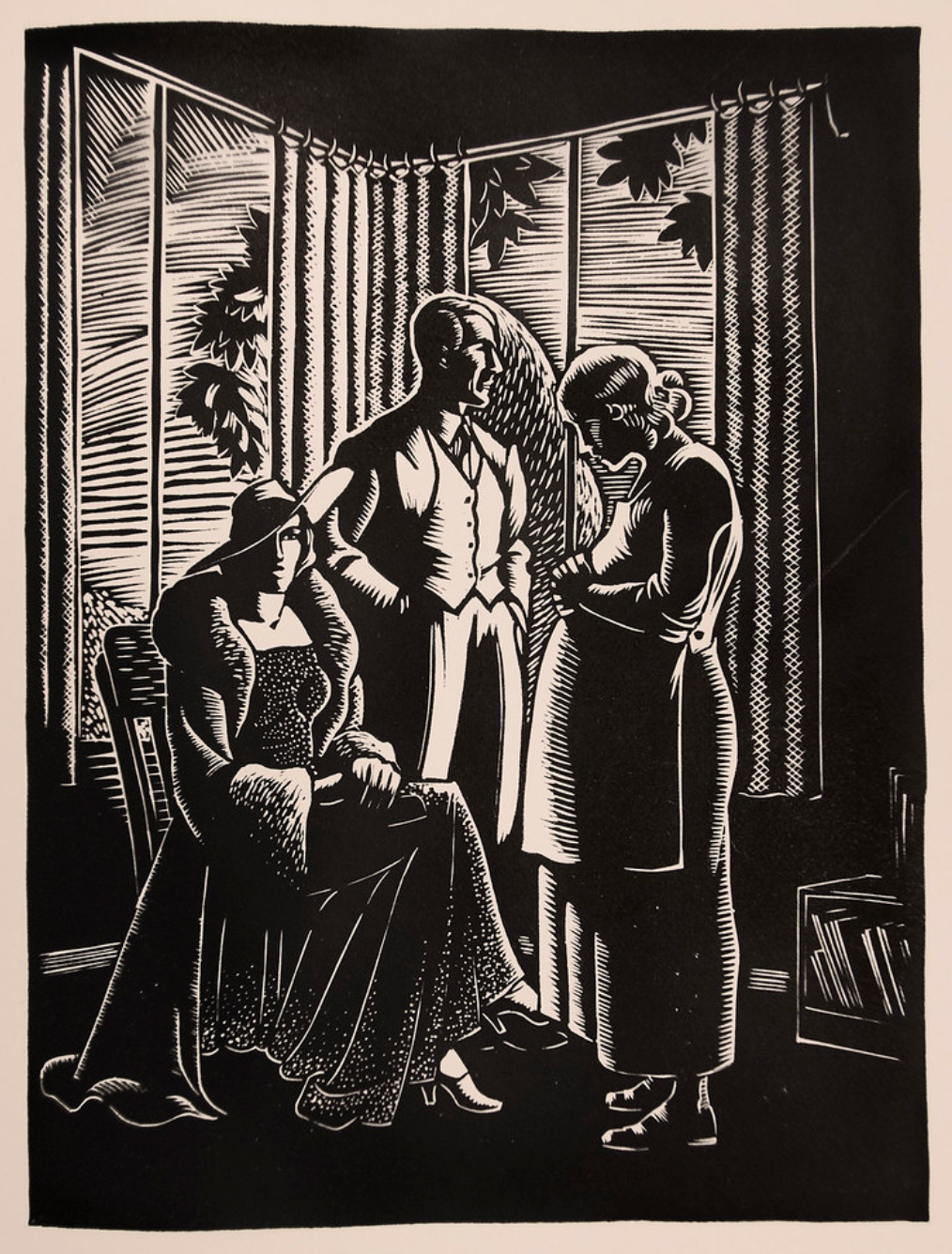
To understand where we need to go, we need to look back at what we've done. Politically speaking, older adults didn't come onto the radar until the 1930s. When Wall Street crashed, and the depression began, we started seeing older workers being forced out of the workforce because there simply weren't enough jobs, and young people could perform more hard labor. Retirement was forced on people who had not prepared adequately, so it wasn't what we envisioned as retirement. It was simply getting fired. If you didn't have any money in the bank, or if the fall of Wall Street wiped you out, that was your problem!
1800-1930
Civil War Veteran Pension
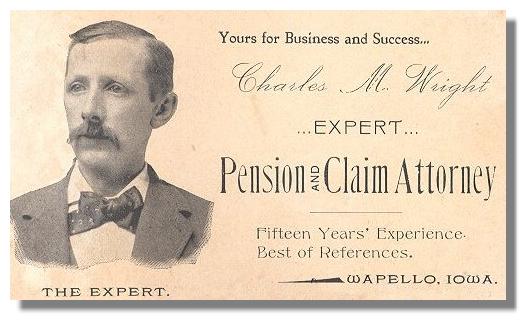 In 1862, following the Civil War, a veteran's pension was created for those returning from war. Originally, it was designed only for veterans who were injured during combat. The law was amended in 1890 to include disabled veterans, regardless of how the disability occurred. In 1906, old age was added as a criterion. (history.com, 2020). Now, let's be honest. In 1862, average American life expectancy was 39.4, so the likelihood of long term use of disability was quite rare.
Such a large federal expenditure could not help but engender some criticism. The process of awarding pensions, which was administered locally, was amenable to political patronage and other forms of corruption. Also, a robust legal specialty sprung up of lawyers who specialized in helping would-be recipients secure potential pensions. Over time, these developments led to skepticism about the program and to concerns that it was rife with fraud, waste and abuse. Whether these concerns were valid, is hard to say.
The Origins of Company Pension - A Preview to Social Security
Prior to the rise of company pension plans, paternalistic companies sometimes "graduated" older workers to token jobs at reduced pay. A few paid some form of retirement stipend—but only if the company was so inclined, since there were no rights to any kind of retirement benefit. Most older workers were simply dismissed when their productive years were behind them.
One of the first formal company pension plans for industrial workers was introduced in 1882 by the Alfred Dolge Company, a builder of pianos and organs. Dolge withheld 1% of each workers’ pay and placed it into a pension fund, to which the company added 6% interest each year. Dolge viewed providing for older workers as being a business cost like any other, arguing that just as his company had to provide for the depreciation of its machinery, he should also "provide for the depreciation of his employees." Despite Mr. Dolge’s progressive ideas and his best intentions, the plan proved largely unsuccessful since it required a worker to spend many years in continuous employment with the company, and labor mobility, then as now, meant that relatively few workers spend their whole working career with one company. Not only was the Dolge Plan one of the first formal company pension systems in industrial America, it was also one of the first to disappear when the company went out of business a few years later.
The biggest problem with company-provided pensions was that the percentage of workers anticipating an employment-related pension from their company or their union was tiny. Indeed, in 1900 there were a total of five companies in the United States (including Dolge) offering their industrial workers company-sponsored pensions. As late as 1932, only about 15% of the laborforce had any kind of potential employment-related pension. And because the pensions were often granted or withheld at the option of the employer, most of these workers would never see a retirement pension. Indeed, only about 5% of the elderly were in fact receiving retirement pensions in 1932.
So the company pension was an option not available to most Americans during the time prior to the advent of Social Security.
1930-1950
The Great Depression struck the older population, especially hard. As families struggled to put food on the table, older adults were starving and had no options. The states did their best to help, but most programs were underfunded and poorly ran. At best, seniors who did get help only received about 65 cents per day.
The Ham and Eggs Movement & EPIC (End Poverty in California) Plans
At the peak of the Great Depression, Californians were desperate for solutions to help the elderly. The EPIC movement, based on the platform used by Upton Sinclair during his bid for governor, proposed that production of food and goods be for the people, not for profit. (Larsen, 1958) The Ham and Eggs movement proposed giving state-sponsored scripp to older adults so that they could have access to food and housing. Neither proposal was put into place, but the foundations of social programs were born. (Mitchell, 2000)
The Townsend Plan
In the early 1930s, a gentleman named Dr. Francis Townsend advocated that we all contribute to helping our older citizens. He set up programs in smaller communities, where there would be a sales tax put in place, and the proceeds of that tax would be saved for older adults who needed help. It was sort of the foundation of what ultimately became the Social Security program. Everybody paid a little bit and helped people who needed it. (Starr, 1996)

The Townsend Plan promised a retirement pension of $200 a month to every American age 60 or older. Why this is so stunning is that the average monthly wage in 1935 was only about $100 a month. So Townsend was promising retirees a pension that was twice what workers were earning who were still at work.
The Townsend Plan proved enormously popular. Within two years of the publication of the Plan as a Letter to the Editor in a Long Beach, California newspaper, there were over 7,000 "Townsend Clubs" with over 2.2 million members actively working to make the Townsend Plan the nation's old-age pension system. At one point in 1936 Townsend was able to deliver petitions to Congress containing 10 million signatures in support of the Townsend Plan. Public opinion surveys in 1935 found that 56% of Americans favored adoption of the Townsend Plan.
The Townsend Plan, despite it popularity, had three fundamental flaws that made it an unworkable idea.
Pension Economics - One of the most breath-taking aspects of the Townsend Plan, and the heart of its appeal to senior citizens, was the extraordinary level of benefits it promised. The Townsend Plan promised a retirement pension of $200 a month to every American age 60 or older. Why this is so stunning is that the average monthly wage in 1935 was only about $100 a month. So Townsend was promising retirees a pension that was twice what workers were earning who were still at work. It may well have been the most generous retirement pension promise of all time.
Macroeconomic Theory - Dr. Townsend was not an economist. He had a kind of home-spun theory of economics, to be sure. But we can easily see that Townsend had one very large unstated economic assumption underlying his Plan, an assumption that was almost certainly not true.
The Social Security Act
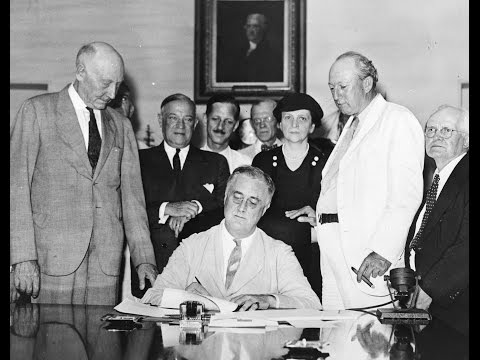
On August 15, 1935, the Social Security Act established a system of old-age benefits for workers, benefits for victims of industrial accidents, unemployment insurance, aid for dependent mothers and children, the blind, and the physically handicapped. Social security, as the title suggests, is designed to provide security. To protect individuals from unforeseen catastrophes, the government spreads certain risks among all society members so that no single family bears the full burden of such occurrences. (Quandagno, 1984)
(Source: CSPAN)
1950-1970
Older Americans Act (1965)
The Older Americans Act (OAA) of 1965 was part of President Johnson's "Great Society." Intended to support older Americans, The OAA enabled them to live at home and in the community with dignity and independence for as long as possible. This infrastructure is defined in the Act as a National Aging Network that currently includes 56 state and territorial units on aging, more than 600 Area Agencies on Aging, upwards of 250 Title VI Native American aging programs, and nearly 20,000 community service providers. (Fox-Grange & Ujvari, 2014)The Older Americans Act was the first Federal initiative design specifically for older adults. It has a goal of having adequate income for older adults and put in place programs and services that equally support the physical, mental, and housing needs of older adults. It legislated retirement with dignity. It is hard to believe that we had to legislate the right to a meaningful existence and to create laws that gave an older adult the right to have freedom and independence, but we did.
Medicare/Medicaid (1965)
President Lyndon B. Johnson made a significant change to the Social Security Act. On July 30, 1965, he signed into law the Social Security Act Amendments, most commonly known as "The Medicare Bill." It established Medicare, a health insurance program for the elderly, and Medicaid, a health insurance program for the poor. In 2019, over 60 million people received coverage under Medicare at the cost of over 700 billion dollars. (Marmor, 1970)
1970-2020
Americans with Disabilities Act (1990)
The Americans with Disabilities Act (ADA)A of 1990 was one of the largest pieces of civil rights legislation to pass into law. It prohibits discrimination on the basis of disability in employment, government activities, or access to public transportation, public accommodation or telecommunication relay services. How does the ADA improve the lives of older Americans?
Please watch this video:

(Source: New England ADA Center)
A New Age of Aging
In addition to Social Security, we also saw banking reforms and Public Works and housing and employment programs. But at this point, the federal budget sort and so did our taxes. In the 1960s and 1970s, we started seeing a lot of rallying cries. Some were for civil rights, and others for the women's movement. It was the time when we first started seeing gay rights protests. Our public awareness was growing. It was also when our conversation shifted to a recognition that our older adults had power, sheer numbers, and could influence social policy for the better of all generations. Thus began the Senior Power movement.
What is senior power? It's older adults using their available time and resources to make a change. Sometimes with results through lawsuits, filing grievances, and running voter registration. Sometimes with certain drives and marches and demonstrations. We see it in resistance activism like boycotts and rent strikes, Sit-ins, and, particularly, voting. There is an acknowledgment that you see that we must vote and use our resources and our power to influence politics over the life course.
The Gray Panthers
The gray panthers were modeled after the black panthers during the time of the civil rights movement. They use Siddons and protests and consider themselves a political action group. They were founded by a woman named Maggie Kuhn, who believed in radical non-violence. She once said, "I don't want an organization where we have to pay dues would be structured." So she created a very loosely organized group. They have newsletters and information, but their goal is to promote peace, justice, and education and make sure that the older adult's needs are met, and if not fixed, at least acknowledged. (Sanjek, 2012)
The Gray Panthers are a "loosely organized" organization, in that each area forms its own branch and self-regulates under the collective understanding that their purpose is to advocate and protect the older population. There are a few ways to learn more about the Gray Panthers.
If you're a Twitter user, check out the page for the New York chapter: Gray Panthers NYC
Otherwise, here's a little news clip from a protest in Chicago. Non Violent, but definitely assertive! The video is from back in 2012, but the principles still hold true.
Please watch the video:

(Source: Graypanthers)
The Power of the Public
In recent months, we have seen the powerful impact of social protest. For better or worse, social protesting gets public engagement through the media. If it's done strategically, protests can become very powerful tools for older adults or common participants in social protesting. Why? We have this idea that groups will only advocate for their own benefit, and we see that that is untrue of the older population. They may be retired, or willing to have an arrest on their record, and are willing to take the “heat” off of the younger protesters who can find their careers or health in jeopardy around anti-protest actions. They are not using their retirement to sit around and be ideal, but to make change.

This is Francis Crow. She actually held a funeral, including a coffin, for the fossil fuel industry. They arrested her in her wheelchair, and took her off to jail. Her comment to the media was "it takes older people like me to step up and put bodies in action.” She died at age 100, and remained active into her final years. Want to learn more about this remarkable person? Read: Longtime Norhampton Activist Frances Crowe Dies at 100

Hedy Epstein was 90 when she was arrested for protesting the killing of Mike Brown. She died at age 91 shortly after her arrest. She was a Holocaust survivor and understood what it was like to be oppressed. A rather controversial person, she devotes her life to opposing war, protecting women's rights, supporting Palestine, and maintaining affordable housing.
In August 2008, Epstein planned to be on board the Free Gaza Movement's ship attempting to break Israel's naval blockade of Gaza, but had to cancel due to poor health.
In 2010, she embarked on one of the ships that intended to deliver humanitarian aid to Gaza, but decided in Cyprus not to take part in the trip. She reportedly had also planned to take part in the 2011 flotilla but did not. She was on board "The Audacity of Hope" ready to join the flotilla.[22] However, they were intercepted by the Greek Coast Guard and turned back.
Epstein was supportive of the Black Lives Matter movement, and was arrested for failure to disperse on August 18, 2014, during a St. Louis protest against the killing of Michael Brown and subsequent police actions.
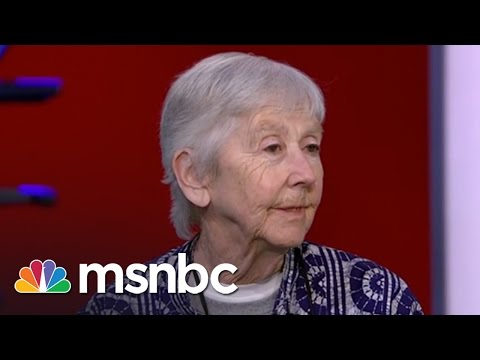
Sister Megan Rice, at age 83, snuck into a weapons facility. No, I'm not recommending that you do that, but once inside she didn't try to destroy the building. She wrote the Bible passages on the equipment. She was sentenced to three years and said she would do it again.
(Source: msnbc)
The Power Behind Doors
Political action groups also work behind the scenes. We have trade associations and professional organizations, and special interest groups that are all working for the benefit of older adults. Trade associations like the Nursing Home Administration (NHA), and the California Association of Nursing Homes (CANH) are working to protect older adults in long-term care settings.
Professionally, as a gerontologist, I highly recommend that students become aware of age-related professional groups like the American Society on Aging (ASA), Gerontological Society of America (GSA), and the National Association of Professional Gerontologists (NAPG).
The AARP (American Association of Retired Persons) is the largest lobbying group for older adults in the United States. There are 37 million members over the age of 50. I am a card-carrying member! It focuses on education, advocacy, and services. It was actually founded by a woman who was forced to retire at 65 from her job. She was the first female principal in California. She was mad because she didn't want to retire! You'll see that AARP contracts with a large number of groups to provide discounts, including offering Medicare supplements long-term care, and automobile insurance. Their real goal is to disrupt the idea that aging is bad. They don't want us to imagine being 80 as something to dread. They want to remind us that all of us over age 50 remains exciting vital and fun. I'd like to show you what it looks like to be an older person in the eyes of the AARP.
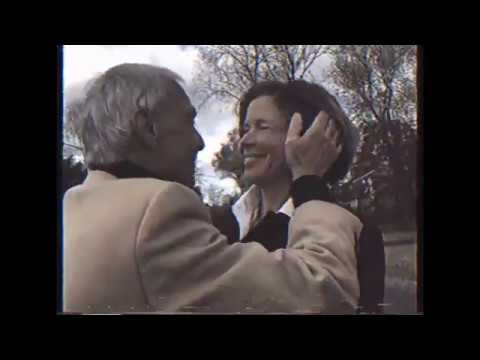
(Source: AARP Michigan)
The National Council on Aging was founded in 1950. You will find Council on aging in almost every community in the United States. They are funded under the older Americans act, and are there to provide services for older adults, advocate for their rights, offer seminars conferences and to find special research. They also offer lots of really good books, articles, and journals that I highly recommend you seek out.

Do any of these advocacy groups sound interesting to you? None of them are ageist. You can join at any age, especially as a college student with new energy and ideas. If you decided you wanted to join, you would enter as a junior member. You can participate as actively as you want. You can be passionate. You can have agency and power over your own aging experience. I encourage you to think about it.
Image Citation
Image courtesy of Wikimedia
Image courtesy of American Friends Service Committee