8.1 How Place Shapes Aging
Allow me to introduce Alice and Agnes.
They have been friends for more than fifty years. They met in their thirties while working in the data center for AT&T. They raised families, built careers, paid taxes, and eventually retired after decades in the workforce.
Today, Alice and Agnes are both in their eighties.
Both have mild arthritis. Both wear glasses. Both occasionally forget where they put their keys. Both are generally healthy and capable of living independently.
When they retired, however, they made different choices.
Alice moved back to rural Tennessee, where she grew up. Her nearest grocery store is twenty miles away. Her home has steep stairs, poor lighting, and limited transportation options. Most social activities require driving, and a trip to the doctor often involves careful planning.
Agnes remained in upstate New York. She lives in a single-story home with good lighting, a bathroom equipped with a few well-placed "convenience bars," nearby grocery stores, reliable transportation options, and neighbors who regularly check in on one another.
Although Alice and Agnes are the same age and have remarkably similar health profiles, their daily experiences are likely to be very different.
Why?
The answer has less to do with Alice and Agnes themselves and more to do with the environments in which they live.
One of the most important lessons in gerontology is that aging does not happen in a vacuum. Every person ages within a physical, social, economic, and cultural environment. These environments can either support independence and quality of life or create barriers that make everyday activities more difficult.
When we think about aging, we often focus on changes within the individual. We discuss health, memory, mobility, retirement, relationships, and finances. While these factors certainly matter, they tell only part of the story.
Aging is not simply about what is happening to the person. It is also about what is happening around the person.
A curb that is barely noticeable to a healthy twenty-year-old may become a significant fall risk for an eighty-year-old with balance problems. A community with accessible transportation can help an older adult remain independent long after they stop driving. A home that once worked perfectly for a growing family may become difficult to navigate after the onset of arthritis, vision loss, or mobility limitations.
For Alice and Agnes, the difference is not simply age or health. The difference is fit.
The relationship between individuals and their environments is the focus of a field known as environmental gerontology.
More Than a Matter of Preference
When we begin talking about housing, neighborhoods, and aging, it is easy to assume that where people live is largely a matter of personal choice. Sometimes it is. People may choose a home because they love the architecture, a neighborhood because it is close to family, or a community because it offers the lifestyle they prefer.
In reality, housing decisions are often shaped by factors far beyond personal preference.
Financial resources, health status, transportation options, family responsibilities, housing availability, community infrastructure, and access to support services all influence where and how people live. The environments we occupy are not simply reflections of our tastes. They are also reflections of our opportunities, constraints, and circumstances.
Agnes recently remodeled her bathroom. Alice did not. The difference is not simply personal preference. Agnes had the financial resources to make modifications. Alice chose to spend her retirement income maintaining a larger property in a rural community. Both made reasonable decisions, but their environments now place very different demands upon them.
For some people, housing decisions involve aesthetics, convenience, and lifestyle preferences. For others, safe housing itself is not guaranteed. Concerns about affordability, accessibility, transportation, neighborhood safety, and basic maintenance may overshadow questions of design or personal preference.
As we learned in the previous module, advantages and disadvantages often accumulate across the lifespan. The same principle applies to the environments in which people age. Individuals with greater financial resources generally have more housing options, more opportunities to modify their environments, and greater access to supportive services. Those with fewer resources may have fewer choices and encounter more barriers as they age.
This is one reason gerontologists pay close attention to housing and environment. The question is not simply where people live. The more important question is how well their environment supports the life they are trying to live.
A beautifully designed home is of little value if it isolates a person from transportation, healthcare, social connection, or family support. Likewise, a modest apartment may provide an excellent environment if it offers safety, accessibility, affordability, and access to the people and services that help someone remain engaged in daily life.
Where we live influences how we age. Equally important, the opportunities we have to shape where we live are not distributed equally. Understanding that relationship is one of the central goals of environmental gerontology.
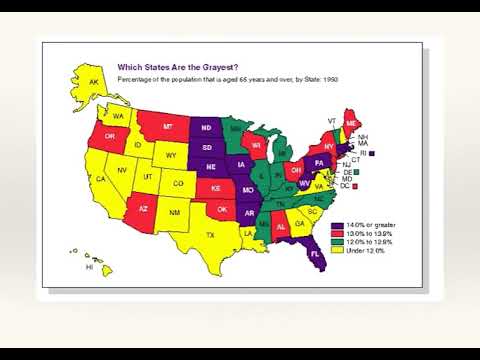
So, Where Do the Old People Roam?
The states with the highest population always have the highest number of older adults. Nine states have over nine million persons over age 65 - California tops the list in terms of sheer numbers, but not percent. California is joined by Arizona, New York, Pennsylvania, Texas, Ohio, Florida, Illinois, Michigan, and New Jersey.
Where are the rest of them? Let's take a look.
Please watch the video:
More Than a Place to Live
The study of the relationship between aging and the environment is known as environmental gerontology.
At first glance, this may sound like a specialized area of study focused on housing or architecture. In reality, environmental gerontology is much broader. It examines how the physical, social, and community environments around us influence our ability to function, remain independent, and maintain quality of life as we age.
The environments we inhabit include far more than the walls of our homes. They include sidewalks, transportation systems, grocery stores, healthcare facilities, community centers, parks, technology, social networks, and even the policies that shape access to these resources.
Consider a typical Tuesday morning.
Alice wakes up in rural Tennessee and realizes she is running low on one of her medications. The pharmacy is twenty miles away, and she has a doctor's appointment next week that will require another lengthy drive. Her closest neighbor lives nearly half a mile down the road. The community she grew up in has changed over the years, and many of the friends she once knew have either moved away or passed on. She enjoys the peace and privacy of rural living, but maintaining social connections requires planning and effort.
That same morning, Agnes discovers she also needs a prescription refill. She walks two blocks to her neighborhood pharmacy and stops to chat with a neighbor along the way. Later that afternoon, she takes a community shuttle to a senior center program and has lunch with friends. If her arthritis is bothering her, she can postpone driving for a few days without dramatically changing her routine.
Remember, neither woman is healthier than the other, nor is one more intelligent, motivated, or independent.
It's the environments surrounding them create very different experiences.
Alice's environment asks more of her. Everyday tasks require transportation, planning, and physical effort. Agnes's environment provides more built-in support through proximity, transportation options, and social connections.
This illustrates an important point in environmental gerontology. Environment is not simply about buildings and sidewalks. It also includes the people around us, the services available to us, the transportation systems we can access, and the opportunities we have to remain connected to our communities.
When gerontologists discuss environment, they are often talking about an entire ecosystem of supports and barriers that shape daily life. As we age, these factors can become just as important as our health status in determining whether we remain independent, engaged, and connected.
Most younger adults rarely consider these questions because the environment generally works for them. They move through the world without thinking much about stairs, lighting, transportation, or distance.
As people age, however, the relationship between individuals and their environments often becomes more noticeable.
A flight of stairs that once seemed insignificant may become challenging after knee replacement surgery. A long driveway may become problematic during periods of limited mobility. A neighborhood that felt convenient while raising children may become isolating if driving is no longer possible.
The environment has not changed, but the relationship between the individual and the environment has. It's this observation forms the foundation of environmental gerontology.
Person-Environment Fit
One of the most important concepts in environmental gerontology is person-environment fit.
The concept is deceptively simple. Every environment places demands on the people who live within it, and every individual brings a unique set of abilities, limitations, resources, and needs. The degree to which those characteristics match determines how well a person functions within that environment.
When the fit is good, people generally experience greater independence, confidence, and quality of life.
When the fit is poor, even routine activities can become frustrating, stressful, or unsafe.
Consider a simple example.
My mother is eighty years old and preparing for an extended trip to England. She can still travel internationally, navigate airports, ride trains, manage luggage, and explore unfamiliar cities. Most people would look at her and conclude that she is highly independent.
They would be correct, but they would also be missing part of the story.
Her ability to travel depends not only on her health and determination, but also on the environment around her. Elevators, escalators, rolling luggage, accessible transportation, online reservations, well-designed airports, and improved mobility accommodations all contribute to her success. If those supports disappeared tomorrow, the experience would look very different.
The same principle applies closer to home.
Remember Alice and Agnes? What happens when Alice decides she is no longer comfortable driving at night. In Agnes's community, transportation alternatives, nearby services, and supportive neighbors allow her friend to remain active and engaged. Alice's experience is quite different. A trip to the grocery store now requires planning, and a medical appointment may involve a forty-mile round trip. Neither woman's abilities have changed dramatically. The environments in which they live produce very different outcomes.
This perspective encourages us to move beyond asking, "What is wrong with the individual?" and instead ask, "What changes might improve the fit between the individual and their environment?"
Environmental Press Theory
When we are young, healthy, and highly capable, we often overcome environmental barriers without much thought. As our abilities change, however, the environment begins to play a much larger role in determining independence, safety, and quality of life.
One of the most influential ideas in environmental gerontology comes from researchers M. Powell Lawton and Lucille Nahemow. Their work, known as Environmental Press Theory, explores the relationship between a person's abilities and the demands placed upon them by their environment.
The theory begins with a simple observation: every environment asks something of us.
Think about your own home for a moment.
How many stairs do you climb each day?
How bright is the lighting in your hallway at night?
Can you reach the items you use most often without climbing on a chair?
How far is it from your front door to your car?
Would your bathroom still work well if you were recovering from surgery, using a walker, or trying to navigate on one leg after an injury?
Most of us rarely think about these questions because our current abilities are well matched to our environment. Yet nearly everyone has experienced a temporary mismatch.
If you've ever recovered from surgery, had the flu, broken a bone, sprained an ankle, or simply tried to function after several nights of poor sleep, you've experienced environmental press firsthand. Suddenly ordinary tasks become more difficult. The staircase seems steeper. Carrying groceries requires more effort. The laundry basket feels heavier. The environment has not changed. Your ability to meet its demands has changed.
Now let's return to Alice and Agnes.
Both women are in their eighties. Both have mild arthritis. Both remain generally healthy and independent. Yet their environments place very different demands upon them.
For Alice, a routine trip to the grocery store requires driving twenty miles each way. Stairs are part of her daily routine. Yard maintenance requires physical effort. Medical appointments involve transportation planning. Everyday life asks quite a bit of her.
Agnes faces challenges too, but her environment places fewer demands on her. She lives in a single-story home. Services are nearby. Transportation options exist if she chooses not to drive. Friends and neighbors are close at hand.
Neither woman is more capable than the other.
The difference lies in the amount of environmental press they experience.
This is the central idea behind Environmental Press Theory.
Lawton and Nahemow suggested that every environment creates a certain level of demand, or "press." At the same time, every individual possesses a level of competence that includes physical health, cognitive abilities, emotional resources, financial resources, and social support. When competence and environmental demands are reasonably balanced, people function well and maintain independence.
Problems begin to emerge when the demands of the environment exceed an individual's ability to meet them.
An older adult with limited mobility may struggle in a home with multiple flights of stairs. A person with vision loss may find poor lighting frustrating and unsafe. Someone with mild cognitive impairment may become overwhelmed by a confusing transportation system or a complicated healthcare website.
Notice that the staircase is not inherently bad. The website is not inherently bad. The transportation system is not inherently bad.
The challenge arises because the demands of the environment exceed the person's current ability to meet them.
This is where environmental gerontology encourages us to think differently.
Rather than focusing only on how people can adapt to increasingly difficult environments, we can also ask how environments might adapt to support people.
Could improved lighting reduce falls?
Could grab bars increase safety?
Could a first-floor bedroom allow someone to remain in their home longer?
Could transportation services reduce isolation?
Could clearer signage make public spaces easier to navigate?
In fact, let's put on our Universal Design hats for a moment.
Look around your home.
If a friend recovering from surgery moved in tomorrow, what would concern you?
Would they struggle with stairs?
Could they safely enter the shower?
Would there be enough lighting in hallways and bathrooms?
Are frequently used items easy to reach?
Would they have difficulty getting to grocery stores, medical appointments, or community activities if they could not drive?
You may be surprised how many of the modifications that support older adults would also benefit younger adults, children, visitors, and anyone recovering from illness or injury.
This is one of the most important lessons of environmental gerontology. The goal is not simply to adapt people to their environments. Sometimes the most effective solution is adapting the environment to the people who use it.
Rather than viewing aging solely as a process of decline, Environmental Press Theory reminds us that independence is often influenced by the interaction between people and the environments in which they live. Small environmental changes can sometimes produce dramatic improvements in safety, comfort, and quality of life.
As we move through this module, you'll begin to see examples of environmental press everywhere. Once you learn to look for it, it's surprisingly difficult to stop.
When the Environment Creates Disability
One of the most powerful ideas to emerge from environmental gerontology is that disability is not always located entirely within the individual. Sometimes disability arises from the interaction between a person's abilities and the environment around them.
At first, this may seem like a strange idea.
Most of us are accustomed to thinking about disability as something that exists within a person. We might describe someone as having impaired vision, limited mobility, hearing loss, arthritis, or memory problems. While these conditions are certainly real, environmental gerontologists encourage us to take a broader view and ask an additional question:
What role is the environment playing?
In a building with ramps, elevators, automatic doors, and accessible restrooms, an individual who uses a wheelchair or walker may navigate the environment independently with few limitations. Place that same individual in a building with only stairs, narrow doorways, and inaccessible entrances, and the experience changes dramatically.
The individual's abilities have not changed.
The environment has.
The same principle applies to many aspects of everyday life. An older adult with reduced vision may function quite well in a well-lit environment with large-print materials and clear signage. That same individual may struggle in a dimly lit building with small print and poor contrast. A person with hearing loss may participate comfortably in a quiet room but find a crowded restaurant nearly impossible to navigate. An older adult who no longer drives may remain active and socially engaged in a community with public transportation while becoming isolated in an area where a car is the only practical means of transportation.
In each of these examples, the challenge is not solely the person or the environment. It is the mismatch between the two.
This perspective has significantly influenced how researchers, planners, architects, healthcare providers, and policymakers think about aging. Rather than focusing exclusively on changing the individual, attention has increasingly turned toward modifying environments to better support human functioning.
The implications extend far beyond older adults.
Parents pushing strollers benefit from curb cuts. Travelers pulling luggage benefit from ramps and elevators. Individuals recovering from surgery appreciate accessible bathrooms and handrails. Clear signage helps visitors navigate unfamiliar spaces regardless of age. Good lighting improves safety for everyone.
In many cases, the changes that make environments easier for older adults make them easier for everyone else as well.
This realization led to the development of a design philosophy known as Universal Design.
Universal Design: Good Design for Everyone
If you have ever pushed a stroller up a curb cut, rolled a suitcase through an airport, used a lever-style door handle while your hands were full of groceries, or appreciated a captioned video in a noisy environment, you have already benefited from Universal Design.

Universal Design is the idea that environments, products, and services should be designed to be usable by the widest range of people possible, regardless of age, ability, or circumstance. Rather than creating special accommodations for specific groups, Universal Design seeks to create spaces that work well for everyone from the beginning.
At first glance, this may seem like a relatively modern concept. In reality, many of the features we now take for granted were originally developed to address accessibility challenges.
Curb cuts were designed to improve mobility for wheelchair users. Automatic doors increased access for individuals with mobility limitations. Closed captioning was developed to support people with hearing loss. Today, these features benefit countless individuals who were never the original target audience.
This illustrates an important lesson in environmental gerontology. Features that support older adults often support everyone else as well.
Consider a simple bathroom.
A curbless shower reduces the risk of falls for an older adult with mobility challenges. It is also easier to clean, more accessible for someone recovering from surgery, and often considered an attractive modern design feature. A handheld shower head may help a person with arthritis, but it can also make bathing children, pets, and household tasks easier.
The same principle appears throughout our communities. Good lighting improves safety for older adults with vision changes while also helping visitors navigate unfamiliar spaces. Clear signage assists individuals with cognitive impairment but benefits anyone trying to find their way through a large hospital, airport, or college campus.
One of the most interesting aspects of Universal Design is that many features originally developed to support people with disabilities eventually become conveniences that almost everyone appreciates. The best design often disappears into the background because it simply works well for everyone.
One of the most interesting things about Universal Design is that once you learn to recognize it, you begin seeing it everywhere.
- Look around your home, workplace, or campus.
- Are door handles knobs or levers?
- Is there adequate lighting in hallways and stairways?
- Are frequently used items easy to reach?
- Can someone enter the building without climbing stairs?
- Are pathways clear and free of trip hazards?
- Would a person recovering from surgery, using a walker, carrying a toddler, or pushing a stroller find the space easy to navigate?
If the answer is yes, chances are someone has incorporated principles of Universal Design whether they used that term or not.
One of the challenges associated with Universal Design is that it sometimes conflicts with our assumptions about what environments should look like.
Many people associate accessibility features with institutions, hospitals, or nursing homes. They picture metal grab bars, ramps, and medical equipment rather than comfortable homes or attractive public spaces. Yet some of the most successful examples of Universal Design are nearly invisible. They blend functionality and aesthetics so effectively that most people never notice them.
I'll confess that I have never been particularly fond of the look of grab bars in a shower. Intellectually, I fully support them. As someone who teaches aging, fall prevention, and environmental design, I understand exactly why they are important. Yet every time I saw one, part of me felt like my bathroom was beginning to resemble a rehabilitation facility.
A friend eventually solved the problem for me.
She suggested that I stop thinking of it as a grab bar and start thinking of it as a convenience bar.
Suddenly everything changed.
Today, my shower contains a sturdy support bar. It also happens to be supporting a loofah, a small waterproof radio, a wine cup holder, and a macramé hanger displaying my shampoo in what I prefer to think of as an aesthetically pleasing arrangement. Most of the time, it functions as decorative storage. If I need a little extra support while balancing on one foot or reaching for something, it conveniently transforms back into a safety device.
The story may sound silly, but it highlights an important reality about aging and environmental adaptation. People do not simply make decisions based on safety. We also care about beauty, comfort, identity, and the feeling of home. Sometimes the most successful adaptations are not the ones that look medical or institutional. They are the ones that blend so naturally into daily life that they become part of the environment rather than a constant reminder of limitation.
Good design does not force us to choose between safety and dignity. At its best, it quietly supports both.
Of course, knowing what would make an environment safer and actually making those changes are often two different things.
The longer I teach this material, the more I realize that Universal Design is rarely a simple matter of identifying the "best" solution. Most people can recognize features that would make their homes easier to navigate. The challenge is balancing functionality with aesthetics, practicality, cost, and personal preference.
For example, I have become a huge fan of drawers in lower kitchen cabinets. They allow me to see and reach everything without crawling on the floor or unloading half the cabinet to find a single baking dish. I also prefer lever-style door handles to knobs because they are easier to use when my hands are full and far friendlier to aging joints. These are relatively small changes that improve convenience for almost everyone.
Other modifications are more complicated.
A two-story home may become difficult to navigate with age, but adding an elevator is unrealistic for most families. Remodeling a bathroom, widening doorways, relocating a bedroom to the first floor, or redesigning an entryway may improve accessibility, but these changes can be expensive and disruptive. The issue is often not whether a modification would help. The issue is whether it is practical.
There is also the matter of identity.
Many people resist environmental adaptations because they associate them with frailty, disability, or old age. A grab bar may symbolize safety to one person and dependency to another. A ramp may represent accessibility for one family and the loss of a cherished architectural feature for another. In these situations, the debate is rarely about the modification itself. It is about what that modification represents.
Some of this resistance is practical. Some of it is financial. Some of it is aesthetic. And some of it reflects the ageist assumptions many of us carry about what it means to grow older.
As a result, successful Universal Design is rarely about creating a perfect environment. It is about finding a balance between functionality, beauty, affordability, and the realities of everyday life. The goal is not to design a home that looks like a healthcare facility. The goal is to create environments that support independence while still feeling like home.
In many ways, good design disappears into the background.
Most of us rarely think about a doorway until it is too narrow. We rarely think about lighting until it becomes inadequate. We rarely think about stairs until climbing them becomes difficult. When environments work well, they quietly support our daily activities without demanding our attention.
This observation highlights another important reality. The ability to modify an environment is not distributed equally. Installing a walk-in shower, widening doorways, improving lighting, or relocating to a more accessible home requires financial resources. Some older adults have the ability to adapt their environments as their needs change. Others must adapt themselves to environments that were never designed with aging in mind.
As a result, Universal Design is not simply a matter of architecture or aesthetics. It is also a matter of access, resources, and opportunity. The environments that support successful aging are often shaped by social and economic factors that extend far beyond the walls of a home.
As we move into the next section, we will explore one of the most important concepts in environmental gerontology: aging in place. For many older adults, the goal is not simply to live somewhere safe and accessible. The goal is to remain in the place that feels like home.
From Design to Place
Throughout this section, we have explored the relationship between people and the environments they inhabit. We have seen that independence is influenced not only by health and ability, but also by housing, transportation, community design, social connections, and access to resources.
Environmental gerontology reminds us that the goal is not simply to create safer homes or more accessible communities. The larger goal is to support independence, dignity, participation, and quality of life as people age.
This raises an important question.
If environments matter so much, why do so many older adults remain deeply committed to staying where they are?
The answer has less to do with architecture and accessibility than it does with memory, identity, relationships, and belonging. A home is rarely just a building. It is the setting for a lifetime of experiences.
To understand why aging in place has become one of the central goals of aging policy, we must first understand the powerful attachment people develop to the places they call home.