1.5 The Changing Face of Aging
Aging Populations
Exactly how did our population become so age-heavy? Population aging isn't simply the result of people living longer. It reflects changes across the entire population, particularly longer lives combined with declining fertility. As fewer children are born and more people survive into later life, older adults make up a larger share of the population.[7]
As you look through this information, I want you to consider what you think the future will look like. With every generation, policies and priorities shift, and I think it's safe to say we will need to carefully examine finance, healthcare, social policy, and family commitment to intergenerational support as the population over age 85 continues to grow.[7]
The growth of the older population reflects two important demographic changes: more people surviving into later life and large birth cohorts moving into older age groups. The population age 85 and older is expected to grow substantially as today's older cohorts continue to age. At the same time, life expectancy has increased dramatically over the long term, although it does not rise smoothly from year to year. In 2024, U.S. life expectancy at birth reached 79.0 years, the highest level recorded to date.[8]
Before we go farther, let's distinguish a few terms we'll use throughout this book. Life expectancy is the average number of years a person in a particular population is expected to live, based on current mortality patterns. Life span refers to the length of an individual's life; when we're talking about humans as a species, it can also refer to the observed limits of human longevity. A birth cohort is a group of people born during the same period who therefore move through historical events at roughly the same ages. The Baby Boom generation, for example, is a birth cohort. [9]
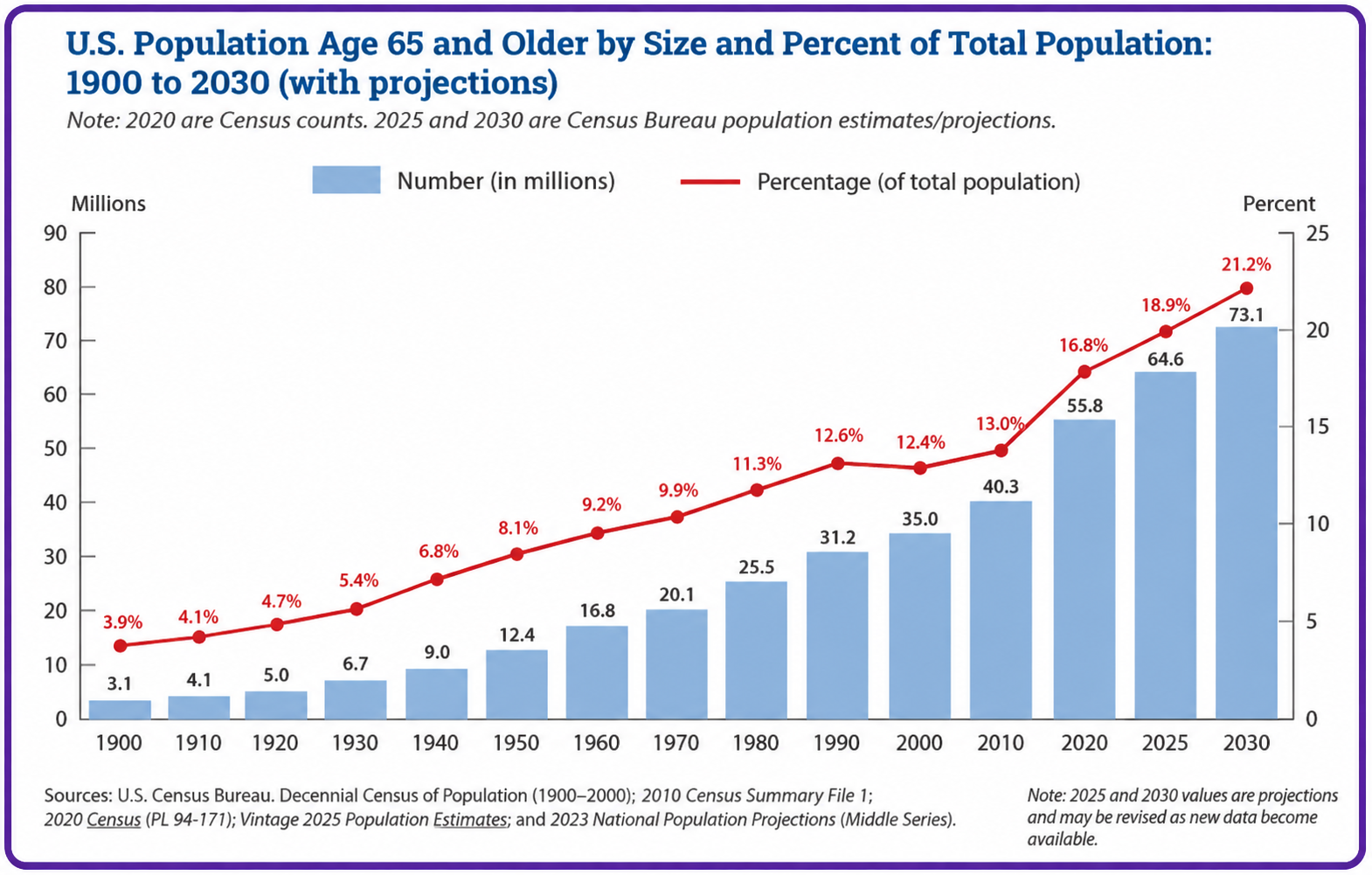
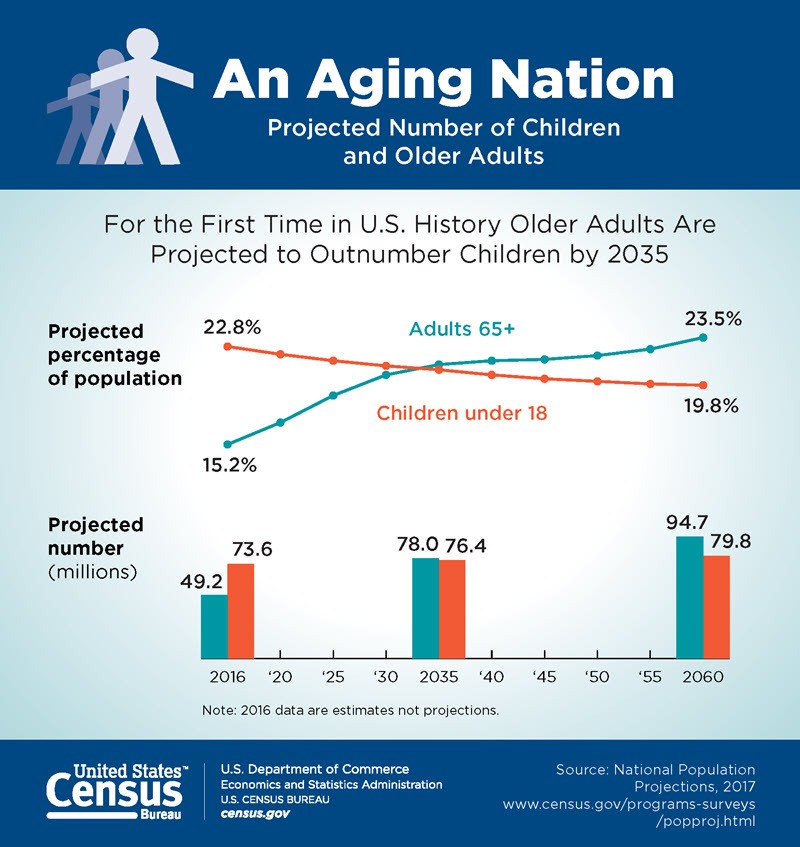
Looking at the most recent Census Bureau estimates, we can see just how quickly the United States is aging. Current Census Bureau projections suggest that adults age 65 and older will outnumber children under age 18 by 2029.[10] In 2025, about 18.9% of Americans were age 65 or older.[7] Just two decades earlier, in 2004, only 12.4% of the population was age 65 or older. [10] That's a substantial shift in the age structure of the United States.
Population projections change as fertility, mortality, and migration patterns change, so projections should always be understood as estimates based on current demographic assumptions.[10]
1.3.1 Population Pyramids
One way demographers (and gerontologists) can get a sense of a population's changing age structure is by using a population pyramid. We will use this tool throughout the rest of the semester, so it is important to understand how it works and what we can use it for. It's a really cool snapshot of what the population looks like at any given time, and it's a fabulous tool if you superimpose historical events on population trends.[11]
Population Pyramids
One of the ways that demographers (and gerontologists) can get a sense of the changing population age is through the use of a population pyramid. We will use the tool as a part of our conversations throughout the rest of the semester, so it is important to understand how it works, and what we can use it for. It's a really cool snapshot of what the population looks like at any given time, and is actually a pretty fabulous tool if you superimpose historical events on top population trends.
Another way demographers describe population structure is with the dependency ratio—a comparison between the number of people typically considered economically dependent because of age and the number considered to be of working age. It can help us think about the relationship between population structure and the resources needed for education, healthcare, retirement systems, caregiving, and other social supports. Keep in mind that it is an age-based population measure, not a description of individuals. Turning a particular age does not automatically make someone economically dependent—or economically productive.[11]
There is no single older population
As populations age, it becomes tempting to talk about "older adults" as though they are a single group with identical needs, values, and experiences. In reality, there is no such thing as a typical older adult.
Age interacts with culture, ethnicity, language, religion, geography, family structure, socioeconomic status, gender, and life experience. The aging experience of a retired farmer in rural Montana may look very different from that of a grandmother in Los Angeles, a recent immigrant in New York, or an elder living within a multigenerational Native community.
This recognition gave rise to a field known as ethnogerontology, which examines how culture and social identity influence the aging experience. Rather than assuming that everyone ages in the same way, ethnogerontology reminds us that aging is experienced through the lens of culture and community.
As America's older population grows, it is becoming not only larger, but also more diverse. Understanding that diversity will be essential for developing policies, programs, healthcare systems, and communities that meet the needs of future generations.

How we age is influenced not only by biology, but also by the world around us. Over the past century, life expectancy has increased dramatically, yet many of our social institutions, expectations, and life plans were designed for a much shorter lifespan. There is often a gap between what people are capable of doing as they age and what society expects or supports them to do.
As more people live into their eighties, nineties, and beyond, questions about education, work, retirement, caregiving, health, and financial security take on new meaning. Living longer is one of humanity's greatest achievements, but it also requires us to think differently about how we prepare for the second half of life. Rather than viewing aging as a brief stage at the end of life, modern gerontologists increasingly view it as a decades-long journey that requires planning, adaptation, and lifelong development.