1.5 Aging Across History: From Gerontocracy to Modernization
A Brief History of Human Aging
Studying the history of aging presents an interesting problem: we can only study it retrospectively. People in the past did not leave us neatly organized data about how they experienced aging, and the farther back we go, the more we have to rely on archaeological evidence, historical records, art, religious texts, and stories passed from one generation to another.
And after thousands of years of human history, you might think we would have aging pretty well figured out.
We don't.
We have learned a tremendous amount about how long people live, what happens to the body over time, and how societies have treated their older members. But many of the same questions have followed us throughout human history: What does it mean to grow old? When does old age begin? Are older people valued for their experience or viewed as a burden? Do longer lives necessarily mean healthier lives? And perhaps most importantly, which parts of aging are biological, and which have we created through culture?
To understand where some of our current ideas about aging came from, we need to go backward for a bit—from ancient stories and Biblical accounts of extraordinarily long lives to tribal societies, early civilizations, and eventually the modern world.
The Enduring Dream of Escaping Aging
Humans seem to need something to believe in. And if aging ultimately reminds us of our own mortality, it makes sense that our ancestors created stories that offered another possibility: perhaps aging—and even death—could somehow be escaped.
Across cultures and throughout history, we find stories of people who lived extraordinarily long lives, places where people never grew old, magical waters that restored youth, and gods or extraordinary beings who escaped the limits of an ordinary human lifespan. The Hyperboreans, Biblical accounts of people living for hundreds of years, legends of the Fountain of Youth, and stories of immortality all reflect versions of the same very human hope.[30]

The idea that aging might be delayed, defeated, reversed, or somehow avoided still runs through our culture. We see it in anti-aging products, miracle supplements, longevity programs, cosmetic treatments, and the continuing search for scientific interventions that might extend human life.
The stories have changed. The hope really hasn't.
- The Hyperborean Myth comes from ancient Greek mythology. Hyperborea was imagined as a distant, almost magical place whose people lived extraordinarily long lives, free from many of the diseases and hardships experienced by ordinary humans. [30]The basic idea should sound familiar: somewhere, other people have figured out how to live longer—and if we could just discover their secret, perhaps we could too. We still see versions of this thinking today. Consider how easily something like the “Mediterranean diet” can be transformed from a healthy pattern of eating into the secret to longevity. Diet matters, of course. But Americans eating olive oil and vegetables are still living within an American environment, health-care system, culture, and lifestyle. There is no single key to longevity.
- The Antediluvian Myth reflects another enduring idea: perhaps human beings simply used to live longer. In the pre-Flood genealogies of Genesis, extraordinarily long lives are common. Methuselah is described as living 969 years, the longest lifespan attributed to any person in the Bible [Genesis 5:21–27]. We have no scientific evidence that humans actually lived for hundreds of years, but the idea of a distant past when people possessed extraordinary longevity has survived remarkably well. Today we know that human beings can occasionally live beyond 120 years—but verified cases are extraordinarily rare.[31]
- The Fountain of Youth Myth may be the easiest one to recognize in contemporary culture. Most of us learned some version of the story that Spanish explorer Juan Ponce de León went searching for magical waters that could restore youth. There is just one problem: historians have found no contemporary evidence that this was actually the purpose of his voyages. The Fountain of Youth became attached to his story later.[32] In other words, even the story about searching for eternal youth became a myth. The search itself, however, is alive and well. Cosmetic companies, supplement manufacturers, wellness programs, and an expanding longevity industry continue to sell versions of the same promise: perhaps this product, treatment, diet, or discovery will help us stay young just a little longer. There is a great deal of money to be made from our very human desire to look younger and live longer—even though we still can't stop aging.
Before Written History: What Did It Mean to Grow Old?
What was it like to grow old before written history?
The most accurate answer is: we don't entirely know.
Prehistoric people didn't leave behind surveys asking how they felt about aging, retirement records, or written descriptions of family life. What we know comes from archaeological evidence, human remains, material culture, and comparisons—made cautiously—with historically documented societies.[34]
One thing is clear: average life expectancy was considerably shorter than it is today, but those averages can be misleading. High rates of infant and childhood mortality pulled life expectancy at birth dramatically downward. Surviving childhood did not mean that a person was destined to die at 35 or 40. Some people lived well beyond those ages, and the very existence of older adults could provide an important resource to a community.[34]
Imagine living in a society without books, Google, medical records, YouTube tutorials, or even written language. Where does the information go?
It lives in people.
Older members of a community could carry decades of accumulated knowledge: where water could be found during a drought, which plants could be eaten or used medicinally, how weather and animal patterns changed, how injuries had been treated, who was related to whom, where the group had traveled, and the stories and traditions that explained who they were.[33]
In that environment, surviving long enough to become old could make someone enormously valuable.[33]
But there is an important caution here. We sometimes tell the history of aging as though all early societies followed the same rule: older people were respected while they were useful and abandoned when they became a burden. Human societies have never been that simple. Treatment of older people varied according to culture, resources, kinship, environment, health, social position, and circumstance.[33]
That variation introduces an idea that will follow us throughout the history of aging: the value assigned to old age has never depended on age alone. It depends on what a particular society values—and what it believes older people contribute.
We Name Things
As human societies became more complex, we became increasingly interested in the differences between children, adults, and older people. We developed expectations about how people at different ages should behave, who should hold power, who should be protected, who should contribute—and even who should be considered valuable. [6]
And, because we're human, we started naming things.
Fear aging or older people? We have a word for that. Think older people should hold the power? There's a word for that, too. Believe that older people have become such a burden that eliminating them is acceptable? Yep. We named that.
We even have a term for sexual attraction to substantially older people.
Yeah. I know.
The point isn't that you will use all of these terms every day. The vocabulary itself gives us a glimpse into the ways humans have thought about age, power, fear, attraction, and social value. So let's get a few of these terms into your brain.
- Gerontocracy — a society or system in which political or social power is held primarily by older people. One historical example is ancient Sparta's Gerousia, a governing council whose elected members were men over age 60 and served for life. [35]
- Gerontophobia — fear of aging, growing old, or older people. The term is also sometimes used more broadly to describe strong anxiety or aversion associated with old age.[36]
- Gerontocide — the killing of older people because of their age, or the deliberate abandonment of older people under circumstances in which death is the intended or expected result. We'll need to be careful with this term historically: hardship, neglect, abandonment, and intentional killing are not necessarily the same thing.[37]
- Gerontophilia — sexual attraction toward older adults, particularly when the attraction is specifically related to the person's older age.[38]
And older adulthood isn't the only age group we've found words for:
- Adultism — attitudes, behaviors, or systems that privilege adults and devalue or dismiss children and younger people because of their age.
- Chronocentrism — the tendency to view one's own historical period or generation as more important, advanced, or correct than others.
- Paedophobia (pediophobia) — fear or strong aversion toward children. Be careful with the spelling here: pediophobia is also commonly used for a fear of dolls, so context matters.
- Ephebiphobia — fear or aversion toward adolescents or young people.
Notice what these words have in common. Age isn't simply something we measure. We attach meaning to it. We use age to organize people, assign roles, distribute power, create expectations—and sometimes justify how one group treats another.
Once we have language for those ideas, we can start recognizing them when they show up. A great example of gerontocide is in a late-1970s movie called “Logan’s Run.” Where society has deemed that anyone over the age of 29 is a burden to society and is called to a great ceremony where on their 30th birthday, they are evaporated by a laser gun. Logan objects and runs away, hence the movie title.
When Age Means Power: Gerontocracy
 We just learned that gerontocracy describes a society or system in which power is concentrated among older people. But why would age translate into power in the first place?
For much of human history, two things that create power tended to accumulate over time: knowledge and property. [39]
In a society without books, schools, databases, or written records, knowledge lived in people. If you survived into later life, you had simply had more time to learn things. You might know the history of your community, family and kinship relationships, religious traditions, medicinal plants, seasonal patterns, previous conflicts, or what happened the last time the river flooded or the food supply failed.[33,39]
Older adults could become the custodians of a community's collective memory.[33]
And then there was property.
As societies developed systems of land ownership, inheritance, wealth, and formal government, control of resources could give older people another source of authority. But we need to be careful here: being old didn't automatically make you powerful. Being an older person who controlled property, wealth, family resources, religious authority, or political office was a very different thing.[39]
In many Greco-Roman societies, political and economic power was concentrated among male citizens from property-owning and elite families. Women were excluded from formal political participation, enslaved people had virtually no political rights, and wealth strongly influenced access to power. In Rome, women could own and inherit property under some circumstances, but they could not vote or hold political office. Roman political institutions also gave disproportionate influence to wealthier citizens.[40]
Ancient Sparta gives us one particularly obvious example. Its Gerousia, or council of elders, included 28 elected men over age 60 who served for life, along with Sparta's two kings. These weren't older people being politely consulted because everyone respected Grandpa. They held actual political and judicial power. [35]
Versions of this relationship between property and political authority continued into early American history. At the nation's founding, political participation was highly restricted, and most states imposed property qualifications for voting. In 1790, 10 of the 13 states still had some form of property requirement. Those restrictions gradually disappeared during the nineteenth century, although voting rights remained sharply limited by race and gender.[39,40]
Think about it: We tend to associate gerontocracy with ancient societies, but the term still appears in discussions of contemporary political leadership. Look at the current age and demographic composition of Congress. How closely—or poorly—does the concept fit?
So gerontocracy isn't really as simple as “people used to respect old people more.”
Power follows resources.
And for much of history, older people—particularly older men with property—were more likely to control them.[39,40]
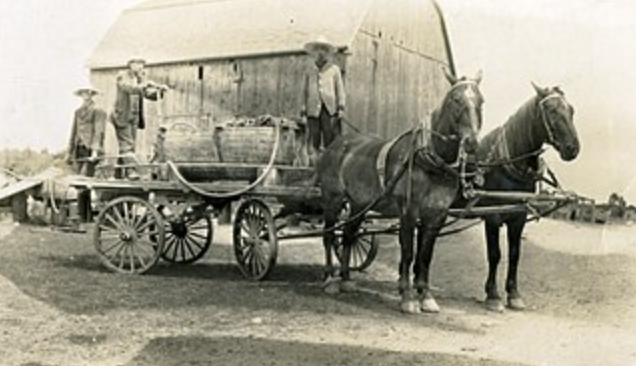 Enter Pa Farmer
Now let's shrink this enormous historical process down to one agricultural family.
Pa and the four boys work the land. Ma and the three girls manage the household. The oldest daughter is expected to help care for Ma and Pa as they grow older. The oldest son expects eventually to inherit the farm and begin the cycle again. But for now, Pa owns the farm. And that matters.
Pa decides what gets planted, how the farm is run, how resources are used, and often what the future will look like for the people who depend upon that farm. He may be wise. He may be stubborn. He may be generous. He may rule with an iron fist.
Either way, everyone else's survival depends substantially upon the success of his farm.
The sons may be adults themselves, but walking away from Pa doesn't simply mean having a family argument. It may mean walking away from the land, livelihood, inheritance, housing, community, and economic security upon which their lives depend.
Pa has knowledge. Pa has property. Pa has power.
Modernization Theory
Think about a family member you've had to help with technology. At your age, for me, it was teaching and re-teaching someone how to program the VCR. Later it became downloading photographs from a phone onto a computer. Whatever the technology, it can get frustrating to explain the same thing over and over.
Why can't they just GET IT?
Now turn that around.
When was the last time you had to learn something completely unfamiliar? I don't mean taking another class in your major. I mean something genuinely new. It took time. You didn't immediately get it. You got frustrated. I've still got a little trauma left over from my struggle with undergraduate Statistics.
And think about all those bits of “old knowledge” we suddenly need.
- What temperature do I cook this chicken?
- How do I get red wine out of the carpet?
- How did our family make that recipe?
- What was Grandpa like when he was young?
Sometimes the person we've been frustrated with because they can't figure out the newest technology is exactly the person we turn around and call:
“Hey, Grandma, how do I...?”
Knowledge hasn't stopped being valuable. We've changed where we keep it, how we get it, and who we need in order to find it.
And that is exactly where Modernization Theory becomes useful.
Think back to Pa Farmer. Much of his authority came from things that accumulated with age. He had knowledge. He had experience. He controlled the farm. His children depended upon him for their livelihood and, eventually, their inheritance.
But what happens to Pa's power when the world around him begins to change?
Modernization Theory (Cowgill & Holmes, 1972; Rhoads, 1984) is one of the classic theories of social gerontology. We will return to it throughout the semester, so I want you to understand the idea well enough to recognize it when you see it happening around you.[39,41]
At its simplest, Modernization Theory proposes that the social status of older adults tends to decline as societies modernize.[39]
Cowgill argued that several changes associated with modernization help explain why:[39]
- Health technology allows more people to survive into later life, increasing the number and proportion of older adults in the population.
- Economic and industrial technology changes the kinds of work and skills a society values and can make traditional skills less economically important.
- Urbanization moves people away from farms, villages, extended families, and the communities in which older adults may have established positions of authority.
- Mass education gives younger generations access to knowledge outside the family and may even give them forms of education their parents and grandparents never received.
Notice what the theory is not saying.
It isn't simply saying that people become meaner to old people when they invent machines.
It is describing a shift in power and dependency.

1.12.1 The Industrial Revolution Changed Everything
We left Pa Farmer on a bit of a cliffhanger.
For generations, much of his authority came from things that accumulated with age. He had knowledge. He had experience. He controlled the farm. His children depended upon him for their livelihood and, eventually, their inheritance.
Then industrialization began changing the arrangement.
The Industrial Revolution began in Britain during the eighteenth century and spread to the United States, where industrialization accelerated during the nineteenth century. Goods that had once been produced primarily in homes, small workshops, or cottage industries could increasingly be manufactured in factories.[42] And factories needed workers.
For younger members of agricultural families, that created something enormously important: options.
Remember Pa's younger sons? They no longer necessarily had to remain on the farm, work under Pa's authority, and hope eventually to inherit some portion of the family's property. They could leave the farm, move to a growing industrial town or city, work for wages, and begin building an economic life independent of their parents. [43]
And it wasn't only the boys.
One of my favorite examples comes from the textile mills of Lowell, Massachusetts. During the first half of the nineteenth century, thousands of young women left New England farms to work in textile factories. Because respectable unmarried women living and working away from their families made nineteenth-century society more than a little nervous, the companies established supervised boardinghouses with rules, curfews, and expectations for the women's behavior.[44]
Restrictive? Absolutely. But also revolutionary. These young women were earning wages away from the family farm. [43,44] That represents a significant change in the relationship between generations. A young adult who could earn wages independently had choices that someone whose economic future depended entirely upon family property did not. [44]
At the same time, industrialization contributed to the growth of towns and cities. Work was increasingly separated from the household. Families moved. Occupations changed. The extended family remained important, but family members did not necessarily spend their entire lives living and working together in the same place. [39, 42]
Now think about what that does to Pa Farmer's position.
Pa still owns the farm. He still knows how to run it. He may still control the inheritance. But leaving Pa no longer necessarily means leaving behind every possibility of economic survival. That's a major shift in power.
Industrialization also changed the nature of work itself. A lifetime of expertise in farming, a family craft, or a cottage industry did not automatically translate into employment in the growing industrial economy. Increasingly, people needed skills suited to new workplaces, machinery, schedules, and systems of production. [39]
This is exactly the kind of transition Modernization Theory is trying to explain. The older person's abilities haven't suddenly disappeared. The society around those abilities has changed. [39] And that created another problem.
Before modern retirement systems existed, most people supported themselves through work, family resources, property, savings, or some combination of the four. An older adult who could no longer work—and who had little property, savings, or family support—had very few options.
One of those options was the almshouse, sometimes called the poorhouse.[45]
Almshouses weren't created specifically for older adults. They housed people who were poor and unable to support themselves for many different reasons. But by the late nineteenth and early twentieth centuries, growing concern about impoverished older adults helped make old-age economic insecurity increasingly visible as a social problem.[45]
Then came the Great Depression.
The Depression didn't create poverty in old age, but it made an already serious problem much harder to ignore. Families lost jobs, savings, homes, and businesses. Adult children who might otherwise have supported aging parents were struggling to support themselves.[39,43,45]
Suddenly, the question of how people would survive when they could no longer work wasn't simply a private family problem. It was a national one.
In 1935, the United States enacted the Social Security Act, creating a federal system of old-age benefits for covered workers. Social Security would eventually become one of the central institutions shaping retirement and economic security in later life.[44]
And notice how far we've traveled from Pa Farmer.
On the farm, economic security in later life was closely tied to family, land, property, inheritance, and intergenerational obligation. In an industrial society, economic security increasingly became connected to wages, employment, savings, pensions, and eventually government programs. [39, 43, 45]
That's an enormous social transformation. And it illustrates the central argument of Modernization Theory remarkably well:
When the structure of society changes, the roles, resources, and status associated with old age can change with it.[39]
1.12.2 So...Does Modernization Theory Actually Work?
At this point, Modernization Theory probably seems pretty convincing.
Pa Farmer controlled the land and the livelihood. Industrialization gave his children other ways to earn money. Urbanization allowed them to leave. Education increasingly moved outside the family. New technologies changed the skills people needed to participate in the economy.
Modernize the society, reduce dependence upon elders, reduce the status of elders.
Nice, tidy theory.
Except human beings are rarely that tidy.
One of the problems with Modernization Theory is that it can tempt us into imagining two kinds of societies: traditional societies where everyone respects their elders and modern societies where older people have lost their status.[41,46]
History and culture are considerably messier than that.
Remember something we've already established: there was never a universal golden age of aging. Older adults have never all occupied the same social position. Gender, wealth, family status, health, property ownership, culture, religion, and other factors have always influenced who held power and who didn't. [46]
And societies don't all respond to modernization in exactly the same way.
In 1984, gerontologist Ellen Rhoads examined Modernization Theory in American Samoa, a society experiencing substantial social and economic change. According to a simple interpretation of Modernization Theory, we might expect those changes to reduce the status of older Samoans [41], but that's not what she found.
Despite considerable modernization, older adults continued to hold relatively high status. Rhoads argued that cultural values could intervene in the modernization process. Rhoads' findings suggested that cultural values could shape how modernization affected the status of older adults.[41]
Modernization Theory gives us a useful way to examine how changes in technology, education, urbanization, work, and economic resources can affect the position of older adults. [46] But it doesn't give us a universal formula.
More recent cross-cultural research has reached a similarly complicated conclusion. Across many countries, greater modernization has sometimes been associated with lower perceived social status for older adults—but the strength and even the pattern of that relationship varies considerably across cultural settings.[46]
So instead of asking:
“Does modernization make society disrespect older people?”
I'd rather you ask:
“What changed, who gained access to resources or power, who lost it, and how did the culture respond?”
That's a much more useful gerontological question.
It also helps us separate two things that are easy to confuse: status and attitudes.
A society can give older adults considerable authority and still hold stereotypes about them. Another society might reduce the formal authority associated with age while providing older adults with greater independence, healthcare, legal protections, education, income, or opportunities.[46]
Modernization itself isn't automatically good or bad for older adults. It changes the environment in which aging occurs. And that is why we're going to keep coming back to this theory. When we look later at retirement, families, healthcare, work, technology, housing, and ageism, I want you to ask the same question:
What changed—and what did that change do to the role of older adults?
1.13 From Gerontocracy to Youthocracy
If modernization can weaken some of the traditional sources of power associated with age, what takes their place? One possibility is what we might call a youthocracy.
I'm using that term primarily to describe cultural values, not political or economic control. Young adults certainly don't control most of our country's wealth, property, corporations, or political institutions. Culturally, however, that's a different story.
Beginning particularly with the enormous Baby Boom generation after World War II, American popular culture became increasingly fascinated with youth. This generation was large enough to become a powerful consumer market while still young, and businesses, advertisers, music, fashion, television, and eventually entire industries learned to pay attention to what young people wanted.[47]
Youth became more than an age. It became an ideal. Look young. Act young. Dress young. Stay current. Keep up. Don't become irrelevant.
Think about how often products are marketed with words such as new, fresh, fast, and next generation. Now compare those words with some of the language we associate with age: old-fashioned, outdated, behind the times, or past your prime. We're not just describing chronological age anymore. We're assigning value to it.
Advertising and entertainment have historically played an important role in reinforcing those values. Older adults have often been underrepresented or portrayed within a fairly narrow range of roles, while youth has been associated with beauty, sexuality, innovation, independence, and possibility.[4,21,27]
There are signs of change. Older models, actors, influencers, athletes, and public figures are increasingly visible in some forms of media. But notice something interesting: when an older model appears in a major fashion campaign, or a company decides not to erase every wrinkle from someone's face, we still sometimes describe it as bold, inclusive, or even revolutionary. Why would showing an older person as attractive, interesting, or desirable be revolutionary? [27]
Mass media doesn't single-handedly create our attitudes about aging, but it certainly participates in them. The images we repeatedly see—and the images we don't see—help establish expectations about who is attractive, competent, successful, interesting, sexual, powerful, or relevant. So which comes first? Does media reflect our cultural attitudes toward aging, or does it help create them? Probably some of both. [4,21,27]
And this brings us back to a question we've already been asking: At what point are we considered old?
We use chronological ages for all kinds of purposes. We have eligibility ages for retirement programs, Social Security, Medicare, senior discounts, and other benefits. We joke about being “over the hill.” But those ages don't tell us much about what an individual person can actually do.
What if I'm running marathons at 70? Am I old? Chronologically? Sure. But if I can outrun you, I'm going to enjoy making you explain exactly what you meant by that.
The problem isn't that chronological age is useless. We need age categories for research, policy, programs, and administration. The problem comes when we assume that chronological age tells us what a person is like.
That assumption can also influence public policy. Older adults are sometimes discussed as though they constitute one enormous population of frail, poor, dependent people requiring support. Some older adults absolutely do experience poverty, disability, serious illness, housing insecurity, and substantial caregiving needs. Others don't.[12]
Most older adults live in community settings rather than nursing homes. Some continue working. Some provide financial assistance and caregiving to younger generations. Some have substantial assets; others enter later life with very little economic security. In other words, becoming 65 doesn't suddenly make everyone alike.[12]
That's one of the recurring problems we'll encounter throughout gerontology: We create policies for populations, but people age as individuals.
So as we move from gerontocracy to modernization to this idea of a cultural youthocracy, don't reduce the story to we used to respect old people, and now we respect young people. That's much too simple. Instead, watch what happens to power, resources, representation, expectations, and social value as societies change. Those are the things that tell us what age means in a culture.