Person Centered Care
Go to any web page for any long-term care facility, and you will learn about their “team approach” to the care of their patients. It's a selling point and one that can influence decisions about where residents may choose to spend their healthcare dollars.
With the passage of the Healthcare Reform Act (often referred to as “Obamacare) there has been a mandated shift toward “patient (or person)-centred care,” which is a good thing. It used to be that the medical profession had little concern for the “whole patient.” We referred to patients by their registration number or room/bed number, or their diagnosis. I remember treating “tuberculosis in bed 305” and the “burn in room 209.” Not only was there an absence of the use of a person’s name, but there was also a distancing of the professionals caring for the patient.
Individual care providers might have made an effort to know their client, but generally, each discipline would do its own thing. The doctor would give orders, the nurses would give medicine, the physical and occupational therapists would do their treatments, the psychologist would treat and the dietary department would deliver and pick up meals. Each of these functions would happen independently of the others unless specifically ordered by the doctor. For example, unless a patient was having his input/output measured, the dietary department would simply deliver and pick up the patients food tray, and never let anyone know that the patient hadn’t eaten.
Caregiving as A Team
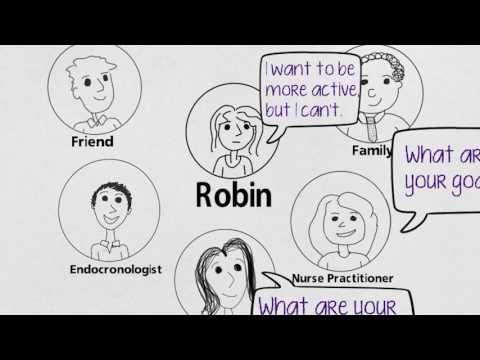
For those working in a formal setting, The “Team Approach” to healthcare requires that someone from each department providing care to a patient, meet and regularly confer with each other about the treatment plan being applied to that patient. Usually once a week, care plan meetings occur. These meetings allow the nurses, dietary professionals, physical therapists, social workers and activity personnel to gather and strategize as to the best way to help a patient. These meetings allow for a “united front,” when it comes to working with the patient, as well as his/her family members and other advocates. If each staff person takes responsibility for the whole patient, instead of his or her own specialty, much more can be observed, and care can be customized.
Patient (or Person) Centered Care
“Patient Centered Care” takes the team approach to a new level, by involving the patient to as great an extent as possible, and individuating care plans.The development of the person-centered care approach is widely attributed to professor Thomas Kitwood in the late 1980s at the University of Bradford in the United Kingdom. Person-centered care is a way of providing care to people in which the unique person and their preferences are emphasized, instead of the disease, its expected symptoms and challenges, and the lost abilities of the person. Person-centered care recognizes that dementia is only a diagnosis of the person and that there is much more to the person than her diagnosis causing the behaviors is the key.
Let’s take a “for instance,” and consider how the team approach might directly apply to your job as caregiver in a formal care setting.
Meet Sally
Sally Smith has been a patient in the long-term care facility for several months. She came to the facility when she broke her hip and has had a long and painful recovery.
One afternoon, you notice that Sally is moving slower than usual. As the hour progresses, you see her slowly slumping to one side. Immediately, you contact the charge-nurse, who has her brought back to her room. Within a few hours, Sally is back to herself and agitating to continue her art project in the crafts room. That afternoon, you meet with the care team and bring your concerns about Sally to the table.
After much discussion, the charge nurse reviews the charts reflecting Sally’s prescriptions, and finds that she was given too much pain medication for her new weight (something that the dietician brought to the table). The next day, Sally’s medications have been adjusted, her calorie count increased, and her bright smile has returned. She is able to participate in your activity and is proud of her accomplishment.
and then there's Marge
Conversely, let’s think about Marge. Marge has been part of the facility for three months. Each week, you bring her to the activity room. Each week, she sits quietly and refuses to do the activity that the activity coordinators have planned. You know the team's goal is to provider her with some enrichment, but you also know that she has the right to refuse. You bring your concerns to the team meeting.
What can the team do to get Marge involved, they ask. As Marge's caregiver, you've had a chance to chat with her about life before the need for care, and you offer the following story. “Marge used to be a classical painter. I’ve spent a lot of time with her lately, and she keeps talking about how she misses painting.” Well, the activity coordinators have been working with wood, glass beads, and wildflowers, but no painting. Your input gives them an idea.
They go visit with Marge and ask her about her painting. Turns out, she used to teach watercolors! Since Marge is still in pretty good shape, they offer her a chance to work on the development of a painting program. Because of YOU, they offer the program and have five other residents sign up. All thanks to your team meeting!
What happened is this scenario is one of a million possibilities. What is important to note is that the relationship between the people caring for Sally and Marge was imperative for their continued improvement. The team approach to healthcare brings everyone together for the good of the client. Open lines of communication, absence of territoriality, and a sense of common goals can make a world of difference in the care that we provide, and the success rate of our patient care.