Older Adults At Risk - The Frail Elderly
Older Adults At Risk
The older we get, the more frail we may become, and the less able we may be to take care of ourselves. We lose the ability to stand up to bullying or to fend off a physical attack. Compound frailty with the added complications of physical or mental decline, older adults, can be in a vulnerable position.
Where does elder abuse occur? Anywhere there are older adults. We see elder abuse in institutional settings, especially in long-term care. However, the greatest incidence of elder abuse comes at the hands of children, spouses, and partners.
Who is at greatest risk for elder abuse
It is insensitive and wildly inaccurate to lump everyone over a particular age, gender, or economic circumstance under an umbrella term like "vulnerable elder." Research has shown us that there are risk factors for becoming vulnerable, though, particularly in times of natural disasters, economic downturns, public health crises, and personal turmoil.
In our discussion of elder abuse, we know that the most likely victim of elder abuse generally falls into the following categories:
- Over Age 80
- High School Diploma or Less
- Lives Alone
- Below Federal Poverty Level
- Female
Exacerbating the above, we see that any one of the factors below can increase risk factors exponentially:
- Ambulatory Challenges
- Cognitive Limitations
- Hearing/Vision Limitations
- Self-Care Limitations (ADL)
- Independent Living Limitations (IADL)
Often, I find that students are surprised at the wide range of older adults who are at risk. So, let me ask you to consider who you would rely on if you found yourself in need of food. Now, consider what you would do if they weren't around. Who could you call? This man found himself at the end, and he had to be creative:
Please watch the video:
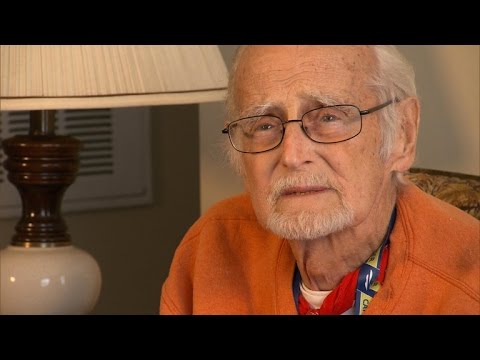
(Source: CBS Evening News)
Who is at risk for committing elder abuse?
I really want to believe that most abuse is a result of a confluence of factors, like desperation, lack of support, stress, or addiction. The unfortunate reality is that there are, indeed, folk out there in the world who will intentionally victimize, and gravitate toward violence and greed, and they are seeking those with the greatest vulnerability (see the list above).
Family and Caregivers
We know that older adults most frequently rely on a network of family and trusted friends to provide informal caregiving and support. We expect the people in our circle of support to provide us guidance and advice. Unfortunately, that dependence on caregivers and friends can open us up for abuse. Vastly underreported, estimates say that only one in fourteen cases of elder abuse is reported and that 90% of abuse is perpetrated by those within that circle of support - family, friends, and caregivers. (napsa.org, 2020)
Consider this scenario:
Margaret, an aging widow, relies on her children to help with transportation and meals. She allows them control of her checkbook so that they can offset their expenses. Margaret realizes that her daughter has been "skimming" hundreds of dollars. When she confronts her daughter, she is slapped, told she is paranoid and withholds visits from the grandchildren until her mother "gets a grip."
A recent study done at the University of Southern California suggested that we actually look at four distinct categories or profiles of abusers - "caregiver," "temperamental," "dependent caregiver," and "dangerous"—each associated with a different set of risk factors.
According to the research, the caregiver type was the largest in the sample and provided high functional and emotional support levels. The dangerous abusers had a history of trouble with the law (83%), a history of alcohol abuse (88%), and behaved in a manner that the victim often described as "emotionally draining." The temperamental group was characterized as emotionally draining with volatile tempers. The dependent caregivers provided emotional support but were characteristically irresponsible, had trouble keeping a job, and were financially dependent on the victim. (DeLiema, 2017)
"The most dangerous category of abusers were the ones most likely to be physically and emotionally abusive," Dr. Marguerite DeLiema said, "whereas those who were providing some emotional support were largely responsible for financial exploitation and neglect."
Would you be willing to report a family member or caregiver for abuse? It's not as cut and dry as you might think. Read this Forbes article, "Would You Be Willing to Report A Family Member for Financial Abuse?"
The Enemy At the Gate
Older adults are vulnerable to family, whom they want to trust. But what about the rest of the world? We know that cyber-crime is on the rise, but older adults have been falling victim to financial fraud, scams, and schemes for decades. I have seen headlines about how the "nice young man came and offered me a reverse mortgage, gave me $10,000 right up front.....and then foreclosed on my home when I couldn't pay the 800% interest rate I signed for." I hear stories about older adults who must have spent thousands of dollars on vitamins that she really didn't need. Heck, my own mother-in-law has a half-paved driveway that she paid for up-front and never saw the man again.
AARP has published a great article reporting Elder Fraud Losses.. Take a quick look, and consider the older people in your life. Are they at risk?
Prevention and Intervention
So, we've spent time identifying types of elder abuse, the economic and psychological impacts, and explored the risk factors. Now, we need to figure out how to prevent abuse from happening in the first place. What resources are available? Who can we call? What is our personal (and ethical) responsibility?
Awareness
We can reduce the risk of elder abuse by putting systems in place that can prevent abuse from the start. For example, we can create community supports and services for caregivers and older people that can reduce the risk factors tied to elder abuse (such as social isolation).
- Take a look at the types of resources available for caregivers:https://www.usa.gov/disability-caregiver
We can increase funding to provide training for people who work in aging-related care on the prevention and detection of elder abuse.
- Take a look at the National Institute of Health (NIH) website on screening and detection: https://www.ncbi.nlm.nih.gov/books/NBK208559/
We can identify ways to empower older people through senior centers and intergenerational programs that will reduce the harmful effects of ageism (biases against or stereotypes about aging that keep us from fully participating in our communities as we grow older).
- Take a look at the National Center on Elder Abuse website for resources on how we can teach our older adults to be empowered against abuse: https://ncea.acl.gov/
In addition to building supports to keep our communities safe, it is also important that we recognize what abuse is and its warning signs. This makes it possible for us to report elder abuse and stop it in its tracks. We can all learn how to recognize, prevent, and report abuse.
Intervention
Unless you are a mandated reporter (someone who works in a field that legally obligates the reporting of suspected abuse), you are under no obligation to do so.... but I never advocate turning a blind eye when we hold someone's health and safety in our hands.
Call the police or 9-1-1 immediately if someone you know is in immediate, life-threatening danger.
If the danger is not immediate, but you suspect that abuse has occurred or is occurring, please tell someone. Relay your concerns to the local adult protective services, long-term care ombudsman, or the police.
If you have been the victim of abuse, exploitation, or neglect, you are not alone. Many people care and can help. Please tell your doctor, a friend, or a family member you trust, or call the Eldercare Locator helpline immediately.
You can reach the Eldercare Locator by telephone at 1-800-677-1116. Specially trained operators will refer you to a local agency that can help. The Eldercare Locator is open Monday through Friday, 9 a.m. to 8 p.m. Eastern Time.
- Take a look at the Eldercare Locator Website: https://eldercare.acl.gov/Public/Index.aspx (Links to an external site.)
The laws in most states require helping professionals in the front lines -- such as doctors and home health providers -- to report suspected abuse or neglect. These professionals are called mandated reporters. Under the laws of eight states, "any person" is required to report a suspicion of mistreatment.