Lecture: Dementia
Dementia is an umbrella term to describe a group of diseases and conditions, each of which includes a decline in cognitive function - memory, problem-solving, language, and ability to perform everyday activities of daily living. Abnormal brain changes cause disorders grouped under the general term "dementia. According to the online resource Alzheimers.Org, dementia is often incorrectly referred to as "senility" or "senile dementia," which reflects the formerly widespread but incorrect belief that serious mental decline is a normal part of aging.
Symptoms of dementia vary among individuals and different diagnoses, but they do share some commonalities:
- Recent Memory Loss - people with dementia often forget things, but sometimes the information does not ake it to memory stores at all.
- Difficulty performing familiar tasks- Such people might cook a meal but forget to serve it or even forget they cooked it.
- Problems with Language - They misuse simple words or use the wrong words, making it hard to understand what they want.
- Time and place disorientation- They may get lost on their own street or forget how to get to a certain place and back home
- Poor Judgment - they often forget simple things like putting on a coat before going out in cold weather.
- Problems with abstract thinking - balancing a checkbook and even knowing what the numbers are and what needs to be done with them may be challenging.
- Misplacing things - they may put things in the wrong places, such as putting the iron in the freezer or a watch in the sugar bowl.
- Changes in mood - they may have fast mood swings, from calm to tears to anger in a few minutes.
- Personality changes - they may experience major changes in personality, exhibiting irritability, suspicion, or fear.
- Loss of initiative - they may become passive, avoiding going out or seeing people (Alzheimers.org; Hillier 2015)

What Causes Dementia
Dementia is caused by damage to brain cells, which interferes with the ability of brain cells to communicate with each other. When brain cells cannot normally communicate, thinking, behavior, and feelings can be affected.
The brain has many distinct regions, each of which is responsible for different functions (for example, memory, Judgment, and movement). When cells in a particular region are damaged, that region cannot carry out its functions normally. (NIH, 2020)
Different types of dementia are associated with particular types of brain cell damage in particular regions of the brain. For example, in Alzheimer's disease, high levels of certain proteins inside and outside brain cells make it hard for brain cells to stay healthy and communicate. The brain region called the hippocampus is the center of learning and memory in the brain, and the brain cells in this region are often the first to be damaged. That's why memory loss is often one of the earliest symptoms of Alzheimer's. (Alz.org)
However, even though Alzheimer's Disease is the most common type of dementia, there are many other conditions that can cause memory loss, disorientation, and inability to process memory and logic.
Dementia is a generic term that describes a global loss of cognitive function—the ability to remember, make judgments, learn, think critically, remain oriented, remain emotionally stable, and communicate.
There are two types, reversible and irreversible dementia, which are referred to as acute (sudden and reversible) and chronic (long-term and irreversible).
Reversible (acute) develops quickly – possible causes could include:
- dehydration
- malnutrition
- stroke
- heart damage
- vitamin deficiency
- brain tumor
- infection
- thyroid dysfunction
- liver disease
- drug overdose
- alcohol abuse
- depression
- sensory deprivation
If these conditions are treated, dementia symptoms will usually disappear.
Irreversible dementia (chronic) develops gradually and becomes progressively worse. The symptoms are caused by brain cell deterioration and degeneration.
We used to call it senility. But now, dementia is the umbrella term that we use for a number of dementia-like symptoms. There are many different kinds of dementia. What do they all have in common? I decline in orientation to time in space, loss of abstract, and memory. In some cases, it looks different than in other cases. Alzheimer's disease is the most common dementia, but here's the thing - we don't know that you have Alzheimer's dementia until after you die because symptomatically, most dementia looks the same. Alzheimer's disease is only detectable at the cellular level through brain tissue samples.
Does it really matter what kind of dimension we have? We tend to swipe all dimensions with a similar wipe of the brush, but it helps individuals and family members know what they're dealing with. For example, what the heck is multi-infarct dementia?
Of the most common "types" of dementia, the ones I want you to be most familiar with are (broken down by percentage of diagnosis):
- 56% Alzheimer's Disease
- 14% Multi-Infarct Dementia
- 8% Late Stage Parkinson's Dementia
- 12% Organic Causes (Creutzfeldt-Jacob Disease, Pick's Disease, Huntington's Disease, and Lewy Body Disease)
- 5% Alcohol or drug
- 4% Traumatic Brain Injury
Multi-Infarct (Vascular) Dementia
Multi-infarct dementia is also called vascular dementia, and it's what happens when there are a series, hundreds, intact, some cases thousands, of little tiny strokes that disrupt the blood flow to a particular area of the brain. It occurs so slowly that it almost looks like Alzheimer's dementia, but it is absolutely not the same when we examine the brain tissue. What is happening is, rather than individual cells becoming disruptive like an Alzheimer's disease, it is whole segments of the brain that are being killed by these little tiny aneurysms.

Lewy Body Dementia
Lewy body dementia (LBD) is the third most common cause of dementia after Alzheimer's Disease and Vascular Dementia. It is also progressive dementia and leads to a decline in cognitive function (thinking and reasoning), but the cause is from an abnormal microscopic deposit that damages brain cells over time. These "Lewy Bodies" are often present in those with Parkinson's and Alzheimer's Disease causing complications that may be hard to distinguish from the primary diagnosis. For example, many people with Parkinson's eventually develop thinking and reasoning problems; conversely, people with Lewy body dementia may experience movement symptoms, such as hunched posture, rigid muscles, a shuffling walk, and trouble initiating movement.
This overlap in symptoms and other evidence suggests that Lewy body dementia, Parkinson's disease, and Parkinson's disease dementia may be linked to the same underlying abnormalities in how the brain processes the protein alpha-synuclein. Many people with both Lewy body dementia and Parkinson's dementia also have plaques and tangles, which are the hallmark brain change associated with Alzheimer's Disease.
Please watch this video:
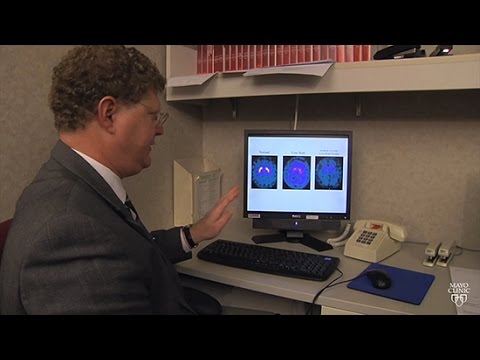
Alzheimer's Disease
At this point, you may be asking yourself "what is Alzheimer's disease?" Let's take a moment to define and clarify AD and dementia. First, AD is a disease of the brain that causes a steady decline in memory. Alzheimer's is a form of dementia which is a loss of intellectual function (thinking, remembering, and reasoning) severe enough to interfere with daily life. Alzheimer's disease is the most common form of dementia. Students frequently ask "if you have dementia then is it Alzheimer's?" Alzheimer's is a form of dementia and is the most common form of dementia of which there are many. Alzheimer's Disease accounts for 70% of all dementia diagnoses. According to the Alzheimers Association, over 5 million older adults are currently living with Alzheimer's Disease.
Prior to addressing the diagnosis of Alzheimer's disease let's look at the Ten Warning Signs developed by my colleague Cheryll Moore to make ourselves aware of common changes to look for in people. Common symptoms may include:
- Memory loss is indicated by loss of interest in common activities, dates, and obligations.
- When we think of the loss of ability to do familiar tasks these may include things like making the bed, folding clothes, making a meal, traveling to work, etc.
- Language problems can refer to problems finding words or the use of inappropriate words.
- When people are disoriented to time and place they may find themselves unable to keep an appointment that they have had for years. Ex., a woman has a standing hair or nail appointment each Friday of the week at 2:00 PM and she arrives on Wednesday at 9:00 AM for her appointment.
- Poor or decreased judgment can occur in this manner. For example, the person starts to make decisions they would not usually make like dressing for the summer in the middle of winter.
- Problems of abstract thinking may include the inability to balance the checkbook after doing it successfully for years.
- Misplacement of things can occur in the following ways: placing your wallet in the freezer, hiding money in dresser drawers and under the dresser, and in envelopes with other paperwork, etc.
- Rapid mood or behavioral changes, examples include: Some families would say to me my loved one just blows up over virtually nothing and for no reason.
- A drastic personality change would be like someone who never swore a word in their life to constantly swearing profane words for no other apparent reason than that of having dementia.
- Loss of initiative can be seen through the unwillingness to participate in activities, social organizations and interactions, and loss of drive to do things in life. People who are demented tend to withdraw from life and those they know as time progresses and the disease worsens.
History of Alzheimer's Disease

1906 a German physician, Alois Alzheimer, utilizing a silver stain, first discovered the hallmark amyloid plaques and neurofibrillary tangles of the brain. We still do not know the exact role these structures play in the loss of brain cells and the disease process. Just an interesting point of note, while AD is most common in those over age 85 - the patient from whom Dr. Alzheimer developed his discoveries was only age 51!
Alzheimer's Disease- Causes?
Alzheimer's Disease Statistics indicates that at present, there are approximately 4.5 million Americans with AD. We always multiply the number affected by four or five, which is the number of people needed to care for the person with AD. So, in reality, there are about 18-22.5 million people directly affected by AD.
Please watch this video:
With one in ten over age 65 and nearly half of those over age 85 having AD, we can readily observe that age is directly related to this disease.
The telltale signs of Alzheimer's disease are tangles in the nerve fiber of the brain cells and plaques (called amyloid plaques) found in areas around cells. These are considered the signature of Alzheimer's disease. Destruction begins in the hippocampus, which is critical for memory. It is a brain disease and not normal aging. This dementia is not caused by the hardening of the arteries or blood vessels. Most AD victims have normal blood flow to the brain but not within the brain itself.
Some people have been found to have an increased amount of aluminum (which acts as a toxin) in the brain. But no one is sure if that is the cause of just an effect of the disease. In fact, many experts deny that aluminum plays a role at all. Yet many concerned individuals have thrown out their aluminum cookware and use only stainless steel and other metal baking and cooking pans.
AD may be the result of a slow-growing virus, a genetic abnormality (an abnormal chromosome that impairs protein metabolism), or an immune problem, but the most reliable theory is the possibility of a missing neurotransmitter called acetylcholine.
Alzheimer's Disease - Diagnosis
There is no single test for AD. It is diagnosed by ruling out all other curable or incurable causes of memory loss. A positive diagnosis can only be made by studying a small piece of brain tissue after death (on autopsy).
A working, or clinical diagnosis, can be made by health professionals trained in various testing procedures.
One test often used is to have the patient draw the face of a clock and place the hands on the clock to read various times, such as 10 minutes after 11. This test can determine normal aging from patients who have dementia and thus difficulty drawing a clock. The 'clock test' tests an individual's cognitive, graphic, and visual-spatial abilities. People with unilateral hemisphere deficits (problems on one side of the brain) may neglect to draw one side of the clock. The inability to space numbers evenly or to sequence numbers appropriately can indicate "planning" deficits. Experts can also tell about a person's mental status by watching them draw the clock. While the clock test is sensitive to dementia, it can not diagnose different types of dementia, such as Alzheimer's.

Symptoms or Stages of Alzheimer's Disease
With a disease trajectory ranging between 1 and 10 years on average, Alzheimer's Disease progresses at a very individual rate.
Early - Alzheimer's patients generally experience memory loss for recent events and disorientation during the first two years. They may go to the local store and not be able to find their way home.
Mid Stage - The patient will have progressive problems with memory loss, judgment, concentration, speech and physical coordination. This is when the patient may forget to take abath and have problems with one-routine chores.
Advanced stage - victims are often afraid of running water and refuse to bathe. In time, the patient's family and caregiver will probably have to provide full-time supervision because of the patient's tendency to wander off and engage in meaningless and often socially unacceptable behavior.

Treating Alzheimer's Disease
Because of the chronic stress Alzheimer's Disease places on the entire family as they watch a loved one slowly regress in front of their eyes, AD is often called a "family disease." Although there is no cure for AD, comprehensive treatment should include the entire family with:
- emotional support
- counseling and educational programs about AD for patients and family members (to provide a safe and comfortable environment at home)
- respite care
- The use of a companion, a homemaker, or an aide at home, or special AD care programs (such as adult day care centers).
Family members should obtain early legal consultation concerning financial and long-term care planning along with end-of-life decisions. The lifespan of a AD patient can range from 2-20 years, and it is possible for the patient to outlive the caregiver, especially with the added immunity problems associated with the stress of caregiving.
Alzheimer's disease and other dementias will affect all of us - be it as a patient, family members, or caregivers. It is imperative that we understand both biologies of what is happening and learn ways to treat people living with dementia with the appropriate levels of care, supporting health and safety, and preserving dignity.