Lecture: A Changing Population
Before we get deep into the content, I'm going to ask you to consider how you organize your thoughts. As you read this first chapter and accompanying videos, which introduces the concept of gerontology (the study of human aging) and answer the question of why we study aging, consider the older people in your life and how you perceive them as individuals vs. "older adults" as a population.
Why do we study aging? What can a course like this teach you about "old people" that you don't already know? Why do "intergenerational relationships" actually matter? Isn't it how things work - young people don't want to get old, and old people don't like young people, right? How in the world is this teacher going change your outlook about generation gaps? Hang on, folks, because this is not your average class! We are gathered here to honor ALL generations - because if we can get out of our way, we can see that there is INCREDIBLE value in learning from each other and creating collaborations instead of conflicts. Hopefully, you can get a few smiles along the way, too!
Our first module is designed to get your feet wet, both in terms of how the course works, but in terms of "terms!" If we have a shared vocabulary from the start of class, you will more easily connect the dots as we go through each module. You will find that gerontology is multidisciplinary - with significant foundations coming from psychology, sociology, biology and chronology. In fact, you will probably come across terms that are familiar if you've ever taken courses in those areas of focus. As you participate in class, see if you can identify the perspectives, biological, chronological, psychological or social aging.
I want to introduce you to the "realities" of aging in 2020, and look back a little bit on where we've come from and how being an older adult NOW is way better than it's ever been. We need to talk about demographics and trends and address some pretty inaccurate ideas about the aging experience. We will journey through the different theories that Gerontologists apply to the study of human aging, and hopefully, give you some foundation knowledge that will help you figure out how to embrace your own aging, and perhaps be a little more aware of what is happening to those in your life who are, themselves, aging.
Watch this 5 minute video from the University of Illinois. It sets the framework for understanding how different we are across the spectrum of aging, and how differently we are aging as a nation.
Aging Populations
Exactly how did our population grow to become so age-heavy? We know that the population of the world is growing exponentially, but we think about population growth most frequently in terms of babies being born.
As you're looking through this information, the question that I want you to be considering is what you think the future will look like. With every generation, there are policy changes and shifts, and I think it's safe to say that we will need to carefully examine both finance, healthcare, social policy, and family commitment to intergenerational support as our population over the age of 85 continues to grow.
According to US Census data, the fastest-growing segment of our population is over age 85. Life expectancy has increased consistently throughout the 19th and 20th centuries and continues to grow (albeit more slowly) in the 21st century.
Population Pyramids
Have you ever seen a population pyramid? It's a tool that demographers use to show a snapshot of a population by age and gender. Take a look at this example. If you look carefully, you can see that 2010 data has been overlayed with 2019 data to show the shift.

What you're seeing is an INCREASE in the number of men and women over age 40, and a decrease in the number of men and women under age 40. The real shifts have occurred in the incredible increase in those men and women over age 65.
Why does this matter? Well, consider the population who works. If we have a lot of people who are work-aged, we can more easily provide for those traditionally non-worked age (under 18 and over 65). With more older adults, there is increased strain on the smaller population of working age adults. A couple of things can happen. The "younger-old" may need to stay in the workforce longer. The "work-aged" may need to be providing both financial and caregiving support to the "oldest-old."
According to US Census data, the fastest growing segment of our population is over age 85. Life expectancy has increased consistently throughout the 19th and 20th centuries, and continues to grow (albeit more slowly) in the 21st century. Take a moment to read the information housed in the US Census Newsroom, "65 and Older Population Grows Rapidly as Baby Boomers Age." (Click the image of the Newsroom below to go to the site)
Please read: Census Bureau, 65 and Older Population Grows Rapidly as Boomers Age
If we look at 2010 census data (the most recent), we can see the huge jump since 1900. The population over age 65 grew from less that 5% to almost 12% of the overall population. That was a LOT, right? Well, recent projections from the census predicts that by 2050, that number will have doubled again, with older adults actually outnumbering children for the first time in history.
Take a look at the image below. It shows a point anticipated to occur in 2035, where for the first time in US history when older adults are expected to outnumber those under age 18.

Lifespan vs. Life Expectancy
How long do we live? That's an interesting question. Two terms are often used to answer the question of longevity. The human lifespan is the maximum number of years an individual from the human species can live based on observed examples. (Roughly 120 years, according to current science.) Though this definition of lifespan may seem simple enough, it is often confused with other common concepts in the study of aging - life expectancy.
While the term lifespan refers to the maximum number of years an individual can live, life expectancy refers to an estimate or an average number of years a person can expect to live. Most simply put, life expectancy can be attributed to and impacted by an individual and their personal health history, genetics, and lifestyle, whereas lifespan holds for all living humans.
What is average life expectancy? That depends! Below is a map of the United States in 2020, with estimates for life expectancy at birth. The average life expectancy in the United States is 81 for women and 76 for men. However, regionally, if you live in California, Washington, Minnesota, or New Hampshire, you have a potentially longer life expectancy than in New Mexico, Oklahoma, and several states in the South.

Life Expectancy and COVID
Of the 1,082,383 deaths caused by COVID-19 in the United States, around 287,058 occurred among those aged 85 years and older. This statistic shows the number of coronavirus disease 2019 (COVID-19) deaths in the U.S. from January 2020 to December 2022, by age.
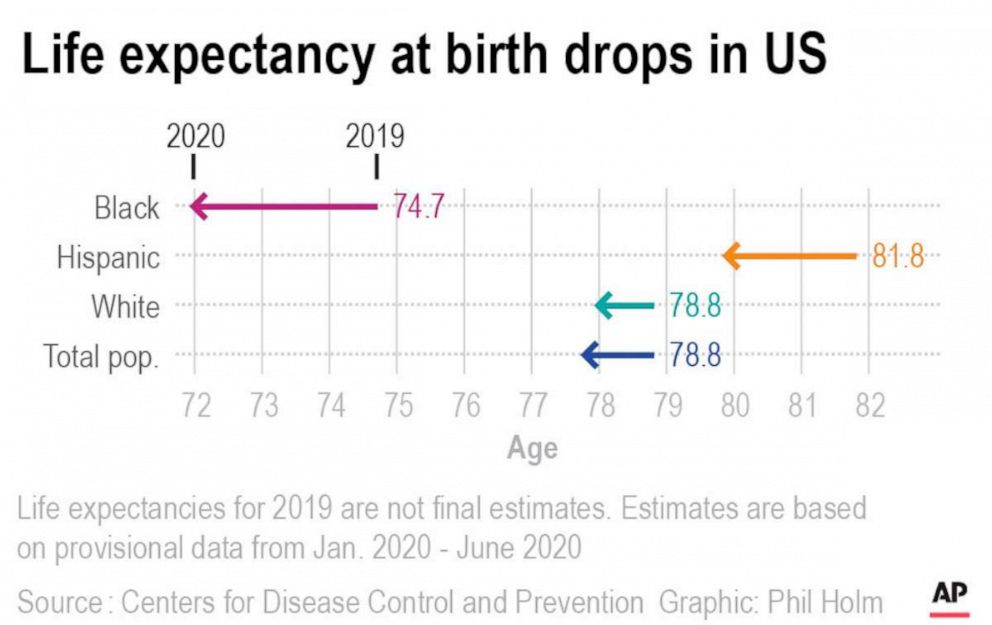
According to the New York Times, the pandemic was "responsible for the decline in American life expectancy in nearly 100 years."
Between 2019 and 2021, average life expectancy dropped by almost 3 years.
In 2021, the average American could expect to live until the age of 76. The figure represents a loss of almost three years since 2019, when Americans could expect to live, on average, nearly 79 years.
Researchers expect that these statistics will eventually normalize, but it is a stark reminder of how the pandemic disproportionally impacted the oldest of our population.
An Aging California
California is projected to be one of the fastest-growing States in the nation in total population. In 2016, California comprised 12 percent of the nation's population1 and is expected to grow 30 percent by the year 2060 (an increase of 11.7 million people)2 . In California, the population aged 60 years and over is expected to grow more than three times as fast as the total population and this growth will vary by region.
Why does this matter? According to a statement by California Governor Gavin Newsom, "An aging population will introduce new opportunities for economic and community growth, but also drive increased health and long-term care costs. We need a plan that brings everyone to the table – local communities, labor, private sector and philanthropy – to help us understand what’s coming and guide us toward taking better care of older Californians."
Let's just look at some numbers:
California 60+
The po pulation over age 60 will have an overall increase of 166 percent during the period from 2010 to 2060. More than half the counties will have over a 100 percent increase in this age group. Twenty-four of these counties will have growth rates of over 150 percent. These counties are located throughout the central and southern areas of the State. The influence of the 60 and over age group on California is expected to emerge most strongly between 2010 to 2030
Where are the older adults? The most significant growth is projected to be in San Bernardino and Riverside Counties, and the counties just south and east of San Francisco. That means more older adults who may require support for independent living, or for direct assistance with activities of daily living.
California 85+
The population over age 85 will increase at even a faster rate than those over 60 years of age, having an overall increase of 489 percent during the period from 2010 to 2060. Of the State's 58 counties, 55 will have increases of more than 150 percent, 45 will have increases of more than 200 percent, and 36 will have over a 300 percent increase in the number of persons aged 85 and older.
Counties can expect to experience even higher growth rates after 2020. In particular, the influence of the 85 and over age group on California will emerge most strongly between 2030 to 2040 as the first of the baby boomers reach 85 years of age.
This population will most likely require in-home assistance and more formal long term care.
The Population is Changing - At EVERY age!
It doesn't take much to remind us that we live in a rapidly evolving cultural, ethnic, religious, gender, and equity-based society. Individual groups are strongly advocating for balance and equity. One of the "-isms" that seems to be distinctly missing from the conversation, is the special needs of the older population, and the idea of "age-ism." (Hoyer & Roodin, 2009).
Yeah, I know, from a young person's perspective it may seem that older adults have it made. They have finished with their careers, and are reaping the rewards of years of hard work, they get super cool discounts on phone plans and can order off the cheap menu at Denny's. However, there are as many older adults who are at risk for poverty, discriminatory hiring practices, race, and gender bias, as there are young people.
Because age has not been brought to the center of focus in our most recent societal conversations, I have grave concerns that by the time our current population ages, many of these issues will have traveled with them along life's journey. It is important for us to understand each individual and the burden that they carry, while different from our own is equally significant.
For now, it is enough to introduce you to the individual groups, and the demographic shifts, that are currently a part of our national conversation. It is imperative that we respect the individual nature of each of these cultures, because each of them addresses aging in a very distinct way, and I think we would be well served to take the best practices from each and apply them to the whole.
Ethnogerontology - A Cultural and Social Shift
How we age, and the way our culture interacts with the changes in demographics....well, there's a bit of a lag between what we are chronologically capable of, and what our society will support. There are some serious considerations that come with living longer - we need to develop strategies for our physical, emotional and financial wellbeing that we can apply across the lifecourse.
Please watch the video lecture: