7.8 Exactly What IS Succesful Aging?

The Problem With the Phrase “Successful Aging”
Honestly, the phrase successful aging has always bothered me a little.
It sounds suspiciously like there is a grading rubric somewhere. As though aging is a group project and some people showed up prepared with color-coded binders and organic snacks while others apparently forgot the assignment entirely.
American culture especially loves the idea that aging can be conquered if we simply work hard enough at it. We are surrounded by messages promising “agelessness,” optimization, longevity hacks, supplements, productivity systems, ten-step skincare routines, and enough antioxidants to preserve a mummy indefinitely. The cultural fantasy goes something like this: if you exercise correctly, think positively, hydrate aggressively, and eat enough kale, you will somehow bypass frailty, grief, disease, wrinkles, dependence, and mortality itself.
Meanwhile, actual human bodies continue doing deeply human things like developing arthritis, producing mysterious noises when standing up, forgetting why we walked into the kitchen, and refusing to metabolize pizza the way they did in 1992.
And honestly, the problem with the phrase successful aging is not that people should stop caring about health. Health matters. Movement matters. Relationships matter. Sleep matters. Meaning matters. The problem is that the phrase sometimes implies that aging well is entirely under individual control.
It is not.
Human beings do not age under equal circumstances. Some people inherit strong genetics. Others inherit chronic disease. Some have access to safe housing, healthcare, nutritious food, financial stability, and social support. Others spend decades surviving stress, discrimination, trauma, caregiving burdens, poverty, isolation, or physically exhausting work. Some people arrive in later life with resources. Others arrive exhausted.
So before we even begin discussing successful aging, we need to acknowledge something important:
human aging is not a level playing field.
Aging Begins Long Before Old Age
At the same time, aging itself is universal. Every single one of us is aging right now. Not eventually. Not at retirement. Not when we qualify for senior discounts and start yelling about thermostat settings. Aging begins at birth and continues until death. It is not a single stage of life, but a continuous developmental process involving biology, psychology, relationships, culture, identity, and environment across the entire lifespan.
Gerontologists often describe development through several types of life influences. Some are normative age-graded influences, meaning experiences tied fairly closely to age itself. Learning to walk as a toddler, entering puberty during adolescence, becoming a parent during adulthood, or retiring later in life are all examples of developmental experiences strongly connected to age expectations.
Other influences are normative history-graded influences. In other words, history itself shapes development. A person who lived through the Great Depression, Vietnam, the AIDS epidemic, September 11th, the COVID-19 pandemic, or the rise of social media carries a different developmental experience than someone born into another historical moment. Cohorts move through life together under shared social conditions, even if they respond to those conditions differently.
Then there are non-normative influences, the deeply personal events that interrupt or redirect life unexpectedly:
the death of a parent during childhood,
a disabling accident,
war,
infertility,
unexpected success,
chronic illness,
caregiving,
migration,
trauma,
recovery,
reinvention.
And honestly, these non-normative experiences often shape people just as profoundly as age itself.
That is why aging can never be understood purely through chronology.
Chronological age simply measures the amount of time since birth. But human beings experience aging in multiple ways simultaneously. There is biological age, involving the wear, resilience, and functioning of the body itself. There is psychological age, reflecting emotional maturity, adaptability, cognition, identity, and behavior. There is social age, shaped by roles, expectations, relationships, and cultural ideas about where people are “supposed” to be in life. And then there is subjective age, which honestly may be the most fascinating of all: the age we actually feel.
Some days people feel ancient because they slept wrong and their spine apparently entered the witness protection program overnight. Other days people in their seventies are traveling, creating art, starting businesses, falling in love, going back to school, or dancing badly at weddings with the confidence of a twenty-three-year-old.
Human aging is complicated like that.
Midlife Changes the Questions
When we are younger, aging feels abstract and strangely exciting. Children cannot wait to become older. Teenagers count the days until they can drive. Young adults race toward milestones:
graduation,
careers,
marriage,
children,
independence,
achievement.
We spend the first half of life trying desperately to become older than we are.
Then somewhere around midlife, the emotional tone shifts dramatically.
The body changes.
Parents age.
Friends get sick.
Children grow up.
Doctors suddenly begin saying things like “routine screening.”
You discover you can injure yourself sleeping.
You realize the musicians you loved in high school are now receiving lifetime achievement awards.
And quietly, the psychological questions begin changing too.
Not:
“What do I want to be?”
But:
“What matters now?”
“Have I done enough?”
“Who am I outside of my responsibilities?”
“How do I want to spend the time I have left?”
“What actually makes a life meaningful?”
Midlife often becomes the first time many people truly recognize that time is finite. There is no turning back the clock. That realization can feel frightening, liberating, motivating, disorienting, or all four simultaneously.
This is also why middle adulthood is frequently described as a period of reevaluation and reconstruction. Some people double down on old identities. Others begin completely reinventing themselves. Some return to school. Some leave careers. Some become caregivers. Some lose spouses. Others discover entirely new passions and identities they never had time to explore earlier in life.
Many adults in midlife also become part of what researchers call the Sandwich Generation. They may still be supporting children financially or emotionally while simultaneously caring for aging parents, all while continuing careers, marriages, bills, and the general exhaustion of everyday adulthood.
And honestly, that experience changes people.
Mortality has a way of reorganizing priorities.
Things that once felt urgent lose some of their grip. Some people become more interested in relationships than status. Others seek creativity, spirituality, service, peace, reinvention, or authenticity. Some realize they have spent decades performing a version of themselves that no longer fits particularly well.
And honestly, that developmental shift is not failure.
It is awareness.
The Traditional Model of "Successful Aging
Gerontologists have spent decades trying to define what successful aging actually means. One of the most influential models came from researchers John Rowe and Robert Kahn, who argued that successful aging involved avoiding disease when possible, maintaining physical and cognitive functioning, and remaining actively engaged with life
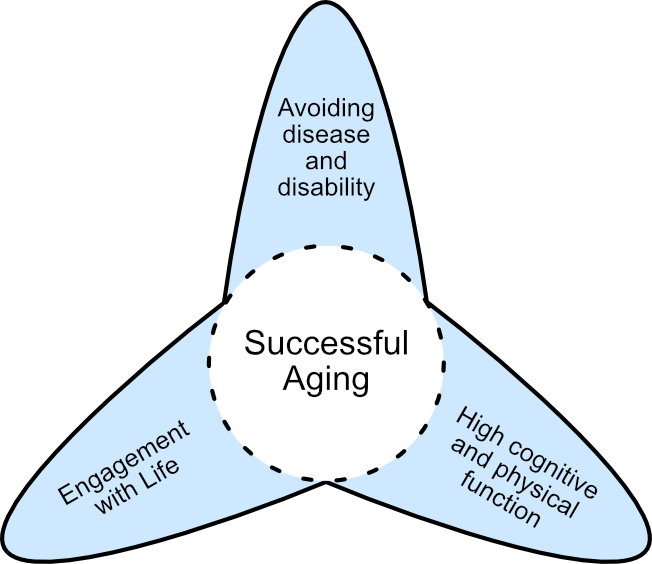
At the time, this was actually a radical shift. Earlier generations often viewed old age almost exclusively through decline and dependency. Rowe and Kahn challenged the assumption that aging automatically meant passivity or irrelevance. Their work emphasized prevention, activity, engagement, adaptability, and continued participation in life.
And honestly, there is tremendous value in that perspective.
Healthy nutrition matters.
Movement matters.
Sleep matters.
Social engagement matters.
Preventive healthcare matters.
Cognitive stimulation matters.
Human beings absolutely influence aspects of how they age.
But over time, many researchers and older adults themselves began pushing back against the model too.
Because what happens if someone develops Parkinson’s disease?
Or survives cancer?
Or becomes disabled?
Or experiences chronic pain?
Or develops dementia despite having done “everything right”?
Did they somehow fail at aging?
Most gerontologists today would argue absolutely not.
Because human aging is more complicated than optimization.
Some people remain physically healthy yet emotionally isolated. Others experience significant physical limitations while remaining psychologically resilient and deeply connected to life. Some lose mobility yet gain wisdom. Some lose careers and discover identity beyond productivity for the very first time. Some become less externally impressive and more internally whole.
And honestly, modern culture struggles with this idea because we are deeply conditioned to associate human worth with performance.
Productivity.
Youth.
Efficiency.
Achievement.
Independence.
But aging eventually forces confrontation with a difficult truth:
human value cannot depend entirely on output because every human body eventually becomes vulnerable.
Lifespan, Healthspan, and the Longevity Obsession
Researchers distinguish between several different concepts related to longevity. Lifespan refers to the maximum number of years humans can potentially live, while life expectancy reflects the average number of years a person born within a certain population is statistically expected to survive.
And honestly, modern culture has become a little obsessed with extending both.
Entire industries now revolve around “anti-aging,” optimization, biohacking, supplements, and promises that science may eventually allow humans to dramatically extend lifespan itself. Some futurists genuinely believe medicine and technology may radically slow or even reverse aspects of biological aging. Optimists believe humans will continue steadily improving longevity and quality of life through public health and medicine. Realists point out that despite extraordinary advances, human beings still remain vulnerable to disease, frailty, decline, and death.
Meanwhile, another concept has become increasingly important:
healthspan.
Healthspan refers not simply to how long we live, but how long we live with meaningful quality of life, independence, engagement, and relative well-being.
And honestly, there is something fascinating about the fact that human beings spend so much energy trying to extend life while often spending far less time discussing what actually makes life meaningful.
Because eventually the question shifts from:
“How long can I live?”
to
“How do I want to live?”
That is a very different question.
The Demographic Reality of Aging
The United States itself is also changing dramatically because of increased longevity and demographic aging. For the first time in history, older adults are projected to outnumber children within the coming decades. The population over age 85 is one of the fastest-growing demographic groups in the country. Women continue to outlive men statistically, and older adulthood is becoming increasingly racially and ethnically diverse.
At the same time, many cultural myths surrounding aging continue to persist.
Most older adults do not live in nursing homes.
Most remain in community settings.
Many continue working, caregiving, volunteering, creating, mentoring, learning, traveling, and contributing long after traditional retirement age.
And honestly, this demographic shift is forcing society to rethink almost everything:
healthcare,
housing,
retirement,
caregiving,
community planning,
employment,
intergenerational relationships,
and even our definitions of adulthood itself.
Because aging is no longer a brief final chapter for a small percentage of the population.
For many people, later adulthood may now span thirty or even forty years.
That changes the developmental conversation entirely.
So What Actually Makes a Life Feel Well-Lived?
Research consistently shows that life satisfaction in later adulthood tends to be connected less to perfection and more to factors like meaningful relationships, purpose, emotional resilience, connection, humor, adaptability, curiosity, engagement, and continued growth.
One older adult described successful aging this way:
“Successful aging is accepting what you are at this time. Not dwelling on what you could have been or forgot to do or couldn’t do or things you want to do that are no longer capable of it… but to be satisfied with where you are.”
And honestly, I think there is something deeply wise in that perspective.
Not resignation.
Not giving up.
Not stagnation.
Adaptation.
Human beings were never promised perfect health, unlimited productivity, or immunity from grief, illness, loss, or change. Yet many people still age with tremendous depth, humor, compassion, creativity, wisdom, and emotional richness.
Perhaps successful aging is not about avoiding change altogether.
Perhaps it is the ongoing ability to remain connected, curious, flexible, engaged, and fully human while life continues changing around us.
How do the "Experts" define "Successful Aging?
Can Aging Be “Cured”?
At this point, the conversation around successful aging takes an interesting turn, because not everyone agrees on what aging actually is.
For most of human history, aging was understood as a natural developmental process. Bodies changed. Systems wore down. Humans adapted as best they could and eventually died. That was simply considered part of the human condition.
Modern science, however, has complicated that conversation considerably.
Some researchers and futurists now argue that aging itself should be viewed as a disease process, or at the very least, as a collection of biological mechanisms that can potentially be slowed, altered, repaired, or even reversed. From this perspective, wrinkles, frailty, cardiovascular disease, cognitive decline, osteoporosis, and many chronic illnesses are not entirely separate problems. They are interconnected consequences of cellular aging itself.
And honestly, once you frame aging that way, the entire conversation changes.
If aging is a disease process, then theoretically it becomes something medicine should try to treat.
Researchers are now studying everything from cellular senescence and stem cell regeneration to gene therapies, regenerative medicine, artificial intelligence in healthcare, anti-inflammatory interventions, and medications specifically designed to target the biological mechanisms associated with aging itself. Some futurists believe humans may routinely live beyond one hundred years in the near future. Others speculate that children born today may become the first generation for whom living to one hundred and twenty or even one hundred and fifty becomes medically plausible.
And honestly, this is where the conversation starts sounding a little like science fiction wandered into a biology lab and refused to leave.
At the same time, critics raise important ethical, social, and psychological concerns. Because extending lifespan and improving the human experience of aging are not necessarily the same thing.
Living longer does not automatically mean living better.
If human beings begin routinely living well into their hundreds, society itself changes dramatically. Retirement systems would need restructuring. Healthcare systems would face enormous pressure. Housing, employment, caregiving, and family structures would all shift. The meaning of adulthood itself would likely change.
Right now, most societies still operate on older assumptions about the lifespan. Education happens early. Careers dominate adulthood. Retirement occurs later. Death follows afterward within a relatively compressed period of time.
But what happens if later adulthood lasts forty or fifty years?
Do people have multiple careers across a century-long life? Do marriages last seventy years? Do people retire more than once? How do we financially sustain dramatically extended longevity? Who gets access to life-extending technologies, and who does not?
And honestly, there is an uncomfortable question sitting quietly underneath all of this:
what happens if only wealthy individuals can afford dramatically extended life while marginalized populations continue facing shortened life expectancy?
Because longevity has never been distributed equally.
The psychological questions become just as fascinating.
Human development has traditionally unfolded through somewhat recognizable stages:
childhood,
adolescence,
young adulthood,
midlife,
later adulthood.
Each stage carries developmental tasks, identities, transitions, and expectations. But what happens psychologically if adulthood itself becomes radically extended?
Will people delay marriage and parenthood even further?
Will identity become more fluid across the lifespan?
Will humans experience multiple major reinventions?
Will people continue learning and retraining across an entire century?
Will intergenerational conflict intensify if older adults remain in positions of economic and political power much longer than previous generations?
And honestly, there is another profound question hidden underneath all of this:
if death becomes more distant, do human beings value time differently?
Part of what gives life urgency is the awareness that it is limited.

Mortality shapes priorities.
Impermanence gives emotional weight to relationships, creativity, love, contribution, and meaning-making. Many existential psychologists argue that awareness of death is actually part of what motivates human growth in the first place.
Which raises a fascinating possibility:
what happens psychologically if humans begin believing they have almost unlimited time?
At the same time, most gerontologists would argue that the real goal should not simply be extending years of life, but improving quality of life across those years.
This is where the concept of healthspan becomes especially important.