4.1 Personality and Aging
Personality is a relatively stable set of traits that predict our individual behavior. Social scientists believe that the root of our personality is established by the time we are about eight years old.
Personality refers to the relatively stable patterns of thinking, feeling, behaving, and interacting that make each of us uniquely ourselves. It influences how we respond to stress, build relationships, solve problems, interpret experiences, express emotion, and move through the world. While our behaviors may shift across different stages of life and under different circumstances, many social scientists believe the foundational elements of personality begin developing very early in childhood. By around age eight, many core temperament traits are already becoming visible, although life experiences continue shaping how those traits are expressed across adulthood.
That does not mean people are frozen in place by elementary school. Human beings continue growing, adapting, learning, healing, and changing throughout life. Our values may evolve. Our priorities shift. Trauma, education, relationships, parenting, illness, loss, culture, spirituality, work, and aging itself all influence how personality is expressed over time. But underneath those changing roles and experiences, there is often a recognizable thread of continuity.
Think about an older adult you know well. Can you imagine what they might have been like at twenty? The sarcastic grandfather who still teases everyone at family dinner may have been the class clown in high school. The highly organized grandmother with color-coded calendars and emergency backup plans probably did not suddenly wake up at age seventy-two and discover a passion for structure. The quiet older adult who prefers solitude may very well have been introverted long before retirement made that preference easier to accommodate.
There is an old saying in gerontology that as people age, they often become “more of who they already were.” In many ways, aging strips away some of the social performance required during earlier adulthood. Careers end. Parenting roles shift. Social expectations loosen. Energy becomes more limited, and people often spend less effort pretending to enjoy things they never actually liked in the first place. Personality traits that were once moderated by work demands, social pressure, or family obligations may become more visible over time.
Students often ask whether major life events or trauma can change personality. The answer is complicated. Significant experiences absolutely affect behavior, coping styles, emotional regulation, trust, worldview, and psychological health. Trauma can increase anxiety, hypervigilance, withdrawal, or emotional reactivity. Loss may soften some people and harden others. Chronic illness may reshape identity and coping patterns. However, even through those experiences, many core personality tendencies remain surprisingly stable across the lifespan.
For example, an introverted person may learn to become an effective public speaker, teacher, or performer out of necessity, skill, or professional expectation. Outwardly, they may appear highly social and confident. Internally, however, they may still recharge through solitude and experience social interaction as draining rather than energizing. Behavior and personality are related, but they are not always identical.
Personality also involves both internal and external dimensions. Some experiences are covert, meaning they occur internally through thoughts, emotions, fears, motivations, or private reactions. Others are overt, meaning they are expressed outwardly through speech, behavior, facial expression, body language, or social interaction. Human beings do not always show the world exactly what they are feeling internally. A person may appear calm while experiencing tremendous anxiety, or appear cheerful while privately struggling with grief or depression.
As personality develops, both genetics and environment play important roles. Researchers continue debating the exact balance between nature and nurture, but evidence strongly suggests that temperament has a significant biological component. Studies involving twins and long-term personality development suggest that genetics may account for a substantial portion of temperament and personality tendencies, although environment, relationships, culture, trauma, education, and life experiences also strongly influence how those tendencies are expressed.
In other words, personality is not created by genetics alone, nor is it completely molded by environment. It is the result of a continuous interaction between biology, experience, culture, relationships, and adaptation across the lifespan. Personality is shaped over time, refined through experience, and revealed most clearly in how people cope with the ordinary and extraordinary challenges of life.
Social Influences
Where we grow up, with whom we develop, and in what cultural context we mature all have a profound influence on our early personality development.
Personality does not develop in isolation. Human beings are shaped not only by genetics and family systems, but also by the historical period in which they grow up. Every generation is influenced by the cultural realities, economic pressures, political tensions, educational opportunities, technological advances, wars, and social expectations surrounding them during childhood and adolescence.
For example, many contemporary older adults spent their formative years during the aftermath of World War II, the Korean War, Vietnam, the Cold War, civil rights movements, economic instability, and periods of profound social change. Those experiences shaped how people viewed safety, authority, work, family, sacrifice, education, and risk. A generation raised during periods of uncertainty and instability may develop very different coping styles and worldviews than generations raised with different social conditions and expectations.
Personal experiences also matter enormously. Individuals who experience trauma, poverty, discrimination, instability, abuse, addiction, loss, or chronic stress early in life may develop very different coping patterns than those exposed to stability, security, opportunity, and support. Human personality is not created by one single event or factor. It is the culmination of biology, environment, relationships, stress exposure, culture, and lived experience interacting across the lifespan.
Because personality is so complex, psychologists and researchers have developed multiple theoretical models to help explain patterns of temperament, coping, stress response, and behavior. No single model fully captures the complexity of human personality, but each offers useful insight into how people respond differently to life experiences, stress, relationships, and aging.
Personality Types - The Alphabet of Personality Types... Explained

The idea of labeling personalities with letters began primarily as a way to study stress, behavior, and physical health rather than as a complete theory of personality. Unlike modern personality models that attempt to describe broad human temperament, the “Type” personality systems were originally developed to explain why some individuals seemed more vulnerable to stress-related illness than others.
The earliest and most influential of these models was the Type A and Type B personality theory, developed during the 1950s by two cardiologists, Meyer Friedman and Ray Rosenman. Interestingly, the theory reportedly emerged after they noticed that the waiting room chairs in their cardiology office were wearing out unusually fast along the front edges. Patients were not sitting back calmly. They were perched forward impatiently, gripping the arms of the chairs, fidgeting, rushing, and displaying visible tension. Friedman and Rosenman began wondering whether certain behavioral patterns might contribute to cardiovascular disease.
Type A
They eventually described Type A personalities as highly competitive, achievement-oriented, impatient, time-urgent, perfectionistic, and chronically stressed individuals who often functioned in a constant state of psychological acceleration. These individuals tended to multitask, interrupt conversations, become frustrated easily, and feel intense pressure to achieve. Early research suggested that Type A behaviors might increase the risk of heart disease, hypertension, and stress-related illness, although later research showed the relationship was more complicated than originally believed.
Individuals fitting in this category are often highly driven, competitive, perfectionistic, time-conscious, achievement-oriented, and easily frustrated by delays or inefficiency. These individuals often thrive in high-pressure environments but may also experience increased stress-related health risks such as hypertension, cardiovascular disease, chronic tension, and burnout. You know the type. They are mentally reorganizing the grocery store line while simultaneously answering emails and wondering why nobody else appears concerned about efficiency.
Type B
Type B personalities were described as more relaxed, patient, flexible, and less emotionally reactive to stress. Type B individuals were thought to experience lower levels of chronic tension and urgency, even while remaining productive and successful.
These personalities tend to be more relaxed, flexible, patient, and less reactive to stress. They may still work hard and achieve significant goals, but they often experience less urgency and emotional intensity in everyday situations.
By the 1970s and 1980s, researchers began expanding the idea of personality “types” beyond stress and cardiovascular disease.
Type C
The term Type C personality emerged from research exploring possible relationships between emotional suppression, compliance, passivity, and chronic illness, particularly cancer. Type C individuals were often described as highly cooperative, conflict-avoidant, emotionally restrained, and overly concerned with pleasing others. Some early researchers proposed that suppressing anger or emotional distress might negatively influence immune functioning. However, the evidence connecting Type C personality directly to cancer development remains controversial and far less scientifically supported than popular culture sometimes suggests.
People fitting type C personalities are sometimes described as highly compliant, emotionally restrained, conflict-avoidant, and overly focused on pleasing others. These individuals may suppress emotions rather than openly expressing frustration, anger, or distress.
Type D
Later, researchers introduced the concept of the Type D personality, with the “D” standing for “distressed.” Type D individuals tend to experience chronic negative emotions such as anxiety, pessimism, irritability, and emotional distress while simultaneously avoiding emotional expression or social connection. Researchers became interested in Type D personalities because they appeared to have increased risks for stress-related health problems, particularly cardiovascular disease and poorer recovery outcomes after cardiac events.
Type D personalities, sometimes called “distressed personalities,” are associated with chronic negative emotions, worry, pessimism, social inhibition, and emotional withdrawal. Researchers have explored connections between Type D traits and cardiovascular health, chronic stress, and emotional well-being.
While these categories are somewhat simplified and not universally accepted as formal diagnostic tools, they help illustrate how personality patterns influence stress response, health behaviors, coping, and interpersonal relationships across the lifespan.
Over time, psychologists recognized that human personality is far more complex than simple alphabetical categories can fully explain. Modern personality research has largely shifted toward trait-based models such as the Big Five Personality Traits, which examine personality across multiple dimensions rather than placing people into rigid categories.
Even so, the Type A/B/C/D framework remains culturally influential because people often recognize pieces of themselves in these descriptions. More importantly, these theories helped establish an important idea in psychology and gerontology: personality, stress response, coping behavior, and physical health are deeply interconnected across the lifespan.
Strategic Personalities
Unlike formal personality theories grounded primarily in trait measurement or psychological testing, the idea of “strategic personalities” developed more from observations about how certain individuals cope with stress, adversity, crisis, and survival.
These models are less about diagnosing personality and more about understanding behavioral strategies people use to navigate difficult environments and life experiences.
Many of these theories emerged during the late twentieth century, when psychologists and behavioral researchers became increasingly interested in resilience. Earlier psychological research often focused heavily on pathology, dysfunction, and illness. Researchers began asking a different question:
Why do some people survive extreme stress, trauma, danger, or adversity better than others?
This shift led to the development of personality frameworks focused on coping, adaptability, resilience, stress tolerance, and survival behavior.
The Hardy Personality
One important contribution came from psychologist Suzanne Kobasa, whose research in the 1970s explored why some individuals appeared remarkably resistant to stress-related illness despite living highly stressful lives. Kobasa introduced the concept of the hardy personality, identifying three major traits associated with resilience: commitment, control, and challenge. Hardy individuals tend to remain engaged during stressful situations, believe they can influence outcomes, and interpret problems as challenges to manage rather than catastrophes to fear.
Kobasa’s work became influential because it reframed stress research. Instead of focusing only on how stress damages people, researchers began examining what protects people from stress.
The Survivor Personality
The concept of the survivor personality was later expanded by researcher and author Al Siebert, who studied individuals who functioned exceptionally well under pressure, trauma, uncertainty, or crisis. Siebert became interested in people who survived dangerous occupations, disasters, military experiences, accidents, and extreme adversity while maintaining adaptability, creativity, and psychological flexibility. He noticed that many resilient individuals possessed seemingly contradictory traits at the same time. They could be confident yet humble, independent yet cooperative, logical yet intuitive.
Siebert argued that resilient “survivor personalities” often develop unusual problem-solving skills because they become comfortable functioning in uncertainty. Rather than shutting down under stress, they frequently become more focused, creative, or resourceful.
The Codependent Personality
The idea of the codependent personality developed somewhat differently. The concept emerged primarily from addiction counseling, family systems theory, and recovery communities during the 1970s and 1980s. Clinicians working with families affected by alcoholism began noticing recurring behavioral patterns among spouses and family members of addicted individuals. These caregivers often became hyper-responsible, perfectionistic, self-sacrificing, and emotionally invested in managing the behavior of others while neglecting their own needs.
Over time, the term “codependency” expanded beyond addiction treatment settings and became widely used to describe relational patterns involving excessive caretaking, poor boundaries, approval-seeking, emotional overfunctioning, and difficulty separating one’s identity from the needs of others. Although the concept became culturally popular, psychologists still debate exactly how broadly or accurately the term should be applied.
The Sensation-Seeking Personality
The sensation-seeking personality emerged through the work of psychologist Marvin Zuckerman, who studied why some individuals actively seek novelty, intensity, stimulation, and risk. Zuckerman noticed that people vary enormously in their tolerance for stimulation. Some individuals feel overwhelmed by uncertainty or excitement, while others actively crave it.
His research suggested that sensation seeking has strong biological and neurological components related to arousal systems in the brain. Sensation seekers are not necessarily reckless or irresponsible. Many are highly functional individuals drawn toward intense experiences, adventure, creativity, innovation, entrepreneurship, or high-risk occupations because they require greater stimulation to feel engaged and satisfied.
Together, these strategic personality theories helped broaden psychology’s understanding of human adaptation. Rather than viewing personality only as a collection of fixed traits, these models explored how individuals strategically respond to stress, uncertainty, relationships, danger, caregiving, challenge, and survival across the lifespan.
In gerontology, these theories become especially interesting because aging tends to amplify existing coping styles. The perfectionist may become more controlling under stress. The hardy personality may become the family problem-solver during illness. The codependent caregiver may overextend themselves while caring for aging relatives. The sensation seeker may continue pursuing novelty and stimulation well into later life. Personality does not disappear with age. In many ways, it becomes more visible.
The Big Five Personality Traits
History, Research, and the Rise of Pop Psychology
As personality research evolved, psychologists gradually moved away from simple “types” and began searching for broader patterns of human behavior that could be measured more consistently across cultures and populations. Instead of placing people into rigid categories such as Type A or Type B, researchers began asking whether personality might exist along dimensions or spectrums rather than fixed boxes.
This eventually led to what is now known as the Big Five Personality Trait Model, one of the most widely accepted personality frameworks in modern psychology. The model developed gradually over several decades through the work of multiple researchers, including D. W. Fiske, Ernest Tupes, Raymond Christal, Lewis Goldberg, Paul Costa, and Robert McCrae
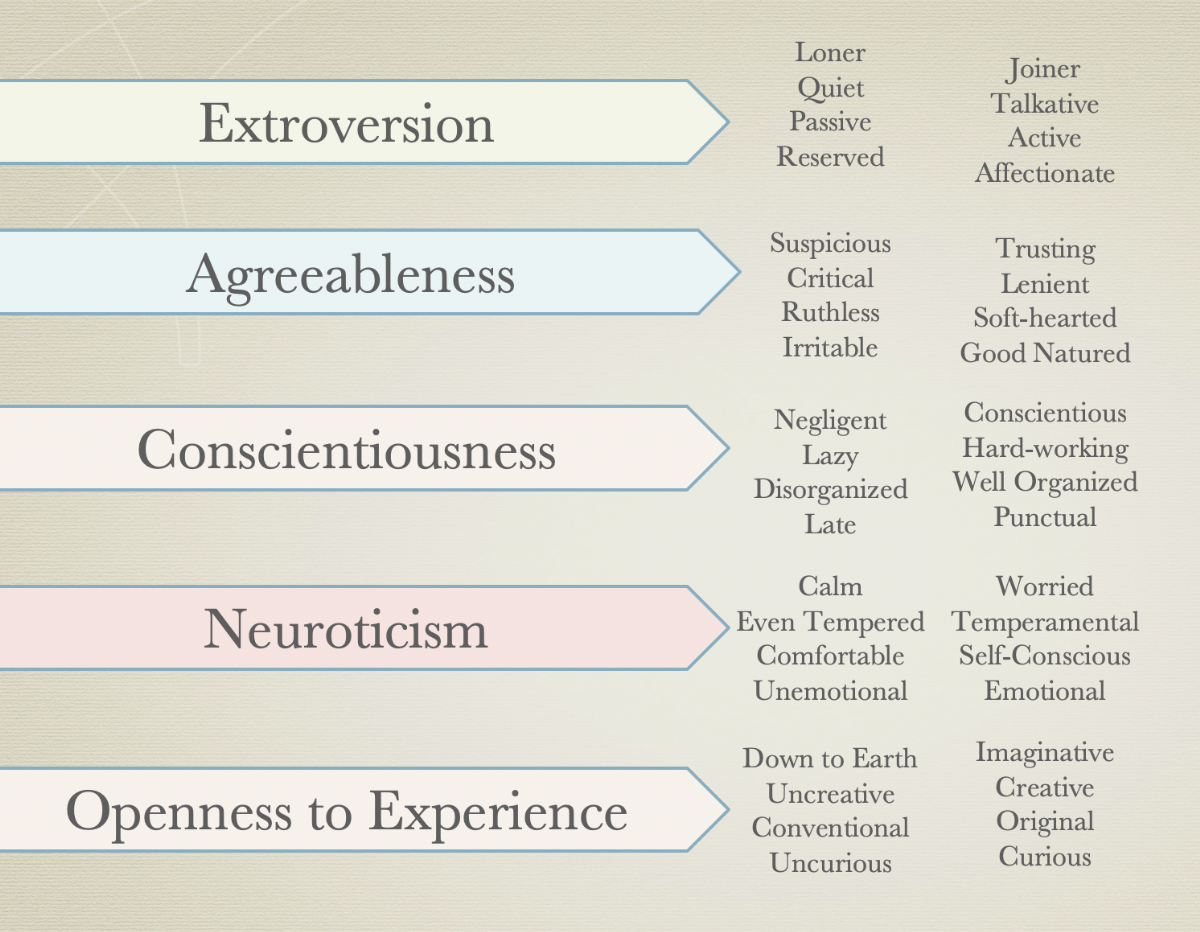
The foundation of the theory came from something called the lexical hypothesis, which proposed that the most important human personality traits eventually become embedded in language itself. In other words, if a personality characteristic matters consistently across cultures and societies, human beings will create words to describe it. Researchers began analyzing thousands of personality-related words and noticed that many clustered together into predictable categories.
Over time, five major personality dimensions consistently emerged across studies:
-
openness,
-
conscientiousness,
-
extraversion,
-
agreeableness,
-
and neuroticism.
These became known collectively as the Big Five personality traits.
Unlike older personality theories, the Big Five does not place people into single categories. Instead, individuals exist somewhere along a continuum within each trait. For example, someone may be highly conscientious but only moderately extraverted, highly agreeable but low in openness, or emotionally stable while still highly sensation-seeking. This dimensional approach reflects the reality that human personality is complicated and layered.
Researchers became especially interested in the Big Five because these traits appeared surprisingly stable across adulthood and were linked to important life outcomes involving:
-
relationships,
-
stress management,
-
career success,
-
health behaviors,
-
coping styles,
-
social interaction,
-
and long-term life satisfaction.
For example, conscientiousness has been strongly associated with healthier behaviors, better organization, improved treatment compliance, and even increased longevity. High neuroticism, on the other hand, is often associated with increased stress sensitivity, emotional reactivity, anxiety, and vulnerability to mood disorders. Extraversion may influence social engagement and emotional expression, while openness has been linked to creativity, curiosity, adaptability, and willingness to embrace new experiences.
In gerontology, the Big Five became particularly useful because personality traits influence how people cope with aging itself. Personality shapes how individuals respond to retirement, caregiving, chronic illness, grief, social change, disability, and uncertainty. An individual high in openness may adapt to aging differently than someone who strongly resists change and unpredictability. A highly conscientious older adult may carefully manage medications and healthcare appointments, while someone lower in conscientiousness may struggle more with organization and routine health management.
At the same time, personality research has increasingly been absorbed, simplified, and sometimes distorted by pop psychology culture.
Social media, self-help industries, dating apps, corporate training programs, and online personality quizzes have turned personality theory into a kind of cultural entertainment. People now casually introduce themselves using personality labels the same way previous generations discussed astrological signs:
“I’m an introvert.”
“He’s such a narcissist.”
“She’s Type A.”
“I have trauma brain.”
“That’s my attachment style.”
Some of this popularization has helped normalize conversations about emotional health and self-awareness. However, much of the nuance of personality science gets lost when complicated human behavior is reduced to catchy labels, memes, or fifteen-question internet quizzes promising to reveal your entire identity before your coffee cools.
One of the biggest problems with pop psychology is overidentification. People sometimes begin treating personality categories as destiny rather than tendencies. Someone who reads they are “introverted” may start avoiding social growth entirely. A person labeled “high neuroticism” may assume emotional instability is unavoidable. Individuals may even begin excusing harmful behaviors by turning personality language into justification:
“That’s just how I am.”
“I’m Type A, so I have to control everything.”
“I’m brutally honest.”
“I have anxiety, so I can’t do that.”
Another major issue is the tendency to pathologize normal human behavior. Social media culture in particular has popularized the habit of casually diagnosing others with personality disorders or mental illness based on limited observation. Terms like narcissist, sociopath, trauma response, ADHD, gaslighting, OCD, and bipolar are now frequently used in everyday conversation without clinical accuracy. Human behavior becomes flattened into labels rather than understood within context.
This is especially important when studying aging because older adults are often unfairly reduced to personality stereotypes. The “grumpy old man,” the “sweet grandmother,” the “stubborn elder,” or the “lonely cat lady” are all examples of how society oversimplifies complex personalities into caricatures. In reality, older adults retain the same psychological complexity they possessed throughout life. Aging may intensify certain traits, but it does not erase individuality.
The strength of the Big Five model is not that it perfectly explains every human being. The strength lies in helping us recognize patterns while still allowing room for complexity, context, growth, culture, and individual experience. Personality research works best when it helps us understand people more deeply, not when it turns human beings into simplified categories for entertainment or judgment.
The Meyers-Briggs Personality Inventory
If you have ever taken a career counseling course, leadership workshop, college orientation class, or workplace training seminar, there is a good chance you have encountered the Myers-Briggs Type Indicator (MBTI).

Few personality inventories have become as culturally popular or commercially successful as the Myers-Briggs system. It has been used by hiring committees, management consultants, military organizations, relationship counselors, educators, corporate retreats, and career development programs. Entire industries have grown around helping people discover whether they are INFJs, ENFPs, INTJs, or one of the other sixteen personality “types.”
The appeal is obvious. People enjoy frameworks that help explain why they think differently, communicate differently, study differently, or react differently to stress and relationships. The Myers-Briggs system gives people a vocabulary for discussing personality and often helps individuals feel seen or understood in ways they may not have previously considered.
The MBTI was developed by Katharine Cook Briggs and her daughter Isabel Briggs Myers during the mid-twentieth century. Their work was heavily inspired by the theories of Swiss psychiatrist Carl Jung, particularly his ideas about psychological preferences and cognitive functioning. Interestingly, neither Briggs nor Myers were formally trained psychologists. They were highly intelligent and deeply interested in personality theory, but their work emerged more from observation, interpretation, and application of Jung’s theories than from rigorous modern psychological research methods.
The inventory attempts to sort individuals into sixteen personality categories based on four dimensions:
-
introversion or extraversion,
-
sensing or intuition,
-
thinking or feeling,
-
and judging or perceiving.
These dimensions combine into personality “types” such as INFP, ESTJ, or ENTP. The system proposes that people develop natural preferences for how they gather information, make decisions, organize their lives, and interact socially.
Unlike many earlier personality theories, the Myers-Briggs inventory became especially popular because it feels personal, accessible, and relatively nonjudgmental. Most people can recognize parts of themselves in the descriptions. An introverted student may suddenly understand why crowded social environments feel exhausting. A highly structured “judging” personality may finally understand why group projects with disorganized classmates feel like psychological warfare disguised as education.
The Myers-Briggs system is also widely used in career counseling because certain personality patterns appear associated with different workplace preferences and strengths. For example, individuals high in intuition and creativity may gravitate toward innovation, design, or counseling professions, while highly structured and detail-oriented personalities may prefer environments emphasizing organization, precision, and predictability.
However, despite its popularity, the MBTI remains one of the most criticized personality assessments in psychology.
One major criticism is that the Myers-Briggs system forces people into rigid categories when human personality actually exists along continuums. For example, most people are not purely introverted or extraverted. Many fall somewhere in the middle depending on context, stress level, environment, health, or life stage. The MBTI tends to create artificial either-or divisions where personality is actually much more fluid and dimensional.
Another major criticism involves reliability and scientific validity. Many people receive different Myers-Briggs results when retaking the test at different times in life. Researchers have also questioned whether the sixteen “types” consistently predict behavior or life outcomes in scientifically reliable ways. Some psychologists classify the MBTI closer to pseudoscience than evidence-based personality assessment because of these limitations.
At the same time, dismissing the Myers-Briggs entirely also misses why it became so culturally influential in the first place.
For many people, the MBTI functions less as a hard scientific instrument and more as a reflective conversation tool. It encourages self-examination, discussion about communication styles, awareness of interpersonal differences, and reflection about strengths, weaknesses, stress responses, and workplace preferences. In educational and counseling settings, that self-reflection can still be useful even if the instrument itself has scientific limitations.
The danger occurs when personality labels become overly deterministic. People sometimes begin treating MBTI categories as fixed identities rather than flexible tendencies. Someone may decide:
“I can’t lead because I’m introverted.”
“I’m bad at relationships because I’m a thinker.”
“I’m disorganized because I’m a perceiver.”
Human beings are far more adaptable than personality labels suggest.
This is especially important across the lifespan because personality expression changes with age, experience, stress exposure, culture, health, relationships, and maturity. A shy twenty-year-old may become an effective teacher by fifty. A rigid perfectionist may soften after caregiving or loss. A highly social person may become more introspective with age. Personality tendencies remain relatively stable, but how we express them continues evolving throughout life.
Ultimately, the Myers-Briggs inventory is probably best understood as a useful but imperfect framework. It can open interesting conversations about personality, coping, relationships, learning styles, and workplace behavior, but it should never be treated as a definitive map of human identity. Human beings are simply too complicated for four letters to fully explain.
Personality in Later Life
Personality does not disappear as we age. If anything, it often becomes more layered, more refined, and in some ways more visible.
The older adult sitting quietly at the family gathering, the retired engineer reorganizing the garage for the third time this month, the grandmother who still collects strangers at the grocery store and leaves knowing their life story, the widower who suddenly takes up painting at seventy-eight, all carry forward personality traits that have been shaped across decades of experiences, relationships, losses, successes, disappointments, and adaptation.
How we react to aging itself is deeply influenced by personality. Some people approach later life with curiosity and flexibility, while others experience change as threatening or destabilizing. Some seek novelty and reinvention; others prioritize routine, familiarity, and predictability. Personality influences how we cope with stress, illness, grief, caregiving, retirement, social change, and uncertainty. Cognitive changes also interact with personality over time. An anxious person may become more worried when memory becomes less reliable. A highly independent individual may struggle intensely with needing assistance. A naturally social person may experience sensory loss or mobility limitations very differently than someone who has always preferred solitude.
One of the most interesting changes associated with aging is not necessarily personality itself, but how selectively people begin using their emotional and cognitive energy. Older adults often become much more intentional about where they invest their time, attention, and relationships. By midlife and beyond, many people begin recognizing that emotional energy is finite. They become less willing to tolerate unnecessary conflict, superficial relationships, exhausting social obligations, or activities that provide little personal meaning.
This shift is strongly connected to a theory developed by psychologist Laura Carstensen called Socioemotional Selectivity Theory. Carstensen proposed that our goals and priorities change depending on how we perceive time.
When people perceive time as expansive and open-ended, as younger adults often do, they are more likely to prioritize exploration, novelty, information gathering, achievement, and future-oriented goals. Younger individuals may invest heavily in education, career building, networking, travel, experimentation, and meeting new people because the future feels broad and still unfolding.
As people age, however, awareness of time often changes. This does not necessarily mean older adults become pessimistic or fearful about mortality. Rather, they become increasingly aware that time is valuable and limited. As a result, emotional priorities frequently shift.
Older adults often begin investing more energy into emotionally meaningful experiences and relationships rather than constantly seeking novelty or expansion. Existing friendships may become more important than collecting new acquaintances. Emotional peace may become more valuable than winning arguments. People may intentionally choose activities that provide comfort, meaning, connection, enjoyment, spirituality, creativity, or emotional satisfaction rather than simply pursuing achievement for achievement’s sake.
This helps explain why many older adults appear less interested in social drama, status competition, or endless busyness. It is not necessarily because they have “given up.” In many cases, they have simply become more selective.
For example, a younger adult might attend every networking event possible because they are focused on opportunity and future growth. An older adult may instead choose dinner with two close friends because the emotional return feels more meaningful than accumulating additional social contacts. A younger person may prioritize gathering information and building experiences. An older person may prioritize depth over expansion.
Carstensen’s work also helps explain why many older adults become more emotionally focused in their relationships. As awareness of time increases, people often become more motivated to resolve conflicts, repair emotional wounds, maintain meaningful family bonds, and focus on emotionally rewarding experiences. In many cases, older adults become remarkably skilled at emotional regulation because they have spent decades learning what truly matters and what simply wastes precious energy.
Of course, these patterns are not universal. Personality still matters enormously. Some individuals remain highly future-oriented, novelty-seeking, and exploratory well into advanced age. Others become increasingly withdrawn, rigid, anxious, or emotionally narrowed. Aging does not magically transform everyone into a wise elder sitting peacefully in a linen outfit dispensing life lessons beside a window plant.
What aging often does provide, however, is perspective.
By later life, many people have survived enough uncertainty, disappointment, reinvention, grief, and unexpected change to recognize that time, attention, relationships, and emotional energy are valuable resources. Personality continues shaping how those resources are used, but aging often sharpens the awareness that not every battle deserves our remaining bandwidth.