7.1 Wealthspan: Why Some Retirements Look Different Than Others
When people think about retirement, they often focus on a single question: How much money will I have?
That is certainly an important question, but gerontologists often approach the issue from a different direction. Rather than focusing only on how much money someone has at retirement, we ask how they arrived there in the first place.
Consider two individuals who reach age sixty-five. Both worked hard. Both raised families. Both paid taxes. Both contributed to their communities. Yet one retires with a pension, a paid-off home, retirement savings, and financial stability. The other relies almost entirely on Social Security and struggles to meet basic expenses.
Why?
The answer is rarely found in a single decision. Instead, financial security in later life is often shaped by opportunities, barriers, advantages, and disadvantages that accumulate over decades.
For this reason, it can be helpful to think about more than lifespan and healthspan. We can also consider what might be called wealthspan: the economic resources, opportunities, and financial security individuals accumulate throughout life and carry with them into later adulthood.
Understanding wealthspan helps explain why retirement experiences vary so dramatically from one person to another.
Factors influencing Wealthspan
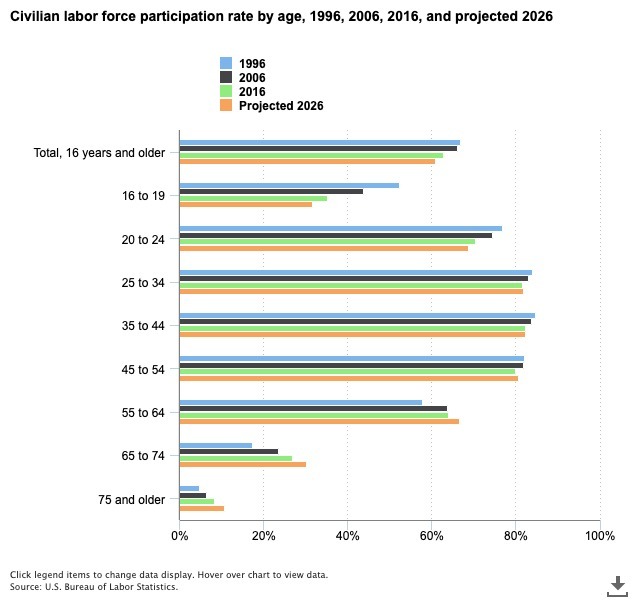
The American workforce is diverse, in terms of ethnicity and gender, and in growing numbers, age. The Bureau of Labor Statistics projects that by 2026, the number of workers over age 65 will have jumped to 30%, compared with 17% in 1996. For workers over age 76, the rate is in 2026 is projected to be 10.8%, compared with 4.7% in 1996.
Cumulative Advantage and Disadvantage
One of the central concepts in social gerontology is cumulative advantage and disadvantage. The idea is relatively simple. Small advantages and disadvantages often build upon themselves over time.
An individual who has access to quality education may obtain a higher-paying job. That job may provide healthcare benefits, retirement plans, paid leave, and opportunities for advancement. Higher earnings may allow that individual to purchase a home, contribute to retirement accounts, and build savings. Over the course of forty years, these advantages can accumulate into substantial financial security.
The opposite pattern can occur as well.
Individuals who experience poverty, discrimination, interrupted employment, disability, caregiving responsibilities, or limited educational opportunities may have fewer opportunities to accumulate wealth. They may spend more years living paycheck to paycheck, have less access to retirement benefits, and face greater financial instability throughout adulthood. Over time, these disadvantages can compound just as advantages do.
As a result, many of the financial differences we observe among older adults are not the result of a single choice or event. They are often the outcome of decades of accumulated opportunities and constraints.
This perspective is important because it challenges a common assumption that retirement outcomes are determined solely by individual effort. Hard work certainly matters, but social and economic circumstances matter as well. Individuals do not all begin adulthood from the same starting point, nor do they encounter the same opportunities along the way.
A Changing Workforce
The relationship between work and retirement has changed significantly over the last several decades.
For much of the twentieth century, retirement was viewed as a relatively predictable event. Individuals worked until approximately age sixty-five, collected Social Security and pension benefits, and exited the workforce permanently.
Today's reality looks quite different.
The Bureau of Labor Statistics projects continued growth in workforce participation among older adults. Increasing numbers of individuals remain employed well beyond traditional retirement age, including growing numbers of workers over age sixty-five and even over age seventy-five.
Several factors contribute to this trend.
People are living longer than previous generations and, in many cases, remaining healthier for longer periods of time. Some individuals continue working because they enjoy their careers and find meaning in their professional roles. Others continue working because they need additional income or healthcare benefits. The decline of traditional pensions, rising housing costs, longer life expectancies, and uncertainty about retirement savings have all contributed to delayed retirement for many Americans.
Retirement, once viewed as a single event, is increasingly becoming a process.
Some individuals gradually reduce their work hours. Others transition into part-time employment, consulting, volunteer work, or entirely new careers. Still others move in and out of retirement as financial needs, family responsibilities, and personal interests evolve.
Age Discrimination in the Workforce
If society increasingly encourages people to remain in the workforce longer, an important question emerges.
Are employers willing to keep them there?
Age discrimination remains one of the most significant barriers facing older workers.
In 1967, Congress passed the Age Discrimination in Employment Act (ADEA), making it illegal to discriminate against employees and applicants age forty and older on the basis of age. The law was intended to protect workers from unfair treatment in hiring, promotion, compensation, and termination decisions.
Despite these protections, age discrimination continues to be a concern.
Research consistently suggests that many older workers encounter barriers when seeking employment, changing careers, or remaining in the workforce. While employers rarely state openly that age is a factor, discrimination can occur in more subtle ways. Job advertisements may emphasize finding a "digital native." Recruiting efforts may focus exclusively on college campuses. Hiring algorithms may filter applicants based on years of experience. These practices may appear neutral on the surface while disproportionately excluding older workers.
This creates an interesting contradiction.
At the same time that policymakers encourage individuals to work longer, many workers report encountering obstacles once they reach middle age or older adulthood. Some find themselves passed over for promotions. Others experience layoffs during organizational restructuring. Still others discover that finding a new job becomes significantly more difficult after age fifty.
The irony is that many of the qualities employers claim to value are often associated with experienced workers. Reliability, institutional knowledge, professionalism, problem-solving ability, and strong work habits are assets that frequently increase with age rather than diminish.
The stereotypes persist nonetheless. Older workers are sometimes portrayed as resistant to change, technologically challenged, less productive, or less adaptable than younger employees. Research generally provides little support for these assumptions. In reality, job performance is influenced far more by individual differences than by age alone.
As you move through your own career, it is worth remembering that age discrimination is not simply an issue affecting older adults today. It is a workforce issue that may eventually affect many of us.
Age Discrimination in the Workforce
We can't have a conversation about work and aging without addressing one of the major barriers to staying in the workforce. Age discrimination. In 1967, legislation was passed to protect applicants and employees 40 years of age or older from discrimination on the basis of age in hiring, promotion, discharge, compensation, or terms, conditions or privileges of employment. The " Age Discrimination in Employment Act of 1967 changed the laws, but 50 years after its passage, age discrimination happens. ProPublica, an Urban Studies institute estimates that more than half of older workers are pushed out longtime jobs before the would choose to retire. (Wilkie, 2019)
The Act, designed to protect older workers was weakened by a 2009 Supreme Court ruling that imposed a higher burden of proof on the worker who alleges discrimination. (Farrell, 2017) The burden of proof is much higher for age discrimination than that of race, religion or gender. An AARP survey done in 2007 reported that a majority of workers over age 45 have seen or experienced work place discrimination.(Terrell, 2017) According to testimony from attorneys at AARP, employers who would never overtly reject applicants on age have found ways to subtly discriminate in the hiring process:
- Specifying "digital native" as a requirement in a job posting.
- Limiting recruiting for new jobs to college campuses
- Requiring a college e-mail to apply for job openings
- Using algorithms to filter out resumes by "years of experience"
As a college student, you may be throwing your hands up and doing a happy dance right now, but the fact is that this behavior is illegal, unfair and limits the range of experience and institutional memory for organizations. Remember the Modernization Theory? Not all new knowledge is better than old knowledge.
So, what about those workers who have contributed for 20 or 30 years, and helped to grow the organization. We know that older workers can produce as much as younger workers Yet, the myths persist that older workers lack strength, stamina and speed. Especially in tech firms, it is not uncommon to hear about the older worker being difficult to train, or lacking drive or imagination. With only minor adjustments in attitude, those who are managing older workers might find that they are an excellent source of institutional knowledge, and are eager to develop new skill sets. Businesses need employees who are honest, dependable, have good work ethic and bring maturity to the workforce. (Bastien, 2006)
If you are up to the viewing of a 'rom-com,' take two hours and watch "The Intern" starring Anne Hathaway and Robert DeNiro. It is a great example (albeit it a bit fluffy) of how valuable the experience and wisdom of older workers can be to the workforce.
Yet, we see age discrimination in cases of the long-employed worker over age 40 in age discrimination complaints across the country. Typical causes include:
Position Terminated - Older workers are told that their position is being eliminated; but when they leave, a younger person is hired and often paid less.
Career Caps - Older workers may find that they reach the maximum retirement contribution, or reach the top scale salary with no room for advancement.
Downsizing - If during any downsizing it is predominantly the older workers who are laid off, it is probably a discrimination act.
Who Is Most Financially Secure?
When researchers examine financial well-being in later life, they find that retirement security is strongly associated with several factors.
Individuals with higher levels of education tend to have greater lifetime earnings and more access to employer-sponsored retirement plans. Stable employment histories often result in higher Social Security benefits, larger retirement accounts, and increased opportunities for wealth accumulation. Home ownership allows families to build equity over time, while access to healthcare can reduce the financial burden associated with chronic illness and disability.
Marriage and long-term economic partnerships have also historically provided financial advantages by allowing households to combine resources, share expenses, and build wealth together.
These factors do not guarantee financial security, but they are strongly associated with it.
What is important to recognize is that access to these opportunities has not always been distributed equally.
Throughout much of American history, women, racial and ethnic minorities, individuals with disabilities, and those living in rural communities faced significant barriers to education, employment, home ownership, and wealth-building opportunities. The effects of these barriers often become visible in later life.
This is one reason why gerontologists pay close attention to issues of inequality. The social and economic conditions people experience throughout life frequently shape the resources available to them in retirement.
Who Is Most Financially Vulnerable?
Just as certain factors are associated with financial security, others are associated with increased risk of poverty in later life.
Individuals with limited education, low lifetime earnings, interrupted employment histories, chronic health conditions, or limited access to retirement benefits are generally at greater risk of economic insecurity as they age.
Historically, older women have been particularly vulnerable to poverty. Many spent years providing unpaid caregiving and household labor during periods when workforce participation among women was significantly lower than it is today. Others experienced wage disparities, interrupted careers, or dependence on a spouse's income and retirement benefits.
Widowhood can create additional challenges. The death of a spouse often results in the loss of income while many household expenses remain unchanged. Housing, utilities, transportation, and healthcare costs continue regardless of whether one person or two people live in the household.
For these reasons, poverty in later life is often discussed as a women's issue, particularly among older women living alone.
The broader lesson, however, is not about any single demographic group. It is about understanding how advantages and disadvantages accumulate across the lifespan and influence financial security decades later.
(Source: Corinne Baumbarten)
Wealthspan and Retirement Readiness
By the time individuals reach retirement age, their financial situation reflects far more than the balance of a retirement account.
It reflects educational opportunities, employment experiences, family responsibilities, health status, access to benefits, housing decisions, economic conditions, and public policies encountered throughout life.
This is why retirement planning cannot be understood solely as a matter of personal finance.
Retirement is also a social issue.
The opportunities available to people throughout their lives influence the resources available to them in later life. Understanding these patterns helps explain why some older adults enter retirement with significant financial security while others rely heavily on Social Security and public assistance programs.
As we begin examining retirement systems such as Social Security, pensions, and retirement savings plans, it is important to remember that these programs do not operate in isolation. They exist within a broader social and economic landscape that shapes how individuals experience aging.
Understanding wealthspan helps us understand that retirement outcomes are not simply the result of what happens at age sixty-five.
They are the result of everything that came before.