2.3 How We Become Ourselves: Developmental Perspectives on Aging

(Source: Image courtesy of Gerd Altmann under Pixabay License)
One of the most important ideas in gerontology is that old age does not begin at age 65.
In fact, many gerontologists would argue that aging begins at birth.
The person you become in later life is not created suddenly when you retire, become a grandparent, receive a medical diagnosis, or celebrate a milestone birthday. Rather, the older adult you eventually become is shaped by decades of experiences, opportunities, relationships, challenges, decisions, and transitions that accumulate across the lifespan.
This way of thinking is known as the Life Course Perspective. Rather than viewing childhood, adulthood, and old age as separate stages, the Life Course Perspective sees development as a continuous process that unfolds over time. Each stage of life builds upon those that came before it.
Think about the life you are living right now. The educational choices you make, the relationships you build, the habits you develop, the career opportunities you pursue, and even the challenges you overcome will all influence the person you become decades from now. Likewise, the older adults in your life did not arrive at old age by accident. They are the product of a lifetime of experiences that shaped their identities, beliefs, health, relationships, and expectations.
The Life Course Perspective also reminds us that individuals do not age in isolation. We grow older within families, communities, cultures, and historical periods. Someone who came of age during the Great Depression experienced a very different world than someone who grew up during the Civil Rights Movement, the Vietnam War, the rise of the Internet, or the COVID-19 pandemic. Historical events leave lasting impressions on individuals and entire generations.
Because of this, two people who are the same age may experience aging very differently. Their opportunities, resources, education, family structures, cultural values, and life experiences may have followed entirely different paths.
The Life Course Perspective encourages us to look beyond a person's current age and ask a deeper question:
How did this person become who they are today?
This perspective is especially valuable in gerontology because it helps explain why there is no single way to grow old. Some individuals arrive at later life with strong social networks, financial stability, and a clear sense of purpose. Others face significant challenges. The difference is often found not in a single moment, but in the accumulation of experiences across an entire lifetime.
As we explore the developmental theories that follow, keep this perspective in mind. Each theorist attempted to explain how people grow, change, adapt, and find meaning throughout life. While they may disagree about the details, they all share one important assumption: human development is a lifelong process.
The Early Architects of Human Development
Today, it seems obvious that people grow and change throughout life. We expect children, adolescents, and adults to think differently and behave differently as they mature. Yet the idea that personality develops over time was once revolutionary.
Some of the earliest attempts to explain human development came from psychologists Sigmund Freud and Carl Jung. Although many of their specific ideas have been challenged, revised, or abandoned over time, both helped establish a foundation for understanding development as a lifelong process.
Sigmund Freud: The Importance of Early Experience
Sigmund Freud believed that much of human behavior is influenced by unconscious thoughts, motivations, and conflicts. He argued that early childhood experiences play a powerful role in shaping personality and behavior later in life.
Freud is best known for his theory of psychosexual development, which proposed that children move through a series of developmental stages during which different psychological challenges must be resolved. While modern psychologists generally do not accept many of Freud's specific conclusions, his broader contribution remains important. Freud was among the first theorists to suggest that who we become as adults is influenced by experiences that occur much earlier in life.
For gerontologists, Freud's lasting contribution is the recognition that later life cannot be fully understood without considering the experiences that came before it. The older adult sitting before us carries a lifetime of memories, relationships, successes, disappointments, and unresolved challenges that continue to influence behavior and wellbeing.
Carl Jung: The Search for Meaning
Carl Jung began his career as a student and colleague of Freud, but eventually developed his own view of human development. Unlike Freud, who focused heavily on childhood, Jung believed that development continues throughout adulthood and that later life presents unique opportunities for growth.
Jung suggested that as people age, they often become more inwardly focused. Rather than concentrating primarily on achievement, status, or external success, many individuals begin reflecting on questions of meaning, identity, purpose, and legacy. He believed that healthy development involves integrating the many different parts of ourselves into a more complete and authentic whole, a process he called individuation.
Jung also introduced concepts that remain influential today, including introversion, extraversion, archetypes, and the collective unconscious. While some of these ideas remain controversial, Jung's emphasis on self-reflection, personal growth, and meaning-making has had a lasting influence on the study of aging.
Many older adults describe a shift in priorities as they move through later life. Relationships may become more important than achievements. Experiences may become more important than possessions. Reflection may become more important than ambition. Jung viewed these changes not as signs of decline, but as part of a natural developmental process.
Together, Freud and Jung helped establish an important idea that still influences gerontology today: the person we become in later life is shaped by a lifetime of psychological development. To understand aging, we must understand not only what is happening now, but also the journey that brought a person to this moment.
Erik Erikson: Development Across the Lifespan
While Freud focused primarily on childhood and Jung expanded the discussion into adulthood, Erik Erikson took an even broader view. He proposed that development continues throughout the entire lifespan and that every stage of life presents its own challenges and opportunities for growth.
Erikson believed that individuals move through a series of developmental stages, each characterized by a central conflict or task. These conflicts are not necessarily crises in the traditional sense. Rather, they represent questions that must be answered as we move through life.
Can I trust other people?
Who am I?
Can I form meaningful relationships?
Can I contribute to something larger than myself?
Can I find meaning in the life I have lived?
According to Erikson, how we respond to these questions influences our identity, relationships, and sense of wellbeing.

(Source: Verywellmind.com)
While all eight stages contribute to development, two are particularly important for understanding adulthood and aging.
Generativity vs. Stagnation
During middle adulthood, people often begin asking a new question:
What will I leave behind?
Erikson called this stage Generativity versus Stagnation.
Generativity involves contributing to future generations and investing in something that will outlast ourselves. Raising children is one example, but generativity extends far beyond parenthood. Teaching, mentoring, volunteering, creating, building, leading, and serving others can all be expressions of generativity.
Many people reach a point where they become less focused on what they can gain and more focused on what they can give. They may invest time in family, community organizations, professional mentoring, creative work, or causes they believe in.
Stagnation occurs when individuals become disconnected from these opportunities for contribution and growth. Rather than feeling engaged with the future, they may experience a sense of isolation, self-absorption, or lack of purpose.
For many older adults, generativity continues long after retirement. Grandparents care for grandchildren. Retired professionals mentor younger colleagues. Volunteers support their communities. Older adults contribute knowledge, experience, and perspective that younger generations have not yet had the opportunity to develop.
Integrity vs. Despair
In later life, Erikson believed that individuals face one final developmental task.
Rather than looking toward the future, they begin looking back.
The question becomes:
Was it okay to have been me?
Erikson called this stage Integrity versus Despair.
Integrity develops when individuals are able to review their lives and find meaning, acceptance, and coherence in the experiences they have lived. Integrity does not require a perfect life. It involves recognizing both successes and disappointments while accepting one's life as a unique and worthwhile journey.
Individuals who achieve integrity often describe feelings of gratitude, acceptance, wisdom, and peace. They are able to acknowledge mistakes without becoming consumed by regret.
Despair occurs when individuals become overwhelmed by feelings that life was wasted, opportunities were missed, or it is too late to make peace with the past. This can result in bitterness, hopelessness, or fear of death.
Erikson believed that one of the most important tasks of later life is making sense of our experiences. Through reminiscence, storytelling, reflection, and life review, many older adults work to integrate the events of their lives into a meaningful whole.
Why Erikson Matters to Gerontology
Erikson's theory remains influential because it reminds us that development does not stop when adulthood begins. Older adults continue to grow, adapt, contribute, and search for meaning throughout life.
His work also challenged the notion that aging is merely a process of decline. Instead, Erikson viewed later life as a unique developmental stage with its own opportunities for growth, wisdom, contribution, and self-understanding.
Perhaps most importantly, Erikson reminds us that aging is not simply about adding years to life. It is also about making sense of the years we have already lived.
The "Other" Erikson: Joan Erikson's Ninth Stage
Most discussions of psychosocial development stop with Erik Erikson's eighth stage, Integrity versus Despair. Yet the story does not quite end there.
Throughout much of his career, Erik Erikson collaborated closely with his wife, Joan Erikson, who contributed significantly to the development and refinement of psychosocial theory. As the Eriksons entered their eighties and nineties, they began to reconsider what development looks like in very late life.
After Erik's death in 1994, Joan published additional work based on their discussions, observations, and Erik's notes. In this work, she proposed a ninth stage of development that specifically addressed the challenges of advanced old age.
Joan observed that many of the achievements described in the earlier stages become more difficult to maintain as people experience the realities of very old age. Physical decline, sensory changes, increasing dependence on others, loss of loved ones, and shrinking social networks can challenge even the most resilient individuals.
In Erikson's original model, each stage is presented as a conflict between a positive outcome and a less desirable one. Trust is preferred to mistrust. Identity is preferred to role confusion. Integrity is preferred to despair.
Joan Erikson suggested that in advanced old age these earlier conflicts often re-emerge, but in reverse.
An older adult may find it harder to trust as vulnerability increases. A formerly independent person may struggle with feelings of inferiority when physical abilities decline. Someone who spent a lifetime caring for others may find it difficult to accept being cared for. Social losses may increase feelings of isolation, while retirement or disability may challenge a person's sense of purpose and contribution.
In other words, the developmental work of old age is not finished simply because earlier stages were successfully resolved. The challenges of advanced age may require individuals to revisit many of life's earlier conflicts and find new ways of adapting to them.
Yet Joan Erikson's perspective is not pessimistic. Rather, it recognizes the courage required to continue growing in the face of increasing vulnerability. She argued that individuals who successfully navigate these later-life challenges often develop a deeper acceptance of themselves, their lives, and their place within the larger human story.
This idea would later resonate with other gerontologists who explored concepts such as wisdom, transcendence, life review, and meaning-making in advanced old age. We will revisit some of these ideas later in the course when we examine theories of successful aging and the search for meaning in later life.
Jane Loevinger: Growing in Complexity
Many developmental theories focus on specific stages of life and the challenges associated with each stage. Jane Loevinger approached development from a different perspective. Rather than asking what task comes next, she was interested in how people make sense of themselves and the world around them.
Loevinger proposed that personality and identity continue to develop throughout adulthood through a process she called ego development. In this context, the ego is not about selfishness or arrogance. Rather, it refers to the way we understand ourselves, interpret our experiences, and navigate relationships with others.
According to Loevinger, people move through increasingly complex ways of thinking about themselves and the world. As individuals mature, they often become more capable of recognizing multiple perspectives, tolerating ambiguity, and understanding the complexities of human behavior. Growth is not simply a matter of accumulating knowledge. It is also a matter of developing greater self-awareness and emotional maturity.
This perspective is particularly relevant to the study of aging because it challenges the notion that development stops in adulthood. Loevinger believed that people continue to grow psychologically throughout life, even in later adulthood. Experiences such as retirement, caregiving, illness, loss, and major life transitions can prompt individuals to reexamine their beliefs, values, and sense of identity.
Loevinger also recognized that development is not always easy. Many societies provide clear expectations and rituals for childhood, adolescence, and early adulthood. We know when children begin school, when teenagers learn to drive, and when young adults are expected to enter the workforce. Later life, however, often lacks these widely recognized roadmaps. As a result, older adults may find themselves navigating major transitions without clear social guidance or cultural expectations.
This observation remains surprisingly relevant today. As people live longer and healthier lives, traditional pathways into retirement and old age have become less predictable. Individuals may find themselves asking new questions: What am I supposed to do now? What role should I play? What gives my life meaning?
Loevinger's work reminds us that development does not stop when we reach adulthood. Human beings continue to adapt, learn, reflect, and grow throughout the entire life course.
Abraham Maslow: What Do People Need to Thrive?
By now, we've explored several theories that explain how people develop across the lifespan. We have discussed identity, relationships, social roles, meaning-making, and adaptation. Together, these theories remind us that people do not arrive at old age as blank slates. They bring with them a lifetime of experiences, successes, disappointments, relationships, and coping strategies.
But what happens when those needs are threatened?
Imagine an older adult who has recently moved into an assisted living facility after the death of a spouse. They have lost familiar surroundings, daily routines, independence, and perhaps some of the social connections that gave their life meaning. They may be frightened, grieving, confused, angry, lonely, or withdrawn.
How do we make sense of those reactions?
One useful framework comes from psychologist Abraham Maslow, who proposed that human beings are motivated by a hierarchy of needs. According to Maslow, people are more likely to thrive when their basic needs are met and more likely to struggle when those needs are threatened.
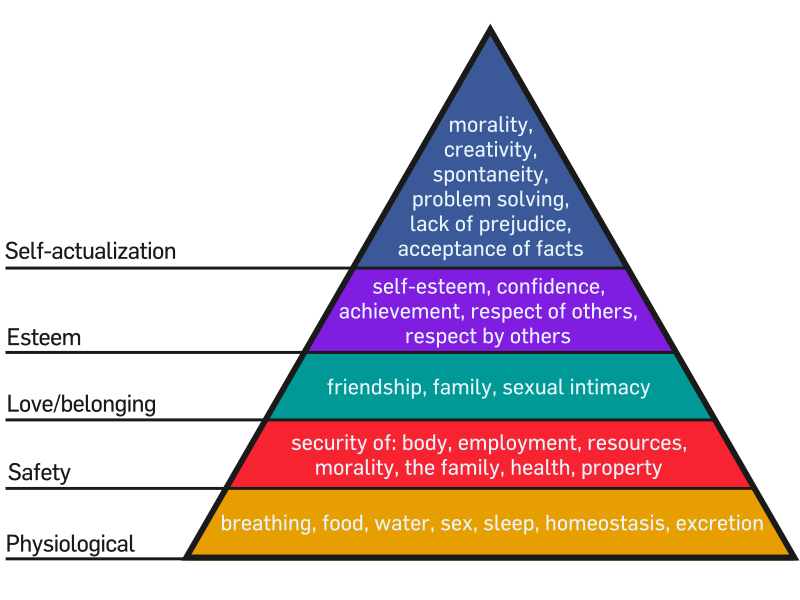 Physiological Needs
At the foundation of Maslow's hierarchy are our most basic physical needs: food, water, sleep, comfort, and freedom from pain.
This may seem obvious, but anyone who has been exhausted, hungry, sick, or in pain knows how difficult it is to focus on anything else. An older adult who is uncomfortable, frightened, exhausted, or experiencing unmanaged pain may appear irritable, withdrawn, anxious, or confused. Before addressing emotional needs, we often need to address physical ones.
Safety Needs
Once basic physical needs are met, people seek safety and security.
For older adults, safety may involve much more than physical protection. It can include knowing where they are, understanding what is happening, trusting caregivers, maintaining routines, and feeling confident that help will be available when needed.
Something as simple as clear signage, familiar possessions, predictable schedules, or a caregiver who takes the time to explain what is happening can significantly increase a person's sense of security.
Love and Belonging
Human beings need connection.
We want to feel loved, valued, accepted, and connected to others. Family relationships, friendships, community involvement, and meaningful social interactions all contribute to this sense of belonging.
One of the greatest risks associated with aging is social isolation. The loss of a spouse, retirement, mobility limitations, or health problems can reduce opportunities for connection. As a result, loneliness has become one of the most significant public health concerns affecting older adults today.
Sometimes a conversation, a shared meal, a familiar voice, or a few moments of genuine attention can be just as important as any medical intervention.
Esteem Needs
Most people want to feel respected, capable, and valued.
Esteem comes partly from how we see ourselves and partly from how others treat us. Throughout life, people develop identities based on their accomplishments, roles, relationships, and contributions. Retirement, disability, illness, or dependence on others can sometimes challenge these sources of self-worth.
A person who spent decades managing a business, raising a family, teaching students, or serving their community does not stop needing respect simply because they require assistance.
One of the most important things caregivers can provide is not just care, but dignity.
Self-Actualization
At the highest level of Maslow's hierarchy is self-actualization, which refers to the desire to live a meaningful and fulfilling life.
For some people, self-actualization may involve creative expression. For others, it may involve spiritual growth, service to others, lifelong learning, family relationships, or personal reflection. There is no single path.
Importantly, Maslow believed that growth continues throughout life. The desire for purpose, meaning, creativity, and contribution does not disappear simply because a person grows older.
Why Maslow Matters to Gerontology
Maslow's hierarchy reminds us that behavior rarely occurs in isolation. When older adults appear angry, withdrawn, fearful, resistant, or depressed, it is often helpful to ask a simple question:
Which needs are not being met?
Rather than viewing behavior as a problem to be managed, Maslow encourages us to view behavior as information. Human beings of all ages respond to unmet needs. Older adults are no different.
As we continue through this course, we will repeatedly return to this idea. Whether we are discussing caregiving, retirement, healthcare, dementia, housing, or end-of-life issues, one of the most important questions we can ask is not simply, "What is wrong?" but rather, "What does this person need?"
Daniel Levinson: The Seasons of Adult Life
Many developmental theories describe life as a series of stages. Daniel Levinson approached development somewhat differently. Rather than focusing on age-based stages, he was interested in the transitions that occur as people move through adulthood.
Based on extensive interviews with adults, Levinson proposed that life unfolds through a series of relatively stable periods that are interrupted by times of transition and reevaluation. During these transitional periods, individuals often examine the structure of their lives and ask important questions about identity, purpose, relationships, work, and future goals.
Levinson referred to this pattern as the "Seasons of Life." Just as the seasons of the year bring periods of growth, change, harvest, and renewal, adulthood is characterized by recurring cycles of stability and transition.
One of Levinson's most influential observations was that major life transitions do not occur only during adolescence or early adulthood. People continue to reassess their priorities, relationships, and goals throughout the lifespan.
A person in midlife may begin questioning career choices that once seemed certain. A recent retiree may struggle to redefine their identity after decades in the workforce. An older adult who loses a spouse may need to reconstruct daily routines and imagine a future that looks very different from the one they expected.
These transitions can be uncomfortable because they often involve uncertainty and loss. Yet Levinson argued that they also create opportunities for growth. Periods of instability frequently force individuals to reconsider old assumptions and develop new ways of understanding themselves and the world around them.
For gerontologists, Levinson's work offers an important reminder: development does not stop once adulthood is achieved. The challenges of later life often require people to build entirely new life structures, adapt to changing circumstances, and discover new sources of purpose and meaning.
This perspective is especially relevant today. Earlier generations often followed a relatively predictable sequence of education, work, retirement, and old age. Modern adults are increasingly likely to experience multiple careers, return to school later in life, delay retirement, remarry, relocate, or reinvent themselves several times throughout adulthood.
Levinson's work suggests that these transitions are not signs that something has gone wrong. Rather, they may be a normal part of human development. Growth often occurs not when life proceeds exactly as planned, but when individuals learn to adapt after the plan changes.
Ken Dychtwald: When the Old Roadmap No Longer Fits
As we have seen, developmental theorists have spent decades trying to explain how people grow, adapt, and find meaning throughout life. Most of these theories share a common assumption: that life follows a relatively predictable path.
We are educated when we are young.
We establish careers in adulthood.
We retire in later life.
Then we gradually withdraw from our primary roles as we enter old age.
For much of human history, this was a reasonable assumption.
The problem, according to gerontologist Ken Dychtwald, is that we are now living in a world that no longer follows that script.
For the first time in history, large numbers of people can expect to live decades beyond traditional retirement age. Improvements in medicine, public health, nutrition, education, and technology have dramatically increased life expectancy. As a result, many individuals find themselves facing a life stage that previous generations never experienced.
What exactly are we supposed to do with an additional twenty, thirty, or even forty years?
Dychtwald argues that society has not yet developed a clear roadmap for this new reality. Traditional expectations about education, work, retirement, relationships, and aging are being challenged by increased longevity. Individuals may pursue multiple careers, return to school later in life, start businesses after retirement, become caregivers for aging parents while helping adult children, or develop entirely new identities in later adulthood.
This means that aging is becoming less linear than it was for previous generations. Rather than moving neatly through a series of predictable stages, many people find themselves revisiting earlier developmental tasks and reinventing themselves multiple times throughout life.
Questions that were once associated with young adulthood often reappear decades later:
Who am I now?
What do I want to do next?
What gives my life meaning?
How do I want to spend the years ahead?
From Dychtwald's perspective, longevity is not simply a medical achievement. It is one of the most significant social and psychological challenges of modern life. We have successfully added years to life, but we are still learning how to add purpose, structure, and meaning to those years.
In many ways, this challenge brings us back to the Life Course Perspective that opened this chapter. Aging is not a destination that begins at age sixty-five. It is an ongoing process of adaptation, growth, and change that continues throughout the lifespan.
The difference today is that the journey is longer, more complex, and less predictable than ever before.